

ꟷ The ultimate reach of visual semiotics of fashion ꟷ
1.
Visual semiotics of fashion redefines contemporary clothing as a performative-conceptual turn centered on the “body iconogram,” rather than a mere system of social representation. In my theoretical views, I tried to bridge aesthetics, media philosophy, and fashion theory to explain how the human body is actively constructed in today’s techno-culture.
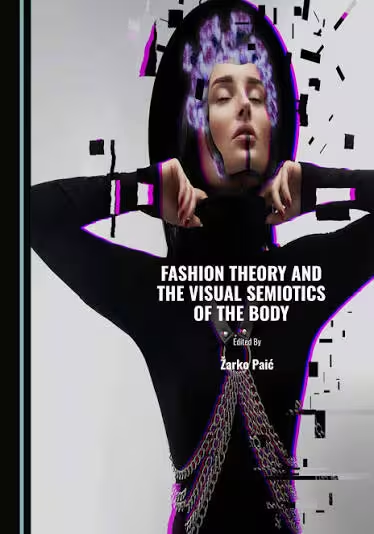
The arguments are heavily detailed in publications such as Fashion Vertigo: Towards Visual Semiotics of the Body (2007) and the edited volume Fashion Theory and the Visual Semiotics of the Body (2022). I reject the traditional sociological view that fashion displays social status or class. Instead, he asserts that fashion is an autonomous visual code that constructs meaning directly on the surface of the body. The body is treated as a living image, or an “iconogram,” shaped by trends, digital media, and cultural preferences.
- The Technosphere and Cybernetics: Contemporary fashion is deeply embedded in electronic networks, where the boundaries between physical reality, hyperreality, and digital simulation are completely blurred.
- Body-Design over Applied Art: Fashion has evolved from an applied art form (creating functional clothes) into an algorithmic tool for “body-design” and creative identity construction.
- Democratization of Luxury: Drawing heavily on thinkers like Gilles Lipovetsky, I claim that rigid economic barriers no longer define luxury in fashion. It serves as a symbolic necessity for manifesting individual aesthetic differences.
The Three Fashion Paradigms
- The Modern Paradigm (1800s–1960s): Fashion anchored firmly in class distinction, high-culture elite rules, and physical craftsmanship.
- The Postmodern Paradigm: A chaotic mix of styles, subcultures, and historical borrowing where irony and eclecticism dominate.
- The Contemporary Paradigm: A highly networked matrix driven by consumer desires, cybernetics, fetishism, and technological transgression.
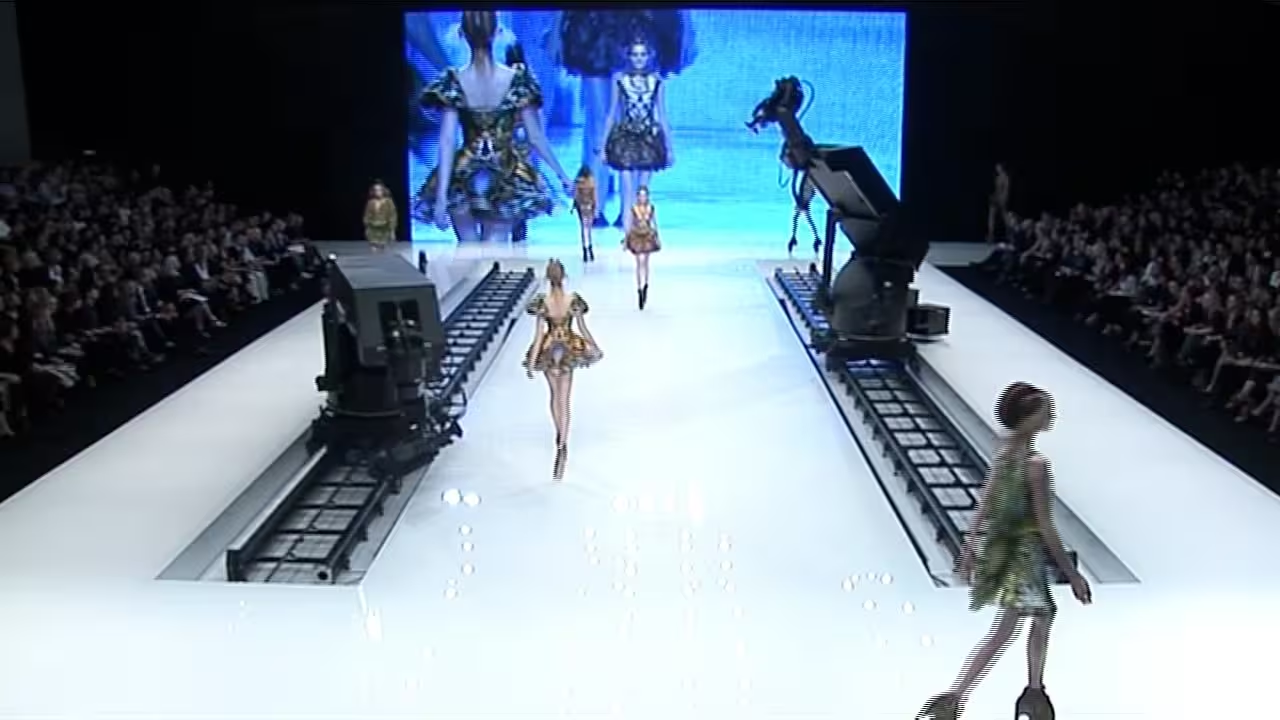
Alexander McQueen’s final runway show, Plato’s Atlantis (Spring/Summer 2010), demonstrates a theory of “body iconograms”: I argue that this show represents a definitive example of contemporary fashion’s performative-conceptual turn, where garments cease to serve as tools for beautifying everyday reality and instead engineer a radical, posthuman transformation. [
McQueen’s apocalyptic vision of global warming—where melting ice caps force humanity to reverse-evolve back into the sea—serves as the ultimate real-world manifestation of visual semiotics.
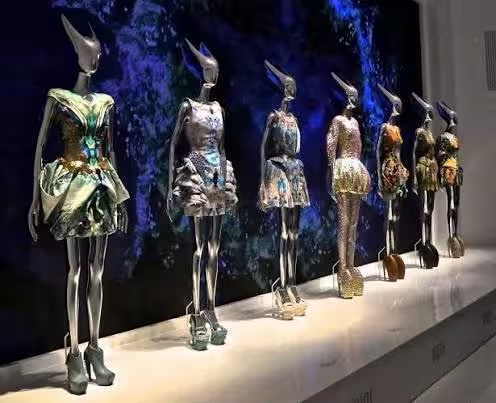
The Body as a “Third Skin”: I highlight that the digitally printed reptile, moth, and jellyfish patterns in Plato’s Atlantis are not decorative surface additions. They act as an engineered “third skin” that merges the human body with animalistic and digital matter, stripping away traditional social identity.
- Transgression of Human Boundaries: A body iconogram represents the end of the symbolic construction of fashion. McQueen achieves this by morphing his models into human-animal-alien hybrids using puffed prosthetic hips, rigid, armor-like structures, and gill-like pleats.
- The “Armadillo” Shoe as a Posthuman Object: So, I explicitly point out McQueen’s iconic 12-inch Armadillo heels as aesthetic objects entirely divorced from utility. By drastically warping the model’s posture and gait, the shoe functions as a cybernetic device that redesigns the body’s biology.
- The Cybernetic Matrix and Livestreaming: Plato’s Atlantis was famously the first major fashion show to be livestreamed globally over the internet. I tie this to the “technosphere,” where giant, bionic robotic cameras on the runway tracked models like prey, projecting the live image onto giant screens. The physical model, the technological apparatus, and the digital avatar fused into a single interactive loop.
- The Eroticism of Death and Trauma: Contemporary iconograms often trade historical luxury for shock, trauma, and “the eroticism of death”. McQueen’s presentation acts as a beautiful yet terrifying eschatological ritual, demonstrating how fashion uses technological transgression to sacrifice the traditional human form in favor of something new.
Visual semiotics bridges Alexander McQueen’s Plato’s Atlantis with Gilles Deleuze’s film philosophy, specifically the concept of the time-image (image-temps) and the body without organs.
In Deleuze’s books on cinema, the transition from the movement-image to the time-image marks a shift in which the body is no longer a tool for action but a site of pure, passive mutation and temporal crystallization. In Plato’s Atlantis, McQueen stops treating the runway as a space for moving garments (movement-image) and turns it into a Deleuzian landscape of pure time and posthuman becoming.
The Runway as Deleuze’s Time-Image
- The Evolution of Eons: For Deleuze, the time-image forces the viewer to confront time in its pure, non-linear state. Plato’s Atlantis achieves this by collapsing the past (pre-human marine biology), the present (ecological crisis), and the future (post-apocalyptic cybernetic mutation). The models do not represent a “season”; they represent an evolutionary epoch compressed into a single visual instance.
- The Body in Crisis: Deleuze notes that the time-image emerges when traditional motor-sensory schemas break down—characters can no longer react to their chaotic environments, so they observe or endure. McQueen’s models, altered by biomechanical prosthetics and towering Armadillo shoes, cannot walk normally. Their restricted, animalistic gaits represent a body experiencing an existential crisis, adapting to a world it no longer controls.
- Crystalline Images: Deleuze describes the time-image as a crystal where the actual and the virtual mirror each other until they become indistinguishable. The giant robotic cameras tracking the models, paired with Nick Knight’s digital live stream, created a literal Deleuzian crystal. The physical model (actual) and her live, morphing digital projection (virtual) fused in real-time.
The Posthuman Body as a Site of Time
- The Body Without Organs (BwO): My notion of the “body iconogram” deeply mirrors Deleuze and Guattari’s concept of the Body without Organs. In Plato’s Atlantis, McQueen strips the human body of its organic, anthropocentric organization. By adding gills, scales, and exoskeleton prosthetics, the body becomes an open plateau of intensities, liberated from traditional human form and gendered social roles.
- Becoming-Animal / Becoming-Intense: Deleuze’s concept of “becoming” (devenir) becomes a molecular mutation rather than a literal transformation. McQueen’s digitally engineered “third skin”—the morphing prints of snake, moth, and jellyfish DNA—shows the body in a permanent state of becoming-animal. The garment becomes the canvas where biological history and technological future collide, embodying time itself.
- The Trauma of the Invisible: In the time-image, cinema captures forces that are invisible to the eye (like time, thought, and psychological trauma). McQueen utilizes fashion to make the invisible forces of evolutionary shifts and impending ecological extinction visible on the skin. The body becomes an indexical sign of deep geological time.
Visual semiotics of fashion culminates in the idea that contemporary clothing has moved from “applied art” to “creative body design,” fueled by what he terms posthuman fetishism. When fashion enters this stage, it ceases to serve the traditional human form. Instead, it treats the physical body as an unfinished biological canvas that must be engineered, augmented, and hyper-stylized through technological and symbolic means.
By intersecting his theories with Deleuze’s radical posthumanism and Jean Baudrillard’s object-fetishism, I map how fashion dismantles humanism to give birth to the techno-body.
2.
1. From Dressmaking to “Creative Body Design”
Traditional fashion design implies creating garments that accommodate, beautify, or signal the status of a natural human body. I argue that contemporary fashion operates as body-design, a paradigm shift in which the body is subjugated to algorithmic and conceptual logic.
- The Canvas of Technosphere: The body canno longer be a natural entity; it is a construction site. Creative body design uses tech-fabrics, digital manipulation, and avant-garde tailoring to rewrite biological anatomy.
- The Death of Utility: Garments are not designed for comfort, weather protection, or daily utility. They exist as structural prosthetics designed to shock the visual field and rupture the boundary between flesh and object.
- The Autonomous Code: In body design, the garment dictates the shape of the body, not the other way around. Think of Rei Kawakubo’s (Comme des Garçons) famous 1997 Lumps and Bumps collection, where down-filled pads radically deformed the female silhouette, discarding traditional ideas of anatomy.
2. Posthuman Fetishism: The Object Overcomes the Subject
In classical Marxist or Freudian theory, fetishism implies investing an inanimate object with misplaced social or sexual power. In my contemporary semiotics, posthuman fetishism evolves into something entirely different: the absolute celebration of the artificial over the natural.
- The Seduction of the Non-Human: Posthuman fetishism cannot be about sexualizing human body parts (like feet or breasts). It is a profound fascination with the synthetic, the cybernetic, and the monstrous. The fetishized object is the hybrid skin—silicone, sleek plastics, and digitally rendered textures that simulate alien or animal biology.
- The Body as a Commodity Icon: Under this lens, the body itself is fetishized into an elite technical gadget. It must look processed, polished, and simulation-ready. It transitions from a living organism to a high-concept “living image” (the body iconogram).
- Eroticism of the Interface: The erotic charge no longer comes from revealing bare skin, but from the highly stylized interface where technology meets flesh. Transgression—such as McQueen’s models wearing molded body armor that looks like external bones—creates a chilling, beautiful tension that celebrates the end of the organic human.
3. The Synthetic Synthesis: The Confluence of Both Ideas
When creative body design and posthuman fetishism merge on the high-fashion runway, they create a highly specific cultural phenomenon:
| Element | Traditional Fashion | Posthuman Body Design & Fetishism |
| Primary Goal | Adornment and social status | Biological transgression and technological fusion |
| Silhouettes | Organic, anthropocentric | Deformed, robotic, hybrid, animalistic |
| Materiality | Natural fibers (wool, silk, cotton) | Synthetic polymers, silicone, and digital projections |
| The Body’s Role | The wearer/subject | The infrastructure for the object |
Through this intersection, fashion becomes the ultimate laboratory for posthumanism. It provides a visual preview of a future in which humans use technology to consciously evolve beyond their own biology, transforming the organic self into a permanent, highly curated art piece.
When fashion reaches its zenith as a Gesamtkunstwerk (Total Work of Art), it fuses dreams, fantasies, and hyperrealism into a single, immersive environment. It completely dissolves the boundary between the real and the imaginary.
In the framework of my visual semiotics and contemporary theory, fashion-as-Gesamtkunstwerk does not just showcase clothing. It constructs an entirely new, self-contained reality where theater, architecture, music, digital technology, and the body unite.
1. The Hyperreal Canvas: Baudrillard Meets the Runway
In my opinion, the contemporary fashion Gesamtkunstwerk becomes fundamentally hyperreal—a concept borrowed from Jean Baudrillard. It represents a condition in which the simulation of reality becomes more real, intense, and seductive than physical reality itself.
- Simulation over Substance: The runway ceases to mimic the outside world. Instead, it builds a flawless, fabricated environment. When Karl Lagerfeld turned the Grand Palais into a hyperrealistic Chanel rocket launch site, a manicured supermarket, or a literal indoor beach, the fantasy supplanted the real. The fake sand and mechanical waves became a more potent aesthetic experience than a real ocean.
- The Elimination of the “Outside”: In a fashion, Gesamtkunstwerk, there is no backstage or external reality. Every element—from the scent pumped into the venue to the algorithmic soundscapes—is meticulously curated. A hyper-designed vacuum swallows the viewer.
- The Living Avatar: Models within this space are no longer human beings wearing garments; they are hyperreal entities. Their skin is airbrushed, their movements are choreographed to match digital landscapes, and they embody a dream state that cannot exist in everyday life.
2. Dreams and Fantasies as Material Infrastructure
In traditional art, dreams are represented within a medium (like a painting or a poem). In the fashion Gesamtkunstwerk, fantasy becomes the literal infrastructure of the event. It uses technological and theatrical transgression to manifest the subconscious.
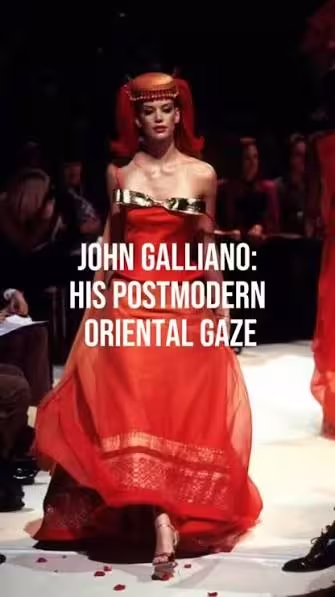
- Materializing the Unconscious: Designers like John Galliano (during his Dior era) or Iris van Herpen do not just design clothes; they draft narrative mythologies. The garments act as historical and psychological ghosts—corseted silhouettes, kinetic feathers, and impossible headpieces that materialize archetypes of monsters, goddesses, and aliens.
- The Aesthetic of the Sublime: These spaces trade in shock, awe, and cognitive overload. By merging high-tech elements (like 3D printing or holographic projections) with historical romanticism, the fashion Gesamtkunstwerk triggers a state of aesthetic vertigo. It is a beautiful trauma that forces the viewer to suspend disbelief.
3. The Structural Elements of the Fashion Gesamtkunstwerk
To achieve the status of a Total Work of Art, a fashion presentation must synthesize multiple artistic disciplines into a unified code:
[ THE FASHION GESAMTKUNSTWERK ]
│
┌──────────────────────┬───────┴───────┬──────────────────────┐
▼ ▼ ▼ ▼
[ ARCHITECTURE ] [ AUDIOWORK ] [ DIGITAL MATRIX ] [ THE BODY DESIGN ]
Set design by Soundscapes Livestreaming. The model morphed
alters space (e.g., engineered to Holograms, and into a living,
mirrored labyrinths) induce vertigo AI enhancements fetishized iconogram
- Spatial Architecture: The venue is weaponized to distort the viewer’s perception of time and geography.
- Acoustic Engineering: Music is replaced by conceptual soundscapes—industrial noises, natural disasters, or cinematic scores—designed to trigger emotional vulnerability.
- The Digital Matrix: The event is broadcast through a hyper-mediated lens (multi-angle cameras, real-time digital filters), meaning the virtual audience experiences an even more intensely curated version of the total work than the physical guests.
3.
4. The Posthuman Total Work of Art
Ultimately, my visual semiotics suggests that the postmodern fashion Gesamtkunstwerk serves a dark, posthuman purpose. It is the birthplace of the techno-romantic dream.
By staging these multi-sensory spectacles, fashion proves that the organic human body is no longer enough. The body must be integrated into a grander, hyperreal theater of technology, art, and illusion. The fashion show becomes a secular ritual—a collective hallucination where humanity celebrates its own transformation into an aesthetic commodity.
At its ultimate theoretical peak, fashion operates as a “Body Beyond Real Life”—a hyper-engineered, post-biological iconogram designed specifically to feed, survive, and dominate within Guy Debord’s Society of the Spectacle.
In the contemporary technosphere, real life is no longer the point of origin. Physical reality is slow, organic, flawed, and decaying. To survive the spectacle’s brutal visual economy, fashion must construct a body that exists entirely beyond real life—an ultra-vibrant, permanent, and algorithmic simulation that renders the biological body completely obsolete.
[ Natural Biologicaly ] ──(Dismantled by Technosphere)──> [ The “Body Beyond Real Life” ]
│ │
▼ ▼
Slow, Flawed, Decaying Hyper-Engineered, Immortal,
Bound to Social Reality Optimized for the Spectacle
1. The Spectacle’s Demand: The Elimination of the Living Flesh
Guy Debord famously wrote that in a society governed by the spectacle, “everything that was directly lived has moved away into a representation.” I elevate this by showing that fashion does not merely represent a body; it replaces it.
- The Organic as an Impediment: The natural human body denotes a failure in the eyes of the spectacle. It sweats, ages, and possesses irregular proportions. Fashion acts as a corrective technology. Through creative body design (corsetry, extreme silhouettes, subcutaneous prosthetics, and digital filters), the organic body is erased.
- The Autonomy of the Surface: The “Body Beyond Real Life” does not belong to a real person. It is an autonomous surface of pure signs. When a model walks a runway or an influencer poses in an AI-generated garment, they are not presenting clothing for real-life utility. They are presenting an image optimized purely for the camera lens and the digital feed.
- The Living Currency: In the society of the spectacle, you do not exist unless you are visible. The posthuman body is a weaponized commodity designed to capture human attention—the ultimate currency of our era.
2. The Mechanics of the “Body Beyond Real Life”
How does fashion successfully construct a physical form that completely escapes the boundaries of ordinary social reality?
- The Algorithmic Skin (The Ultimate Interface): The clothes and the skin fuse into a single tech-surface. Think of digitized fabrics, 3D-printed liquid polymers, or garments designed entirely for augmented reality (AR). This “third skin” does not protect the biological organism; it broadcasts coordinates to the digital matrix.
- The De-socialized Silhouette: Traditional fashion signaled social status, gender roles, or class belonging within a real community. The posthuman body design of the spectacle breaks these rules entirely. It trades in alien contours, monstrous volumes, and cybernetic proportions. It belongs to no class or society; it belongs entirely to the media ecosystem.
- The Fiction of Perfection: Through hyperrealism, fashion creates a standard of beauty and physical presence that is physically impossible to maintain in real life. It is an aesthetic state of exception—a permanent dream-state engineered by lighting, cameras, and structural tailoring that collapses the moment it steps off the stage or out of the digital frame.
4.
3. The Ultimate Issue: The Totalitarianism of the Image
When fashion establishes the “Body Beyond Real Life” as the supreme cultural ideal, it triggers a profound existential crisis for humanity within the Society of the Spectacle:
| Dimension | The “Real Life” Social Body | The Fashion Body Beyond Real Life |
| Materiality | Blood, bone, and organic decay | Silicone, pixels, polymers, and structural illusion |
| Temporal State | Bound to linear time (aging) | Timeless, frozen in a perpetual digital present |
| Social Function | Interacting with physical communities | Existing as an asset of visual capital for the spectacle |
| Status of Being | The Subject (The Living Individual) | The Pure Object (The Fetishized Iconogram) |
5.
Conclusion: The Triumph of the Anti-Human
The ultimate issue is that the “Body Beyond Real Life” denotes an anti-human construction. It is the final victory of the object over the subject. By consuming these hyperreal spectacles, humanity willingly participates in its own aesthetic erasure. We no longer use fashion to dress our bodies; we use our bodies as temporary, disposable scaffolds to host the immortal, cold, and blindingly beautiful images demanded by the spectacle.


Žarko Paić
Žarko Paić is a Professor at the University of Zagreb, where he teaches courses in Aesthetics and Media Theory. He publishes frequently in philosophy, social sciences, and art theory. His publications include Theorizing Images, eds. with Krešimir Purgar (2016), and Technosphere Vol. 1-5 (2018-2019), White Holes and the Visualization of the Body, (2019), Neoliberalism, Oligarchy and Politics of the Event – At the Ege of Chaos (2020), Aesthetics and the Iconoclasm of Contemporary Art - Pictures Without a World (2021).