

Terrence Malick and the Heideggerian filming of the world
1. Art between the abyss and the light
No great contemporary film director can be reduced to an artist as a mere embodied transmitter to the screen of the thoughts of one of the groundbreaking philosophers of our time. There are, however, film ideas like The Matrix bytheWachowski brothers, which are almost a transcription of Baudrillard’s postulates about reality as an order of simulacrums. This is precisely what prompted Boris Groys to declare this film a case of “the filming of philosophy” in the sense of the pure tautology of thought-as-image. This is why this film risks serious objections, because it would also be a critical discourse on Baudrillard’s postmodern strategy of thinking, rather than about the virtues and flaws of the cult film of Generation X. (Boris Groys, “Iconoclasm as an Artistic Device: Iconoclastic Strategies in Film’, in Art Power, The MIT Press, Cambridge-Massachusetts, London, 2008, pp. 67-82.)
Godard did not “screen” Deleuze’s cinematic thought, just as Bergman did not do so with Kierkegaard’s and Freud’s ideas, which are found in his works, such as The Seventh Seal and Wild Strawberries. There are indeed complex interdependencies between film as philosophy and philosophy as film. However, there is one complete exception. His movies are referred to as Heideggerian films. (Marc Furstenau and Leslie MacAvoy, “Terrence Malick’s Heideggerian Cinema,” Vertigo, 7.9.) 2023. https://www.closeupfilmcentre.com/vertigo_magazine/volume-2-issue-5-summer-2003/terrence_malick-s-heideggerian-cinema7
Does this mean that contemporary American director Terrence Malick is Heideggerian as one who follows the thought paths of the master from Todtnauberg in his movies as images of events, or, on the other hand, to only endow the film with an almost hermetic atmosphere that only indirectly evokes associations with Heideggerian concepts such as fourth (Geviert), event (Ereignis), and releasement (Gelassenheit)? It seems that the answer lies between these two opposing logics, as the rule of discourse over the image and vice versa, that is, it lies beyond these opposites. To demonstrate this, because in the philosophical understanding of film there should be no final adjudicative proving of one’s own epistemological-theoretical position in the dispute over ‘truth’, but rather a consideration of film thinking through images of events in an effort to approach that which is decisive for the existential encounter of freedom and the groundlessness of Being, we will try to analyze two of Malick’s key films that offer themselves as the openness of the current of thought of what belongs to Heidegger’s thesis about overcoming metaphysics (Überwindung der Metaphysik ) and the “other beginning” (andere Anfang) of a new way of thinking about the meaning of Being and time. (Martin Heidegger, “Überwindung der Metaphysik” in Vorträge und Aufsätze, Klett-Cotta, Stuttgart, 11th ed. 2009, pp. 67–95, and Martin Heidegger, Über den Anfang (1941), GA, Vol. 70, V. Klostermann, Frankfurt am Main, 2005.) 12th ed.
These are the films Days of Heaven (1978) and The Tin Red Line (1998). In contemporary American film and world cinema more broadly, Malick appears as an eccentric director on the edge between philosophy and the poeticization of life. In addition, he himself creates an obvious paradox regarding Heidegger and film. Namely, it is known that the thinker of the historicity of Being and time, in his search for the original meaning of events that transcends the modern-day obsession with Being in the enframing (Gestell) as the essence of technology, remained indifferent to film art and film as a new medium in the 20th century. The reason seems identical to Heidegger’s attitude towards the avant-garde art of painting, namely, its reduction of Being to an abstract image that subjects thinking to narration entirely within the process of technical subjectivation. In other words, the art of painting, with the exceptions of Cézanne and Klee, does not open the possibility of devising Being from the original poetic saying (Sage). Instead, everything is nihilistically reduced to the establishment and organization of the drive of ‘culture’ and ‘aesthetics’ as substitute structures for art. It loses the ambiguity of language and becomes a mere “experience” of a dehumanized subject to whom metaphysics provides the final justification. (In a note to Klee’s diary, Heidegger writes: “Today’s art: Surrealism = metaphysics; abstract art = metaphysics; non-objective art = metaphysics”. – See Günter Seubold, Kunst als Enteignis: Heideggers Weg zu einer nicht-metaphysischen Kunst, DuMont Verlag, Bonn, 2005. 2nd ed p. 125.)
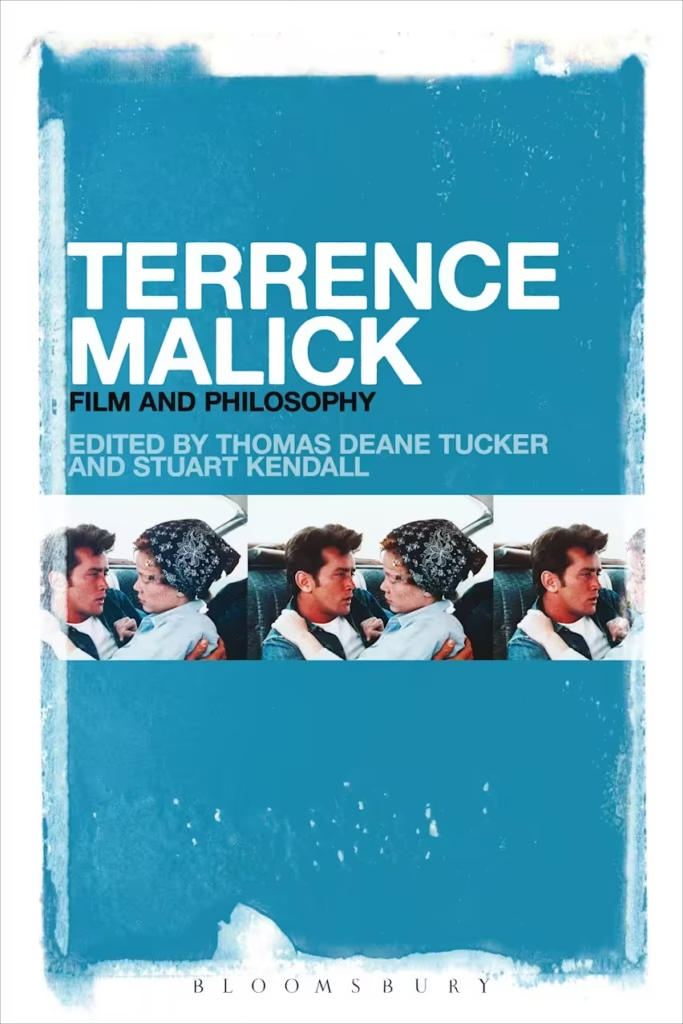
The paradox is, therefore, that the only contemporary thinker who did not see in film anything decisive for a turn in the essence of metaphysics becomes, thanks to Malick, a credible sign of a possible philosophical interpretation of film or, better yet, of film thinking as a possibility of a different insight into the openness of the coming future. Of course, there are many reasons why Terrence Malick, in his “Heideggerizing” of film as a visual art, is an eccentric case that transcends all the mythopoetic and philosophical approaches to cinema seen in the 20th century. First, we must never forget that Malick studied philosophy at Harvard with Stanley Cavell, philosopher, along with Deleuze, the most important representative of film ontology. In 1965, he received a scholarship to continue his studies at Oxford. But a year later, he broke with his philosophical path and embarked on a writing career as a journalist for The New Yorker, Life, and Newsweek. As a journalist, he went to Bolivia in 1967 to report on the trial of the French theorist, media theorist, and left-wing intellectual Regis Debray, who was Che Guevara’s closest collaborator in his revolutionary guerrilla struggle. In 1968, Malick taught philosophy at MIT. In 1969, he published his translation of Heidegger’s famous treatise On the Essence of Reason (Vom Wesen des Grundes, 1929),with a critical introduction and notes. (Martin Heidegger, The Essence of Reasons, Northwestern University Press, New York, 1969. Translated from the German by Terrence Malick. See on this Stuart Kendall and Thomas Deane Tucker, “Introduction”, ed. Terrence Malick: Film and Philosophy, Continuum Books, London, 2011, pp. 5-6)
The second reason, in my opinion, why Malick creates formally Heideggerizing films as a representative of the new Hollywood film of the late 1960s and 1970s, together with Coppola, Lucas, de Palma, Lynch, Spielberg, Scorcese and others, lies in the fact that, as Stanley Cavell has precisely stated, he has found what constitutes the essence of film ontology in general, which stems from the photographic image as developed by Siegfried Kracauer and André Bazin. Without this innovation, his films would not have the aura of painterly atmosphere and artistic atmosphere that opens fundamental questions about the essence of the world between the abyss and the light. Namely, according to Cavell, these images, as reflexive images, possess ontological status.
object projected on the canvas,” and therefore”self-referentially think about their physical source. Their presence refers to their absence, their location elsewhere.” (Stanley Cavell, The World Viewed: Reflections on the Ontology of Film, Harvard University Press, Cambridge, Massachusetts, 1979, p. xv.)
Film photography becomes reflexive only because, in Terrence Malick’s movies, the camera does not follow the logic of reality as such. Still, it focuses on signs of trembling and flickering, vibrations of earth and sky, the oceanic silence of the soul, and listening to the wind in the trees as a harbinger of a sublime and traumatic event. For some interpreters, this is proof that, behind the structure of Heideggerian filmmaking, lies the divine, as in The Tree of Life (2011). Instead of God as absolute transcendence, it is as if Malick focuses attention on what, like the image of an invisible spirit, enters the world through the quiet trembling of a blade of grass and everything suddenly moves, all the spirituality of the world that is not depicted and represented by the film as an image of an event, neither symbolically nor allegorically, but appears in physical absence as the sound of the sublime beauty of that which connects heaven and earth, immortals and mortals as fromHeidegger’s thought about the fourth beyond metaphysics(Geviert). (See on this Christopher B. Barnett, “Spirituality in the Films of Terrence Malick, Journal of Religion and Movie, https://digitalcommons.unomaha.edu/jrf/vol17/iss1/33 )
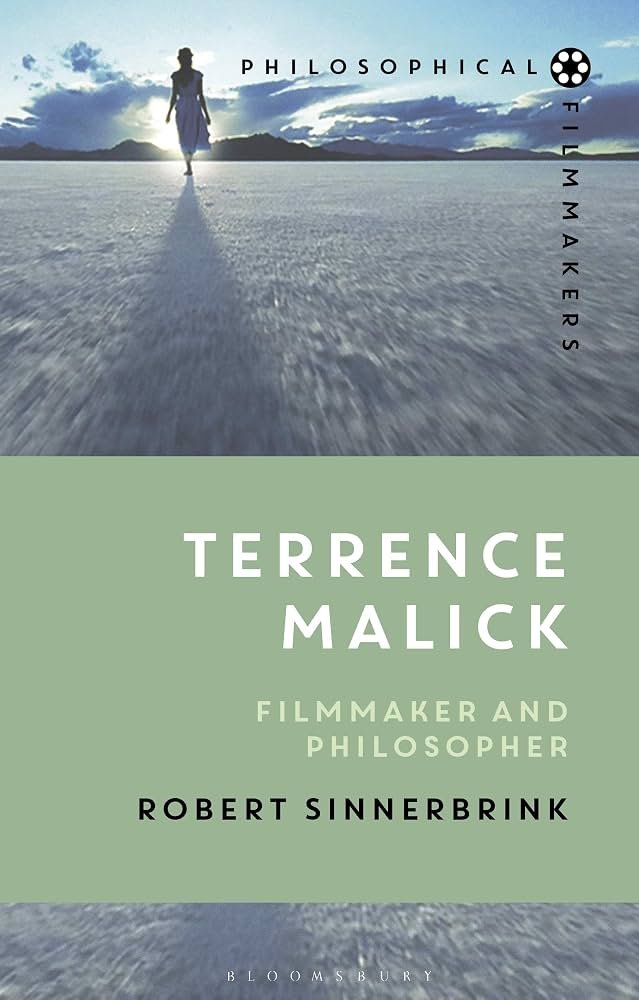
The third reason, finally, might be probably decisive for Malick’s paradoxical intention to introduce a complete Gelassenheit syndromeinto contemporary film, and in the context of American Hollywood’s apocalyptic-commercial spectacularism from the 1990s to the present. Namely, to open the way to the enchantment of mytho-poiesis by romanticizing the world as a pictorial film, through the experience of an elemental sensitivity born of the essence of life’s simplicity on earth. The first to clearly point out the direct-indirect relationship between Heidegger and Malick’s films was, of course, Cavell, because it involves introducing entirely new concepts beyond the boundaries of metaphysics. Just as Heidegger, in the analysis of a work of art, opened up the possibility of insight into the trinity of what belongs to the essence of the work itself as to set-truth-into-the-work (Ins-Werk-Setzen der Wahrheit), with the artist and the land itself as the event of the original soil as the rootedness of Being in the world, so too in Malick’s films there is an attempt to humbly elevate Human from his establishment as a subject and master of the land. (Martin Heidegger, “Der Ort des Kunstwerkes”, in Holzwege, V. Klostermann, Frankfurt a. M., 2003, pp. 1-74. On the relationship between Heidegger’s understanding of the essence of art and Malick’s movies, see the text by Robert Sinnerbrink, “A Heideggerian Cinema? On Terrence Malick’s The Thin Red Line”, Film- Philosophy, Vol. 10. No. 3, December 2006, pp. 26-37. https://www.euppublishing.com/doi/epdf/10.3366/film.2006.0027 )
Let us see, then, how this is shaped cinematically and what the far-reaching consequences of this true turn in the essence of contemporary film are, with its return to what is more original than any obsessive desire to transform the image into an event of the true reality of life as a technosphere.
2. Days of Heaven or about “tragic indiscernibility”
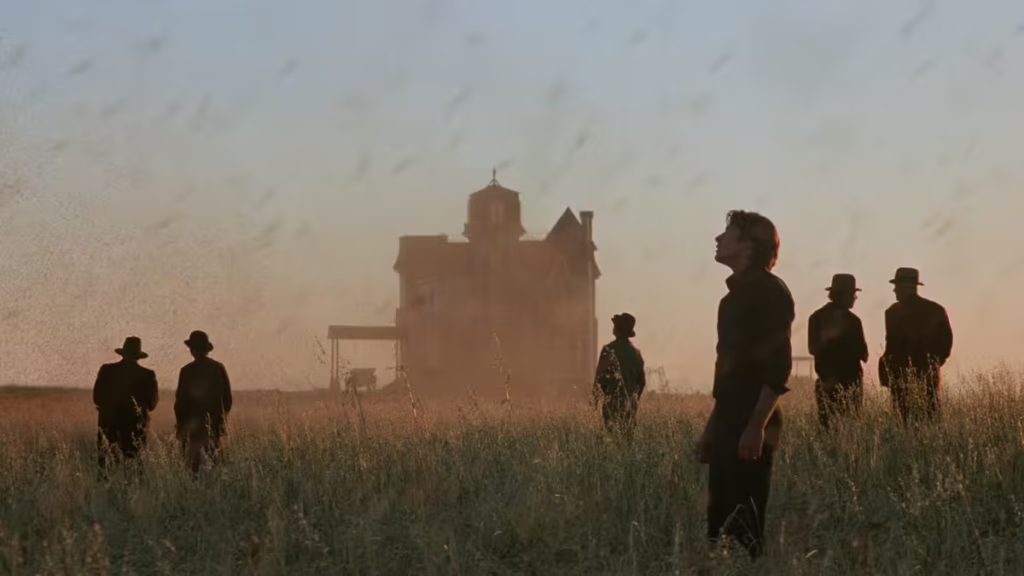
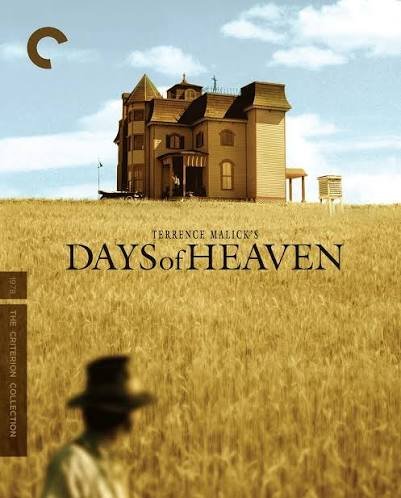
The plot of Malick’s probably most important movie ever, Days of Heaven, shot in 1978, takes place in the years before World War I. After accidentally killing his supervisor in a conflict, poor factory worker Bill, played by Richard Gere, flees the city. He is accompanied by his younger sister and his girlfriend, Abby, played by Brooke Adams. To avoid gossip, Bill introduces Abby as his sister. They find work on a secluded farm in Texas, owned by a wealthy but seriously ill young man, played by American writer, director, and actor Sam Shepard. He takes a liking to Abby, and Bill persuades her to marry him and take the inheritance. She accepts. However, her new husband’s health improves rapidly, and she begins to fall in love with him, which makes Bill jealous. While stealing medicine for Abby from the doctor’s car, Bill overhears a conversation that reveals the young owner is seriously ill and has only about a year to live. The farmer, now aware that he has little time left, gathers his courage and approaches Abby. Pressured by poverty and worries about their future, Bill persuades her to accept the landlord’s advances, marry him, and then acquire a large inheritance that will fall to her after her husband’s imminent death. She does not like the idea, but Bill, who has had enough poverty, insists.
After the harvest is over, the workers leave the farm, and Abby stays in the farmer’s house with her brother and sister. The wedding follows. Abby feels guilty and unhappy at first, but she eventually enjoys her honeymoon and grows closer to her husband. Bill is pleased with his newfound financial security and the fact that he does not have to work all day, but Abby being with another man begins to bother him. His health stabilizes, and it becomes clear that he will not die so soon. While hunting together, Bill contemplates murder. The farmer’s old manager suspects that the two are frauds. Fatherly concerned, he warns his employer, which angers the young man, but he himself begins to develop suspicions. At the same time, Bill realizes that Abby loves her husband. Angry, he leaves the farm and returns only after several months. Aware that he is to blame for the situation, he wants to say goodbye to her and leave finally. But her husband sees them together, and this enrages him. While locusts are ravaging the farm, Bill helps to drive them away with smoke. The farmer attacks him and, in his anger, starts a fire that destroys the entire field. Bill kills him in self-defense and flees with Linda and Abby. The farmer’s old manager organizes a chase, and after a while, they are found. Bill resists and is killed. Abby, already overwhelmed with guilt for everything that has happened, places Linda in a girls’ school and boards a train carrying soldiers, presumably to work as a nurse. Linda meets her old friend from the farm and runs away from school with her, with no idea where they will eventually go.
Critics received the film extremely well. The cinematography was particularly praised, along with the selection of beautiful scenes, which are otherwise characteristic of all of Malick’s films. Many scenes were shot in the morning and evening, resulting in distinctive lighting effects (e.g., a sunless sky). Filming took place in Alberta (Canada). During post-production, Malick spent two years editing, removing many dialogue scenes and replacing them with narrative fragments from Linda Manz, who plays the young sister in the film. A year after filming ended, he invited the actors to shoot additional scenes to complete the film. Cinematographer Néstor Almendros won an Oscar and several other awards for best cinematography. Cinematographer Haskell also participated in the production, and Malick, as the best director, was awarded at Cannes and by the American film critics. In addition, the movie was nominated for Oscars in the categories of costume design, sound effects, and original music by Ennio Morricone, using a melody from Saint-Saëns’s Carnival of the Animals: The Aquarium. In 2007, Days of Heaven was included in the United States National Film Registry as a culturally, historically, or aesthetically significant work.
First, no other Malick film, except perhaps The Thin Red Line, has this epic narrative script that seems to have come from some grand novel about 20th-century American history. So, it is not surprising that Stuart Kendall, in his excellent interpretation of the film’s philosophical structure, speaks of a “tragic indiscernibility.” (Stuart Kendall, “The Tragic Indiscernibility of Days of Heaven “, in Stuart Kendall and Thomas Deane Tucker, edited by Terrence Malick: Film and Philosophy, pp. 148-164.)
Although the synthesis of the photographic image as a reflective image of an event and what the image emanates in its immersion in the beauty of an almost idyllic-pastoral depiction of nature in all its cyclical events like Vivaldi’s seasons is what Malick seeks to perfect in this film, the entire narrative framework of the film coincides with what connects the human tragedy of the lover and the nomad with the contingent necessity of the natural-human apocalypse. The lie, the illusion, and the ignorance about the nature of the relationship between the lover and the farm owner have the structure of the desire to master the Other. until the Other unconsciously creates a situation of complete entropy out of unconditional love for Abby.
Everything, therefore, unravels toward the necessary tragic indistinguishability among the actors of this dreamy idyll, with a very realistic decor of the rise and fall of American modernity beyond the metropolises, in the heart of the West as a promised utopia of well-being and happiness. It is no coincidence that Malick, at the beginning of the film, presents the audience with a montage of photographs from the late 19th and early 20th centuries, thus paying tribute to great American photographers such as Lewis Hine and H.H. Bennett, along with pastoral paintings from European painting that marked the visual nostalgia for the countryside and idyllic landscapes, such as the paintings of Breughel and Courbet, for example. However, their function seems anything but realistic. It is a pure postmodern technique with elements of parody, pastiche, and irony, depicting a world that hides its tendency towards violence and the traumatic history of capitalism behind an escape into dreams and an idealized imaginary past.
The movie Days of Heaven thus combines visual-auditory pastorality as a prelude to a future disaster of tragic proportions. Nothing is peaceful in itself, not even the magnificent symphony of nature in its reasonlessness, for the tragedy that, from the Greeks to the present day, arises from the essence of what is uncanny, as a feeling of the gap between the divine and the human, raises the question of why necessity should destroy the world at the moment of its grandeur and harmony. Malick uses, in his cinematographic counterpoints, the technique of visualizing what arises from the gaze on things and their non-concealment, such as the invasion of locusts as a harbinger of the farm owner’s murder and the great fire on the prairie.
Looking at the Other in all modes of visualization connects the camera and the human gaze. What is it that is looked at if not the outlines of visibility behind which there is no transcendent form of the gaze of the hidden God (deus absconditus), but what connects the yawn of the sky and the song of the earth, the sun and the body in the Rimbaudian meaning of the visual ecstasy of life. Great modernist directors like Kurosawa or Visconti, in their films, tried to visualize beauty as something that requires a look at a sublime object radiating the aura of light itself, which was a great aspiration of the impressionists at the end of the 19th century. Tragedy always occurs in the environment of nature’s tranquility and bliss, as a romantic idyll, because it concerns the broken absolute of what is not the Greek physis but the modern-day natura naturans and natura naturata.The imaginary is represented by the Heideggerian event of Gelassenheit as a twofold relaxation towards the nihilism of the unconditional position of modern technology and the capitalist will to power over nature and humans in general, culminating in the final stage of exploitation and alienation. (Martin Heidegger, Gelassenheit, Klett-Cotta, Stuttgart, 2014, 16th ed.)
However, unlike the modernist distance towards the object of the recording or the camera’s view of the outside world, here the distance is abolished. There is no longer the possibility of sensitivity as an expression of suffering and a sublime relationship with what is visible, like the final scene of the Venetian lido, with the agony of light merging with the horizon, in Mahler’s Adagio from the Fifth Symphony in Visconti’s Death in Venice. Malick’s postmodern travesty-tragedy in Days of Heaven is marked by reflective images of events from which the characters, in their impulsive dramatic nature, are always and only icons-figures not of ideas, but of what Heidegger calls in Being and Time (Sein und Zeit) existentials. And so, everything rises from fear, anxiety, atmosphere, the presence of death as that which transcends human subjectivity and becomes more-than-a-film, more-than-a-picture of sublime existence in the environment of the non-metaphysical fourfold (Geviert) of heaven and earth, immortals and mortals. (Martin Heidegger, Unterwegs zur Sprache, Klett-Cotta, Stuttgart, 2007. 14th ed .)
Malick placed acting outside the traditional film image. Instead of the representation-and-presentation of something as something, the Being of beings, speaking in Heideggerian terms, he set out to eccentrically grasp what cannot be behind the physical presence of an object in space. This is not some non-presence of either things or people in nature as a pastoral symphony of life, but the openness of the event of the image as the telling of what is truly the unconcealment of being itself, that original Greek aletheia, but now caught by the eye of a cinematographer and director who persistently and persistently breaks with the idea of film as a continuation of literature, drama and photography by other means. In his films, we encounter the sky’s revived yawn and the earth’s song, in which people, as the governors of Being and time, search for harmony and concord, forthe meaning of life beyond nihilism and the disintegration of all forms of human insignificance.
3. The thin red line or the ethical paradox
1998. Terrence Malick made the brilliant film The Thin Red Line, which, along with Coppola’s Apocalypse Now can truly be considered the best war film ever, although this achievement is completely beyond the boundaries of the so-called genre in which violence, terror, militarism, suffering and the horror of human tragedies, along with an arsenal of sophisticated film effects, give the film the power of commercial success. Indeed, this movie proves to be a reflection on the meaning of being in the Heideggerian key of philosophical insight. (See on this Marc Furstenau and Leslie MacAvoy, “Terrence Malick’s Heideggerian Cinema,” Vertigo, 7/9/2023.) https://www.closeupfilmcentre.com/vertigo_magazine/volume-2-issue-5-summer2003/terrence_malick-s-heideggerian-cinema and Robert Sinnerbrink, “A Heideggerian Cinema ‘? On Terrence Malick’s The Thin Red Line”, Film- Philosophy, Vol. 10. No. 3, December 2006, pp. 26-37. https://www.euppublishing.com/doi/epdf/10.3366/film.2006.0027 )
However, it seems necessary to say this before analyzing the film. There is a whole series of orthodox film “narratologists” and critics who refuse to acknowledge Malick’s credibility as an artistically authentic approach to understanding film in a literally syncretic position between American realist commercialism and European avant-garde conceptualism, claiming that all his films are on the verge of the perceptual endurance of the mass audience due to the violent mytho-poetization of life and the romantic aestheticization that give the film the cinematographic beauty of iconic scenes, but often turn the actors into mere objects of a secret dark inexpressibility. The Thin Red Line is not free from these critical objections to “philosophizing”. Although, to be fair, the scenes of the counterpoint of the wondrous and sublime nature, the ocean and the rainforest, against the horror of war as a struggle to destroy the Other in the conflict between the Americans and the Japanese in World War II on the tropical island of Guadalcanal in the Pacific Ocean, are what Malick peculiarly reinterprets in the light of Heidegger’s critique of metaphysics, nihilism and modern technology. Horror never occurs in the illusion of modern fascination with the architecture of metropolitan grandeur, except in the case of the new Hollywood blockbusters of apocalypse and catastrophe, which are nothing more than beneath any level of critical reception. No, his “topology of Being” denotes a primordial space where the Anthropocene does not subdue wild nature. Therefore, the meditativeness of the voice that expresses those thoughts about a drop of water, dew, duration, transience, eternity, redemption, and the final reconciliation of man and the divine in the truth of being as an event of openness of meaning is simply something that bestows a higher level of aesthetic reflexivity on the brutal reality of war’s destruction and the destruction of humanity.
The thin red line denotes the line of thought that passes between the worlds of metaphysical transcendence and immanence, that which is present and visible, and that which transcends all the suffering, horror, and pain of man’s existential assault in the time of a single event. (See on this Hannah Patterson, ed. The Cinema of Terrence Malick: The Poetic Visions of America, Columbia University Press, New York, 2007.) I emphasize here the approach of the American philosopher Simon Critchley, who argues that Malick’s filmic reflexivity, within the framework of Heidegger’s efforts to overcome the metaphysics of the West, should be read not as a philosophical meta-text but as a reading of the film that expresses itself artistically through philosophical reflection. In other words, Critchley stands on the standpoint of the autonomy of the film medium, as something that permeates its own pictorial expression with that which is not the depiction or representation of some external reality, but the very thing that connects philosophy and film. (See Simon Critchley, “Calm: On Terrence Malick’s Thin Red Line “, in Rupert Read and Jerry Goodenough, edited by Film as Philosophy: Essays and Cinema after Wittgenstein and Cavell, Palgrave Macmillan, New York, 2005, pp. 133-148.)
The Thin Red Line represents a film based on the novel of the same name by American author James Jones. The film follows a fictionalized version of the Battle of Mount Austen, which was part of the real-life Battle of the Pacific during World War II. The main characters are members of “Charlie” Company, played by Sean Penn, Jim Caviezel, Nick Nolte, Elias Kostas, and Ben Chaplin. The title of the film is a reference to a line from the poem “Tommy” by Rudyard Kipling. The film was extremely well received by critics and audiences and won the prestigious European Golden Bear Award at the Berlin Film Festival. What Simon Critchley lucidly sees in his interpretation of Malick’s directorial process is that the philosophical level of The Thin Red Line is shown through three correlative thematic environments: first, loyalty in the conflict of hierarchical authority between Colonel Tall, played by Nick Nolte, and Captain Staros, played by Elias Koteas; second, love of Ben, played by Ben Chaplin, expressed in his devotion to his wife Marty, played by Miranda Otto, after she writes a letter saying she is leaving him because she is in a relationship with another man; and third, the question of the metaphysical relationship of struggle and conscience between the lieutenant, played by Sean Penn, and Private Witta, played by Jim Cazaviel.
It should be no coincidence that Malick, in addition to the paradox of adopting Heidegger’s framework of metaphysical criticism for his reflexive project of film art. At the same time, Heidegger himself rejected film as a paradigm of modern art, but he also did something else extremely important. I will call this an ethical paradox. It is known that Heidegger almost eliminated the concept of ethics from his thinking. However, in Being and Time, the concept of Being-with (Mitsein) served as a non-metaphysical support on the way towards a different formation of the original community beyond the limits of modern nihilism, in which man is reduced to the subject and object of a mass society of capitalist consumption. In addition, Heidegger’s proximity to the Nazi project of total mobilization of the German people in the politicization of life also meant contempt for any metaphysically structured ethical position as a system of values.
That is why Malick, both in The Thin Red Line and especially in the 2019 film A Hidden Life, a romantic epic story aboutan Austrian peasant named Franz Jägerstätter who, out of absolute loyalty to Christian doctrine, refuses to side with the Nazis in Austria and be a member of Hitler’s destructive machine of destroying the world of freedom and humanity, introduces into circulation the question of the necessity of a decision from the essence of human conscience. The ethical paradox, in addition to the so-called ontological-aesthetic one, defines Malick as a thinker of the images of events in the footsteps of Heideggerian reflexivity (Besinnung). What is the meaning of the ethical imperative in The Thin Red Line? There is no doubt that, here, the trinity of truth, morality, and humanity, as Critchley expresses in his analysis, is measured from a different perspective than the traditional ethical one within the context of metaphysics. There is, therefore, an attempt to derive from Heidegger’s late thought a connection between concepts such as fourth and compassion (Geviert and Mitleid) through a reflection on the original Greek understanding of ethos and on what, in modern times, signifies the vulnerability of human existence in a world of nihilism. (Werner Marx, Gibt es auf Erden ein Maß? Felix Meiner, Hamburg, 1986.)
In Malick, the ethical must always be measured from a deeper meaning that, as in Heidegger, arises from the groundlessness of freedom, from that which is neither Being nor beings, but the openness of the meaning of Being and time in general. In a film that cannot be understood as either war nor anti-war, but beyond all metaphysical boundaries in which war is thought of as horror, tragedy, and the idea of something new in world history, lies something much more than violence and terror by which the political dimension of achieving freedom is imprinted by the necessary sacrifice of one’s own life in the defeat of the Other. This cannot be a film that boasts of any religious redemption or Judeo-Christian messianism by which the horror of war must be freed from the sea of blood and ashes of the earth. No, Malick represents a film thinker who, in his “filmic poiesis ” (Robert Sinnerbrink, “A Heideggerian Cinema? On Terrence Malick’s The Thin Red Line“, Film- Philosophy, Vol. 10. No. 3, December 2006, pp. 26-37. https://www.euppublishing.com/doi/epdf/10.3366/film.2006.0027) opens the issue of the cosmic-natural final calm in spiritual Being with which man finds what Heidegger calls the meaning of Being (Sinn der Seins). And precisely because his film thinking denotes an ontological and ethical convergence of paradoxical twists, it should be necessary to conclude that, in his impossible project of film philosophy ‘today’, he is unique, eccentric, and singular, without precedent. That this happened within the framework of the history of the image-movement, as in his reflections on film, Deleuze defines the period of European avant-garde film before World War II, when Malick would have had predecessors in the performative turn of film, pure visualization of the brain as a source of brutal physical expressiveness, such as Artaud’s ideas or those of Jean Epstein.(See Žarko Paić, “Le cinema brut: What can a film do? in Antonin Artaud: The Sun and Madness, Litteris, Zagreb, 2023, pp. 45-80.)
Well, Terrence Malick belongs to the history of postmodern and contemporary American cinema, from his first film, Badlands, in 1973to the present day, and draws on it for all his creative transpositions in dialogue with literature, modern photography, painting, andother visual arts of the 20th and 21st centuries. For his ” filming of the world”, Heidegger is the first and last thinker of what exists as a Gelassenheit syndrome, like an atmospheric envelope and a corona of time, like a ringing game of Being and time in an age obsessed to the point of madness with novelties and the artificial reality of the technosphere. This is nothing more than proof that the philosophical understanding of film, along with the creation of reflective images of events, is also something even more fateful.
Film thinking becomes the tremor of chaos and the flickering of the primal in the yawning of the sky, the singing of the earth at the outcome of the very idea of film as another life with which we share the same body, soul, and spiritual being in the becoming of that ineffable and sublime moment of the beginning and end of all things.
(Chapter from the book On the Philosophy of Film: Images of Events, Bijeli val, Zagreb, 2024.)

Žarko Paić
Žarko Paić is a Professor at the University of Zagreb, where he teaches courses in Aesthetics and Media Theory. He publishes frequently in philosophy, social sciences, and art theory. His publications include Theorizing Images, eds. with Krešimir Purgar (2016), and Technosphere Vol. 1-5 (2018-2019), White Holes and the Visualization of the Body, (2019), Neoliberalism, Oligarchy and Politics of the Event – At the Ege of Chaos (2020), Aesthetics and the Iconoclasm of Contemporary Art - Pictures Without a World (2021).