

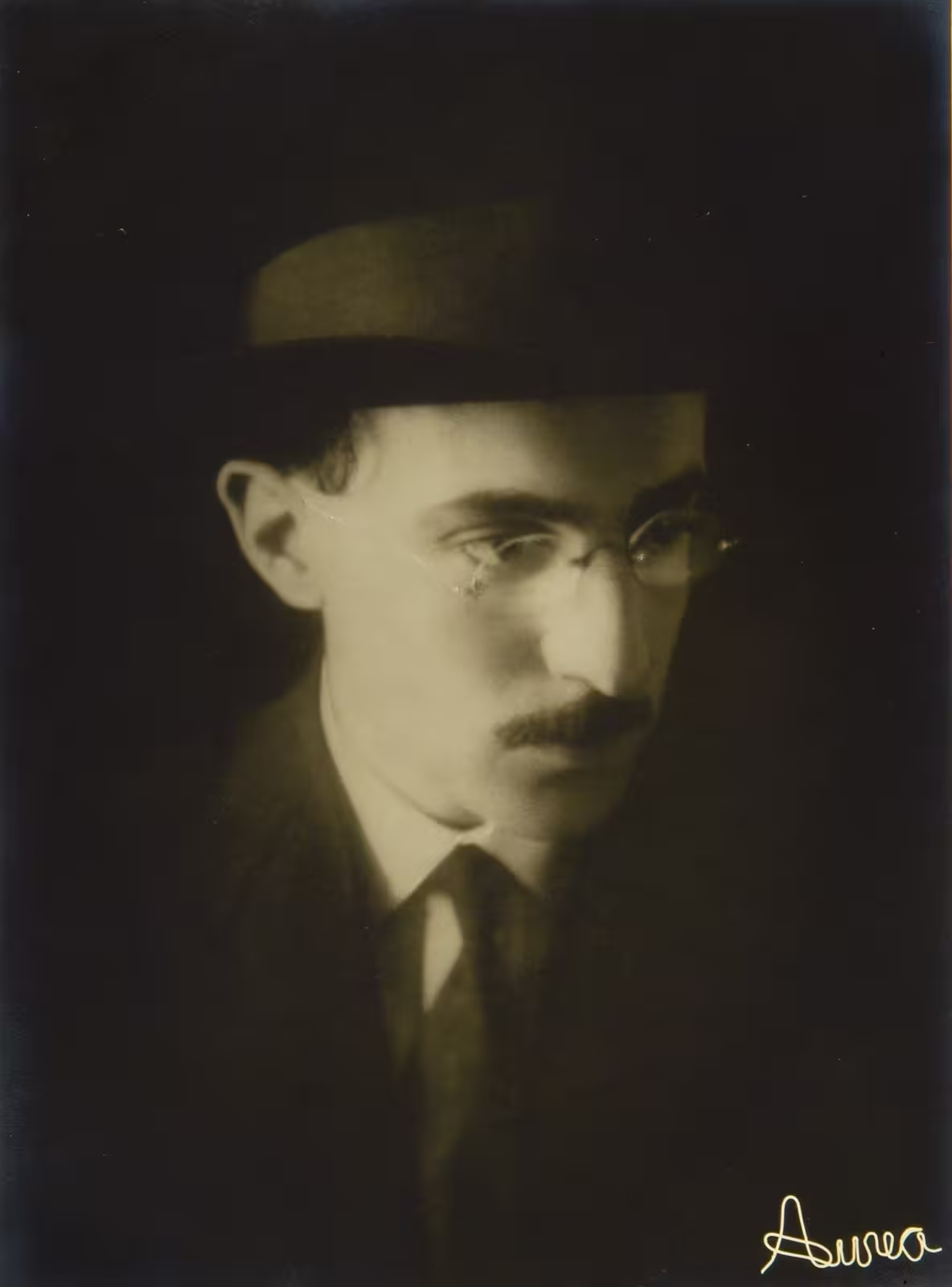
To Ribbons painted with a fountain pen, glasses, and a scent
from the book Eros and Psyche
Abstract
The author analyzes writing as the thinking of the Portuguese poet Fernando Pessoa, one of the most significant artists of the 20th century. However, his influence is only now gaining the deserved world reception not only in the fields of literary theory and poetry, but also in contemporary philosophy. Since the fundamental problem of his work is represented in the multiplication of persons he created as authentic participants in thinking and writing, it appears that access to his works requires, first, an insight into the ontological-metaphysical questions regarding Being, beings, and the essence of Human, because a person cannot be reduced to the matrix of subjectivity. Instead, Pessoa demands a different approach, immediately addressing the aspiration to traverse his heteronyms (Campos, Caeiro, Reis) and recognizing that writing must be understood as absolute freedom in constructing new identities. In accordance with Heidegger’s and Wittgenstein’s thoughts regarding the questions of language, and in the search for a newer analysis of Pessoa’s works in the philosophical writings of Alain Badiou and Judith Balso, the author tries to follow his own way of interpreting Pessoa as a thinker-artist whose voice shows the authentic simulacrum of the world, in which contingency represents the necessity of freedom. The chaos of imagination becomes creative order without beginning or ending.
Keywords: metaphysics, madness, Pessoa, heteronimy, plural literary space, chaos of imagination
Introduction
Approaching the thought directly in the work of Fernando Pessoa does not mean grasping the whole. Without the paradoxes and aporias of the discursive adventure, we will not get anywhere. It should be reconciled in advance that this impossibility of access to his work is simultaneously an open area of overlap between the styles and forms of the writer’s drama of singularity. There is no a priori given personality, some supreme transcendental “I” with which we can reliably start in what follows ꟷ the dissolution and unraveling of the secret of Pessoa’s thought, in which philosophy and art overlap and separate on the same path. If we are deprived of what Judith Balso calls in the title of her inspiring book a “metaphysical courier” (Balso 2006) to penetrate the labyrinth of his writing, then what is left for us? Perhaps the instructions for entering that labyrinth can be found in a fragment of Bernardo Soares’ Book of Disquiet (Livro do Desassossego por Bernardo Soares). Here, in probably the most lucid way, the fundamental problem of the relationship between thinking and writing has been shown from the spirit of metaphysical understanding of things in general.
“Metaphysics has always seemed to be an extended form of latent madness. If we knew the truth, we would see it; everything else is the system and environment. If we think about it, it is enough for us not to understand the universe; wanting to understand it means being less than human, because being human means knowing that the universe is incomprehensible.” (Pessoa 2001: 89)
Pessoa often uses the word metaphysics as an adjective for various phenomena. The same applies to the word mystery. Namely, metaphysics denotes obsession and illusion in an aesthetic sense. However, it is also about the way of thinking of man, which is given to him out of the necessity of his ambiguous existence as a being who feels, suffers, and experiences anxious moments in the face of the drama of existence. If metaphysics is madness, then this diagnosis should be something completely different from the science of psychoanalysis. For Freud, the central maxim is that where It was, shall I be (Wo es war soll Ich werden). This Enlightenment “rationalism” by other means ꟷ the discovery of the unconscious as a language ꟷ starts from the idea that the self is “that” which rules and governs our archipelago of desires. Admittedly, it no longer does this from the center of the mind, but from the displaced area of the living body. However, metaphysics cannot be overcome by reversing it. It goes down from head to toe. Pessoa, therefore, does not understand madness as a disease of the mind or thought. There is only one different opinion, and that from difference constitutes identity as a river of dreams and the contingency of multiplied “I”. Their origin lies beyond any replication of a proto-original (arché). According to this, Pesso’s undertaking is linked to the revelation of the non-existence of the first cause and the last purpose (télos) of the event. If so, then metaphysics cannot be just madness. It also denotes a necessary obsession with giving Human a substitute consolation: that God might exist and that the world might make sense. For Pessoa, metaphors and figures in literature, as paradigms of art, because language becomes the condition for the possibility of the worldliness of the world, are the same thing that Nietzsche attributes to the conceptual language of philosophy: that it is a substitute for the real appearance of things. Art should be thus played out in double coding. It becomes simultaneously “avant-garde decadence” and “decadent avant-garde”.
In the case of Pessoa, this will have far-reaching consequences for the understanding of “his” poetic thought or logic based on the model of aporia and paradox. What, for classical metaphysics, is the unity of place and time, a kind of Aristotle’s fundamental law of the aesthetic determination of the world expressed in Poeticsas the coincidence of the substance of things and the order of meaning in the environment of the harmony of the world, will be completely reversed and denied. Instead of an either-or logic in Pessoa, everything becomes simultaneously positive and negative, possible and real, in the sign of logic, either-or. This is why we must keep in mind two metaphysics and, accordingly, two types of “metaphysical madness”:
(1) Aristotelian with the fundamental principles inherited by modern philosophy and science under the name of the principle of sufficient reason (principium rationis) and further developed in the thinking of Descartes, Kant, and Leibniz;
(2) non-Aristotelian with an attempt to recognize the primacy of dreams, fantasies, daydreams, phantasmagorias, and imagination in the productive sense of new aesthetic knowledge before the rational model of expertise and practical conception of the world.
Under the heteronym of Álvaro de Campos, Fernando Pessoa expressed this most fruitfully in a text of a manifest character entitled “Notes for a Non-Aristotelian Aesthetic” in 1924. It might not be unusual for a philosophical text about “new aesthetics” to be cloaked in the language of representatives of the European historical avant-garde. The whole personality of a radical poet, a marine engineer, and a writer of avant-garde manifestos, like Campos, is expressed in it. In the text, the guiding thought emerges with volcanic force: that the idea of beauty, which reaches its peak in Aristotle’s aesthetics and from which the primacy of the mind over feeling arises, must be opposed by the idea of strength born of original sensibility. Why? Campos’s answer seems so obvious.
“All art stems from and is based on sensitivity. While the Aristotelian artist subordinates his sensibility to intelligence, to make this sensibility human and universal, that is, to make it accessible and pleasant, thereby ensnaring other people, the non-Aristotelian artist subordinates everything to his sensibility, transforms everything into the substance of sensibility, so that, making all the same, its sensibility abstract as intelligence (without ceasing to be sensibility), emissive as will (without still being will) became emissive an abstract emotional hearth that can force others, whether they want it or not, to feel what he felt, that can control others through inexplicable power…(…) When the “idea” of beauty is the “idea” of sensitivity, emotion, and not an idea, sensitive to the mood of one temperament, that “idea” of beauty becomes strength (…).(Pessoa 1997: 252-253)
Metaphysics historically refers to the duality of worlds, the “real” one and the one that opposes the reduction of life to calculation, planning, and construction. Therefore, this crucial word from the depths of tradition is a mystery for Pessoa, as it was for Heidegger and Wittgenstein. The reason for this lies in the language used to express the world as such and the world of human existence. Therefore, mystery is not what is “mysterious” in the non-real, but reality itself, which shows itself in the modal categories of necessity, reality, and possibility. Why could that be so? The simple reason is that the decision about the way of thinking, as a contingency, is set by factuality, with no alternative. What happened was that it happened only to so-and-so. Although there may have been other possibilities, they remained unfulfilled. When the conflict between ideas and reality begins with Plato, the separation of what belongs to philosophy and what belongs to art is already at work. So, it always starts in the realm of eternal, permanent Being and descends to the levels of changing appearances.
In Pessoa’s philosophical texts, this duality is analyzed much more precisely and strictly. All this takes place within the framework of synthesizing rationalism and perspectivism. This almost-impossible synthesis of Kant and Nietzsche might be resolved by thinking ecstatically that true life springs from the oneiric puzzle of the body’s sensuality. In contrast to Artaud, who understood the body metaphysically in his departure from the impurity of sexual reproduction, Pessoa’s notion represents a poetic cosmogony of feelings. It seems visible in all “embodiments” of the writer’s existence. To be for Pessoa means to write. Human as homo scribens creates from life a Book of another nature, or, better said, the nature of the Book as the real life of the Other.
Suppose a person cannot be determined otherwise than from the experience of this “metaphysical madness”. In that case, his fate is identical to the attempt to overcome this disease by its means. These are dreams, daydreams, and phantasmagorias, as well as escape into imagined landscapes of a multiplied self to the extreme limits between battle and nothingness. The problem with the approach to Pessoa becomes already evident, as his magnificent oeuvre of diverse works (poetry, prose, theosophy, esotericism, philosophy, political texts, plays, diaries, letters) is almost impossible to contain. It does not seem at all appropriate to give it the aura of a “work” (ouevre) in a way that assumes the linearity of time and the roundness of what Maurice Blanchot calls “literary space.” (Blanchot 1989) The space of Pessoa’s writing cannot, however, be completely identified with the space of thought established by the “canon” of modern art in the West in the 20th century. His interventions are much closer to the contemporary experience at the edges and hubs of the network of textuality. Recognizing authorship and a signature as fixed identities can no longer be decisive. Instead, we encounter a search for a fluid and impermanent “subject”.
Derrida and Lacan call it decentred, while Deleuze gives it the right to lose any permanent center simply because the subject question has become a question of the metamorphosis of it becoming in state changes. The subject is constructed, paradoxically and aporetically, by its de-subjectivization. The more its “being” is ungrounded, the more it is a step towards the kind of aesthetic object for which the rule set since Paul Klee’s insight in his diary entries applies: “Now objects notice me”. Who is thinking of whom here ─ Pessoa’s heteronyms, or are they autonomous objects of his own literary will to power from the spirit of difference and otherness?
1. Thinking as writing
Thinking as writing makes Pessoa a unique case of transgression of all previously established rules about the identity and permanence of figures such as philosophers and writers. Both are, admittedly, connected to the “geometry of the abyss” of the language itself. But the shackles that keep them from falling into the infinite black holes of that abyss are the result of the historical legacy of metaphysics. A philosopher thinks conceptually, and a poet, as a writer, deals with feelings. Once again, this brings us back to the simultaneous reading of Nietzsche and Pessoa. Let’s remember that Nietzsche, in his “aesthetic turn”, demanded the interweaving of philosophy with art. In this respect, he was the predecessor of all those thinker-writers who aspired to philosophically pursue a different path of their own, writing against and outside the modernist current and its powerful new tendencies. Some, as in the case of Franz Kafka, have become the “new canon” today, such as the cinematic style of writing, the networking of events in the temporal sense of the flow of the constant now to the spatial reorganization that requires the placement of the subject and the heterogeneity of language in its practical performance.(Deleuze and Guattari 1986)
Pessoa’s proprietary project of permeating philosophy and art, starting from the singularity of sensibility, from what in medieval theology is called nominalism and implies the primacy of the movement of the one-off and unrepeatability of an individual being before the universal Being, is evidenced primarily by the avant-garde movement called sensationism. By establishing a “plural literary space” and styles without the hegemony of the One and Only, Pessoa seeks to include all styles within a network of coexistence. (Ribeiro 2010: 74-95)This is what we can call the singularity project of “absolute difference”, because the autonomy of each way of writing, according to which its most essential heteronyms and semi-heteronyms are formed, is derived from the emergent practice of exception that creates a new rule. Therefore, the demand to rejectclassicism insensationalismcannot be merely the Portuguese version of futurism and its arrogance in determining the avant-garde path to the future. Instead, Pessoa favors the possibility that sensibility in the cosmopolitan sense presupposes the development of the local-national component of the epoch, with its cult of destruction, innovation, and experiment.
A lot has already been said about Pessoa’s poetic modernism and proprietary inventions of the Other, which he called heteronyms and semi-heronyms. In Harold Bloom’s 1944 book The Western Canon, Fernando António Nogueira Pessoa (1888-1935) is considered the most representative poet of the 20th century. Western literature is established with his work as a paradigm of a new way of thinking and writing in general. (Bllom 1944) To that should be added what Gabriel Josipovici in his work Lessons of Modernism & Other Essays from 1977 placed Pessoa alongside Cavafy, Kafka, Eliot and Borges as “the embodied spirit of modernism” in agreement with the local / a national and cosmopolitan meeting place of the city and the world, because all the mentioned poets and writers are connected to their cities (Lisbon, Alexandria, Prague, London and Buenos Aires). (Josipovici 1977: 26) In different worlds, languages are guardians of historical memory and bearers of the universal message of the radical breakthrough into the new era.What appears as “new” cannot be what Pessoa creates from Nothing, but from already existing “canons” of literature. His predecessors in the idea of the Other as a dreamily created machine of different “authors” or heteronyms, in a certain way, are the philosopher Søren Kierkegaard and the poet Arthur Rimbaud in the 19th century. The first is because he uses pseudonyms to mislead others’ search for his authorship, and the second is because, with him, he begins the project of ending the absolute “I” on the foundations of the modern metaphysics of the subject as representation.
The novelty of the new lies in becoming part of the creative process. Nothing “new” is just a change in the form of Being and its repetition in a different way of manifestation. What seems genuinely new in the era of aesthetic modernism in the first half of the 20th century encapsulates the dual nature of progress and development. On the one hand, it is an unconditional faith in the destruction of tradition, from which the technical world of objects is born, and, on the other, a turn to the archaic age with its pagan sources of immediacy without reflection. This seems evidenced by the heteronyms of the already-mentioned Álvaro de Campos, with his futuristic odes (“Triumphal Ode” and “Maritime Ode”), and by the poet of the union of romanticism and symbolism, the one whom Campos calls his true “Teacher” ─ Alberto Caeiro. Therefore, anyone who discusses the innovative aspects of Pesso’s literature cannot support only one side. After all, the truth cannot be the whole. This is how Adorno formulated it in his protest to Hegel’s theodicy of absolute spirit. But, likewise, the truth is nothing more than the perspectivist semblance of a Being in transformations.
How can we approach a work that resists any possible attack of aesthetic evaluation? If today Pessoa’s work is no longer left at the mercy of silence in interpretation, although, as we have seen, it is already in Harold Bloom. The same applies to the top Mexican poet and essayist Octavio Paz, right after the first translations of his poems into French and Spanish after 2. World War II prompted a reevaluation of the entire tradition of modernism in Europe in the 20th century; there is no doubt that it was considered philosophically very late. After all, it was only a matter of time before the approach to Pessoa would have to be fought, as Alain Badiou did in the 1998 book Petit manuel d’inesthétique. In the essay entitled “The Philosophical Task: Being Pessoa’s Contemporary”, Badiou asserts that what he speaks in thinking with Pessoa, especially with the heteronym of Álvaro de Campos, is identical to “some of Deleuze’s philosophical positions”. (Badiou 2005: 36) As much as what was said is highly fruitful for understanding Pessoa’s opinion of the world’s fragmented poetics, what Badiou calls “poetic subversion of the principle of non-contradiction” as a way “beyond Platonism and anti-Platonism” seems much more important. (Badiou 2005: 38)
Wanting to think of oneself as “Pessoa’s contemporary” obviously requires abandoning something that should be a fundamental problem here. It is, of course, about the “metaphysical madness of the epoch”. It is not like Wittgenstein’s therapy, which aims to get the philosopher out of the mousetrap into which he is led by a mind imprisoned by metaphysical language, because Pessoa does not care about the so-called ordinary language with its rules. On the contrary, the language with which something new is opened in the constant transformation of forms and characters of consciousness about writing, phenomenologically speaking, has no function of enlightenment and bringing to the ultimate truth of absolute reality. Pessoa creates by thinking beyond the game of transcendence and immanence, beyond the rule of Platonism and Aristotelian aesthetics, with the key notion of self-awareness and its limits.
In what follows, I will try to expose the mystery of thinking that opened with Pessoa and announced the possibility of escaping the age-old matrix called metaphysics, with its various characters. Through the fragments of the essential incompleteness of the work, it is shown as a sign of something that goes against the idea that thinking in the era of modernity, with its technical worldliness, is nothing more than the dispositive of the experimental game of a form of life that is stamped by writing. Nothing happens without writing. This seems nothing so unusual. Let’s imagine a world without letters and a philosophy reduced to nothing more than philosophizing, as Socrates did in the Athenian squares. What else would be left to the coming generations of humanity except many legends and myths? There might be no possibility that all these Pessoa’s heteronyms (allegedly 75 of them during his lifetime) could ever attain the right to their “own” autonomous existence, and that they still relate to each other in the network of texts. For Pessoa, there is no other life without a writing space. No one lived their destiny as a writer in such an absolute way in the 20th century.
Therefore, living in fictitious conditions denotes the possibility of real life, not vice versa. This should be understood as an ontological construction, not a simple reversal of the so-called realism. Although Pessoa, like the other leading modernists of the 20th century (Kavafis, Kafka, Eliot, and Borges), lived as an office clerk during the day, thus proving that the only place of freedom is in dreams and a time of relief from the monotony and banality of everyday life, imbued with the logic of corporate capitalism, his so-called. Real life, as we discern it from the psychobiography of semi-heteronym Bernard Soares, assistant bookkeeper in Lisbon and author of The Book of Disquiet, takes place only as a survival exercise in response to what happens at night. Then the heart of the city pulsates intensely. Writing creates new worlds woven from words and dreams, from the anxiety and pleasure of reading what is written on cigarette boxes, scattered papers, on the edges of accounting accounts, on everything that makes up the imaginary of a modern man in the bustle of his fast-passing technical existence.
We will see how, through several interconnected fragments. Still, at the same time, in their overlap and independence, an adventure of thought unfolds, for which everything is not only possible, real, and necessary, but above all open to transformation into something impermanent and impermanent, over time, that is lost with the arrival of other thoughts and thereby annulled. The problem that must be faced in approaching Pessoa is not a special philosophical or literary problem, such as the emergence of the era of modern enchantment of the world in the spirit of science and technology. On the contrary, the problem is that Pessoa himself cannot be disentangled from the self-intelligibility of work and life, since his orthonym, alongside the three most essential heteronyms (Alberto Caeiro, Ricardo Reis, and Álvaro de Campos), appears as a question: what happens when Pessoa writes down signs and words belonging to the Other? For Wittgenstein in the Tractatus Logico-Philosophicus, it was clear that “the philosophical self cannot be the human being, nor the human body, or the human soul, with which psychology deals ꟷ nor is it a part of it.” (Wittgenstein 1974: 58)
Isn’t it, in Pessoa’s case, in analogy with what Wittgenstein argues, that it should be possible to go even further and say that beyond the metaphysically determined self or “I”, there reigns an all-out creative chaos of fragments of a multitude of personalities that all together do not form a whole. Still, instead of the wholeness in its incompleteness, does it show itself as a sign of the “metaphysical madness of the epoch”? After all, is there any clear criterion to determine what it means to be One and Only, authentic and unrepeatable, singular and contingent in its “fate”?
2. The secret of heteronyms
Writing as thinking must, however, be distinguished from thinking as speaking. The difference is that both are only possible from a deeper perspective. As Heidegger showed, thinking is derived from the truth of Being as telling (aletheia and poiesis). (Heidegger 2002) Whoever thinks about Being always expresses it in its openness and purity. The mythical marking of nature, the religious mystery of God’s divinity, the artistic presentation of the beauty of the world, and the philosophical thinking about beings are made possible by language as a telling. The matrix of metaphysics, therefore, imprisons every way of speaking in the history of Western civilization from the moment when speech and writing, what is said and what is written, are separated. The speech pronounces the irreducible singularity of the event. This is why it is bound by the boundaries of Being as presence (ousia). Writing, on the other hand, transcends the limits set by space (“here”) and time (“now”). In both cases, something insurmountable, such as pure facticity, exists between them.
There is a clear difference between a voice and a letter carved into a material surface (stone, wood, paper). Within physical space, the voice remains an echo of the moment. The written sign, on the other hand, is immortalized in the medium of the Book. A trace of another presence emerges from it. It is that presence for which the rule of memory, not memory, applies. Namely, memory is based on repeating Being in an artificial way of stopping time. Memory has no possibility of this because it takes place in the linearity of time, as the duration of a moment. Hence, the negation of memory lies in forgetting the singular individual, and the affirmation of memory appears like the disposition of the text in the testimony of collective memory. The first concerns the process of de-subjectivizing space, and the second concerns objectifying time that has never passed. People remember, and that’s why everything that happened must be deceptive and unreliable. Books and libraries remember, and that’s why everything printed is just a matter of different interpretations of what was written in time. Memory denotes an intentional act of awareness of an object in time. As for memory, it goes beyond intentionality. The reason is that various “artificial memories” question the object’s self-understanding.
Everything that can be said, for example, about the historical existence of Jesus Christ comes only from the memory of the Book (Gospel). Nothing else has proof of authenticity. However, this might be a historically derived opinion of space and time, substance and subject, identity and difference. This almost inevitably results in what Pessoa calls “metaphysical madness”. How should it be understood? Or rather, who is “crazy” ─ philosophers from Plato and Aristotle to Nietzsche and… Pessoa?
Let’s return to the interpretation with which Alain Badiou set the standards for further reading of Pessoa’s philosophical-literary project. Why is Pessoa still more than a mystery to philosophy? While thanks to Heidegger, the poetry of Hölderlin rose to the highest level of overcoming nihilism as metaphysics alongside Nietzsche, it seems that, by analogy, it has not yet reached Pessoa’s trail. Badiou himself regretfully admits that Mallarmé has the key to interpreting his “poetic activity”. In the same way, French Heideggerians such as Lacoue-Labarthe have already opened space for the philosophical reading of poets such as Paul Celan. (Badiou) But all that falls apart in the case of Pessoa. Speculative approaches, hermeneutic, phenomenological, poststructuralist, semiotic, and many others, fail in the approach. Badiou’s answer becomes extremely stimulating. He says that Pessoa’s metaphysics cannot be unraveled with a philosophical key, that is, there may not yet be such a “philosophy” that could take his opinion into account as its “object” of analysis. More precisely, the historical course of philosophy up to modern times did not reach the threshold of Pessoa’s toponomy.
Badiou’s strategy is not at all different from what Heidegger did in his contributions to the overcoming (Verwindung) of metaphysics. Considering poets like Hölderlin, Rilke, and Trakl, he “Heideggerized” them. In other words, he permeated them in thinking and reading with his specific terminology (event, fourth, second beginning, homeland). In his interpretation of the toponomy of Pessoa’s thinking, Badiou claims that what Pessoa thinks cannot be opened poetically, even when he expresses it in the language of poetry. For this reason, probably the best approach in this direction today, the one in the books and texts of Judith Balso, stops within the metaphysical scheme of poetic speech as such. (Badiou 2005; Balso 2006: 247-266) This attitude is both a complaint and a compliment. Supposedly, the essence of poetry in Pessoa lies in the fact that it is impossible to arrive at what he cares about, which seems obvious in his metaphysical madness. However, Badiou does not analyze this statement from the Book of Disquiet and thus ignores it, even though it seems decisive for my approach. In that case, it can be said that Pessoa is neither a poet nor a philosopher, but as he defined himself, “a poet inspired by philosophy, not a philosopher with poetic abilities“. (Pessoa 1996: 14)
The subtlety of Badiou’s interpretation could be summarized as follows. Connecting Pessoa’s thinking, which is poetic in form, but not completely infected by Nietzsche so that it could only be understood by his double as an epigone and eclectic, with the opinion of becoming and the ontology of processualism in Deleuze, the central premise is that the reversal of Platonist metaphysics mediates it. It is known, however, that Pessoa did not identify himself as religious or profess the Christian faith. The reversal of the metaphysics of Platonism presupposes something exceptional for Badiou. Nor is it a twist that would belong to anti-Platonism by other means. Instead of such an empty gesture, Pessoa aims beyond any leading transcendental structure of the subject-substance that understands poetry as serving the living gods or the dead God of the Christian tradition. Although Pessoa, in the heteronym of Alberto Caeiro’s “Great Teacher,” returns to pagan customs, to what Hölderlin and the entire European romanticism (mainly German) sought by returning to nature to the very beginning of poetry in Greek, his role is less messianic-apocalyptic and more propaedeutic.
The archaic, the original, always appears as a symbolic projection of the West’s metaphysical heritage. The reversal of Platonism and anti-Platonism projects would not have been possible without this. In other words, for Badiou, it is about establishing another kind of difference between being as a foundation and being as becoming the Other (heteronyms). Pessoa carries out this operation of grounding metaphysics, starting from the metaphysical assumption of the occurrence of events by returning to the “pre-Socratic step back,” as Heidegger did with his thinking of the turn (die Kehre). Inboth Caeiro and Campos, the programs of romanticism and the avant-garde present a critique of the metaphysics of subjectivity established by Heidegger. Well, let’s finally ask how Badiou proposes that Deleuze’s philosophy of events, as becoming eternal change, becomes the real key to deciphering Pessoa’s thinking in a radical turn away from Platonism? Are we dealing with Deleuze to understand where Pessoa is going?
If nothing has permanent value or meaning, then philosophy as ontology can no longer be set as the first and last judge of “eternal truths”. Instead of the One as a Being at work, there is a Multitude of singularities (beings). And this means that Pessoa is simultaneously a thinker-poet of the destruction of metaphysics, which, with Plato, divides the world into ideas and phenomena, and one who demands a new metaphysics of affirmation-negation. Anyone with a superficial knowledge of the relationship between the four main heteronyms, of which Pessoa is an orthonym. At the same time, Caeiro, Campos, and Reis are three distinct embodiments of what opens with the idea of thinking as a poetic way of existence, and they will immediately recognize the strong interdependence among the characters they create. The former takes shape in the latter as his “Teacher”.
But so that the other moves away from the First by adopting avant-garde poetics and denying the essence of tradition until finally accepting that the tendency to change is only an illusion and that every progress is a step forward. On the other hand, the third serves as a reflective critique of the First and Second. But in such a way, the logic of II is felt in it: agreement and denial, separation and synthesis. Singular Multiplicity, to that extent, for Pessoa signifies an alternative to the entire history of metaphysics.
Why? Life cannot be moved without the torment of personality and the anxious desire for the property of freedom, which is becoming the destiny of modern man. What, after all, determines that step from the universality and arithmetic of Being to a singular multiplicity but the essence of Badiou’s ontology of events!? (Badiou 2010) Yes, through Deleuze, Pessoa became Badiou’s networked into a series of events, into contingent singularities without which any doubling/multiplication of Being cannot reach a meaningful stability.
Heteronymy itself, created as a device for thinking, more than a subjective drama, directs the composition of an ideal place to a type in which the correlations and disjunctions of figures evoke the relations between the ‘supreme genera’ (or species) in Plato’s Sophist. (…) …we identify the figure of the Same with Caeiro, and we immediately notice that Campos is understood as the figure of the Other. (…) … We can therefore say that heteronymy is a possible image of an intelligible place, a composition of thought through another game of its categories.”(Badiou 2005: 43)
A device for thinking ─ a beneficial concept! I agree with this statement because Pessoa’s so-called crisis in 1914, formulated by Judith Balso in her book, coincides with the emergence of heteronymy in a real thought event. The provision includes the traditionally said terms and categories in philosophy, their use in discourse, and the relationship between writing and the lived drama of one’s existence. Since Pessoa, in reckoning with the tradition and modernity of Western metaphysics, uses all available means of writing as an opinion. His figural-scriptural practice strictly focuses on the impossibility of transforming a singular individual in heteronymy into the Other without fatal consequences. Everyone carries their roses in the cross of history. No one can fail to play the role destined for him in the cosmic drama of existence. Sartre defined it as the condemnation of man to his freedom. But how is this done, with what poetic means does the effect of intertwining that which combines sublime feelings of serenity in the contemplation of the world with the destruction of any pre-determined meaning come about?
When there is no metaphysical framework of the first cause and the last purpose in telling events, which are always invented and therefore real, the result of dreaming and objects of phantasmagoria, we encounter substitute strategies of meaning. So, that seems precisely why completely unexpected relationships arise between poetry inspired by philosophy and philosophy of different directions, prose without intentional action, and diaries without time slices of reflection. All this heteronomous universe of “elementary particles” with a great power of action crosses the boundaries of what the Portuguese language was in the 20th century ꟷ a marginal post-colonial medium of mediation with Brazil, Angola, and a few other African islands. Although Pessoa wrote in English and sometimes in French, his trilingualism was always rooted in sayings belonging to the realm of literature and text as a treasure of universal memory. This strategy of taking over, appropriating from the Other, and giving the Other his soul in transformations of thought will be a constant for his writing. Badiou defined it as follows:
“… Pessoa is the inventor of the quasi-labyrinthic use of negation that is distributed throughout the verse so that there is no guarantee that the negated concept will ever again be fixed. We can therefore say that, in contrast to the strict dialectical use of negation in Mallarmé, in Pessoa it is a moving negation that affects the poem with a constant ambiguity between affirmation and denial…(…) Pessoa, therefore, produces a poetic subversion of the principle of non-contradiction.” (Badiou2005: 19)
The extent to which this “subversion” can go is probably most impressively evidenced by a fragment from The Book of Disquiet. Through the words of the semi-heteronym Bernardo Soares, Pessoa touches on the impossibility of agreeing on a single political option.
“To create within myself a state with one policy, with parties and revolutions, and to be all that I, to be God in the real pantheism of that people-I, the essence and action of their bodies, their souls, the land they tread on, and the deeds they do. To be everything, to be them, and not to be them. Poor me!” (Pessoa 2001: 144)
There are, however, some other ideas conceived with Pessoa that deserve closer consideration. Although each of the three leading heteronyms deserves special attention because they are mutually produced and found in a non-reciprocal relationship, here we will dwell on what belongs to the furious poetics of the destruction of the old metaphysical world in the work of Álvaro de Campos. We have seen that the program of a non-Aristotelian poetics is attributed to him. From everything we know about him, he is a paradigmatic poet-thinker of the avant-garde. The obsession with the spirit of new technology, the beauty of the modern metropolis, and the logic of creating aesthetic objects created in the reproductive chain of industrial production is reflected in his texts. Moreover, one finds something else derived from the functioning of modern society and culture. In the middle lies the contrast between mechanical reproduction and the creative spirit of life.
After the First World War, and especially in the 1920s, when the entire structure of modern production was directed towards innovations enabled by scientific discoveries, this dispute between the logic of the machine and the vital power of self-affirmation was mostly thematized in Bergson’s work. It would therefore be expected that Pessoa, like most of the thinkers of the Spanish circle of vitalism, such as Miguel de Unamuno and Ortega y Gasset, would accept the direction that the irreducibility of the soul presupposes the soullessness of technical progress. However, on the trail of this “ontological subversion” in poetry, philosophy, and all other texts of Campos, an attempt is made to reconcile the monstrous frenzy of futurism with the metaphysical depths of historical tradition. It contrasted the fringe cultures of Europe and the West with the legacy of rationalism and the speculative tradition of modern philosophy.
When Campos sings about how he “wants to be a machine” or how, as a “shipping engineer,” he is affected by “pantheistic rage”, as he expresses it in the poem “The Passage of the Hours” (May 22, 1915), it seems clear that the telling becomes a simultaneous praise of the spirit of the new and the breaking of anxious feelings. Abandonment by the world is a constant companion of the fury of modernity. Judith Balso is right when she asserts that Campos is a “spokesman for the secret of heteronomy”. (Balso 2006: 19) The reason should be sought in what belongs to the avant-garde in the art of modernism. In most significant achievements, Malevich’s Suprematism, Marinetti’s Futurism, and Tzara’s Dadaism, the avant-garde tried to unite image, words, and sound in the idea of new art. Its basic word/term for it is “event”.
In contrast to the work’s aesthetics, everything here is directed towards the movement of physicality in the space of the life world. All metaphysical boundaries are broken. The body, as a machine, becomes a medium for realizing a philosophy that rested on the separation of the worlds of ideas and reality. Since 1914, none other than Álvaro de Campos has triumphantly celebrated the arrival of the “new era”. In the odes dedicated to war and seafaring, and in “Ultimate”, which expresses futuristic anger against the institutions of civil life, the metaphysical stimulus for the desire to create a new world is reflected. Therefore, the avant-garde cannot be the only worship of machines and modern technology. It primarily expresses the desire to synthesize the primal cry of freedom and the coming technotopia of life. Alain Badiou concludes this way, dealing with Campos and the “Maritime Ode”:
“The ecstatic and merging vision of the approach to the Idea, the approach to the ‘I/we’ relationship that is crucial in the century, does not establish any time, and dissipates in its beginning. Any persistence is already mourning. For Campos, an idea is an act, never a construction of time.” (Badiou 2008: 122)
The idea, as an act, signifies the primacy of the event over the work’s subsequent reflexivity. And indeed, in this formal separation of event and deed, act and reflection, the experience of a new way of writing takes place, which, admittedly, has its immediate and distant predecessors from Kant and Rousseau to Rimbaud and Kierkegaard. However, it is both irreducible and unique in its focus on overcoming Platonic metaphysics. What Deleuze calls the “anti-logos machine” in his study of Proust could also be applied to Pessoa’s way of thinking and writing. (Deleuze 2014) In the middle is the decision that writing is no longer understood as an act of inspiration or service to external purposes (God, beauty, sublimity). The very act of writing is a literary machine in the sense of a driving force and a framework of thought without a known goal in advance.
Writing means precisely that ecstatic activity that gives belief to the anti-logos of language, the possibility of unsuspected dimensions of reality. To that extent, one does not get rid of internal traumas by writing. On the contrary, writing presupposes an autonomous field of “ontological vertigo” (Judith Balso used the term) of words and things. However, while for Proust the world is constructed from the synesthetic nature of language as a sensory experience of time in flow, Pessoa collects time in the implosion of literary space. To that end, it is necessary to understand why the heteronym Alberto Caeiro, in the poem “The Keeper of Sheep,” resolutely denies that nature and time are transcendental experiences. Instead, this poetic thinking about the metaphysical understanding of the world represents not only an ontological, but also an epistemological subversion.
What else exists if “nature” does not exist or “time” does not exist? For Caeiro, there are only trees and rivers, flowers and meadows, but not the entirety of Being. (Pessoa 1986: 26, Balso 2006: 73-75) Judith Balso emphasizes his interpretation of Albert Caeiro’s heteronym and his poem “Keeper of Sheep” as an anti-metaphysical path of singing that establishes the “a-cosmic figure of Being”. It is not difficult to understand that the verses about the non-existence of the idea of nature in its universality show almost the same thing that will be the result of Wittgenstein’s criticism of metaphysics: namely, that the secret of metaphysics is that there is no secret beyond the facticity of being as the singularity of being. Language does not reveal the secrets of metaphysics but only shows and indicates the relationships between things and thoughts in words. However, none of this is proof that Pesso’s poetry should be interpreted in a Wittgensteinian key, despite the undeniable coincidence between poetic utterances and positions in philosophical discourse. There is an inner kinship of speaking the language, but not the sameness of thought.
The beingness of beings denotes their singularity in constantly becoming different and Other. For Campos, moreover, time spreads out here as a journey and navigation, as a dynamism and acceleration of movement that makes man a cog in a machine, a means of a new and therefore universal cosmic-historical adventure without the possibility of insight into whether history still has meaning and salvation, or is it all just a fluke. Everything multiplies and changes; everything is just a process, the emergence of new relationships between objects in the network of events. The difference, after all, is that in the case of Campos and the volcanic nature of the destruction of tradition, the desire to create a new language appears as a sublimation of what belongs to the primordial traces of poetry and its avant-garde reduction to bodily performativity.
In “Maritime Ode”, this is felt and experienced in multiple ways:
Steamers entering the port in the morning
They bring with them my eyes
The joyful and sad secret of arrivals and departures.
They bring memories from distant shores and other times,
to another form of the same humanity at other points.
Every docking, every departure is a ship ─
I silence it in myself as I silence my own blood ─
unknowingly signifiable awesome
threatening metaphysical signs
which disturbs my former being in me … (Pessoa 1997: 146-147)
The secret of the heteronymous “fate” of multiplying the voices of poetic speech is that it cannot be reduced to the idea of a “decentered subject”, according to what the early Derrida and Lacan put forward in their discussions. We can reformulate the question we have already asked about who writes what comes to light in telling multiplied beings in their biographies and the way of singular telling of personality (Caeiro-Campos-Reis-Pessoa as an orthonym). Who manages this navigation of the literary space as an “anti-logos” if it is not Fernando Pessoa as creator and metaphysically possessed in his various “incarnations”? This question, in various authoritative interpretations (Alain Badiou, Judith Balso, Simon Critchley, Richard Zenith, Nuno Filipe Ribeiro, and others), is decisive in judging Pessoa as a poet “inspired by philosophy”. Suppose we immediately break with any illusions of transcendence, as Caiero and Campos do in different ways. In that case, we can assert that he writes who thinks from the very essence of language as telling.
It is not, therefore, Fernando Pessoa as the founding subject of poetic speech in different “beings”, but language itself, which can be understood as it was carried out in contemporary philosophy by the late Heidegger and the late Wittgenstein. For the former, language speaks, not the subject of speech; for the latter, language games (Sprachspiele) are a special “form of life”. In both cases, we witness how language, in a reversal of the metaphysical basis of history as the meaning and purpose of telling the story of Being, is established on the other side of self-understanding and the logic of human action in the world.
Language sings by speaking the undisguised matrices of the creation of new worlds, and the poetic and philosophical thinking that comes from letting things be as they always are signifies what Campos sings about in “Maritime Ode”. There are metaphysical signs of the arrival and departure of ships in the harbor. Lisbon and Portugal, therefore, take on the double nature of the deployment of metaphysics in general. On the edge of Europe and the West, thrown into the anxious freedom of the search for new worlds far in the expanses of the ocean, the way of thinking that corresponds to the destiny of the people and the country seems to be a closed structure of this impossible mission. To be Pessoa’s contemporary means to cross with any illusion of the big and small self, the central and the decentralized. If there is no nature or time, if poetry does not exist as a universal idea of art that expresses the truth of Being as claimed by Heidegger, then what is left? Perhaps only the language in fragments and the ambiguity of Being as presence-absence (anousia-parousia) of completely different forms of thinking preceded the separation into ideas and reality.
There are many places in Pessoa’s open and essentially unfinished work (letters, biographies of heteronomes and semi-heteronomes, debates, notes) where an attempt is made to explain his doubling and multiplication of beings. Many interpreters refer to them. So did Giorgio Agamben in the writing Remnants of Auschwitz: The Witness and the Archive (Quel che resta di Auschwitz. L’archivio e il testimone) from 1998, which gives an interesting judgment about that event:
“In the poetry of the 20th century, Pesso’s letter on heteronyms constitutes perhaps the most imaginative document of de-subjectivation, the transformation of the poet into a pure ‘experimental foundation’ and its possible consequences for ethics”. (Agamben 2002: 117)
However, it seems to me that the most precise clarification of this secret thinking and writing is emphasized in Pessoa’s philosophical texts. As is known, they were clearly placed within the framework of discussions of metaphysics and philosophical issues from Heraclitus to Descartes, Kant, Schopenhauer, and Nietzsche, including a whole series of British empiricists, as well as contemporary representatives of vitalism such as Bergson. In different editions collected under the title Philosophical texts in Collected Works, we come across an analysis of the metaphysical origin of thinking about the subject and the problem of its identity formation. Thus, for example, in a text that probably originates from 1911 and is marked with the number 32, Pessoa deals with Heraclitus and his position on Being as being/becoming, and in the same fragment, he touches on Descartes’ position on the self, which is expressed by the personal pronoun ” I”.
“All things change, “ says Heraclitus, so knowledge about it is impossible. My answer to the fact that all things change is that I also change with them; therefore, I am in real stability. The subject and the object are eternally changing by being constant about the other. The world can only be understood by starting from eternal change, which is opposed to something unchanging. What is that thing that doesn’t change? Descartes hoped he had found the answer: “It is I as a thinking subject”. I believe that Descartes was almost right about that. However, I believe he is wrong to posit the principle of constancy in the “ego” as a changeable and sensitive thing. It seems to me, however, that the principle of immutability does not apply to me as a thinking subject, nor even to my opinion, but to that opinion set by a pure mind, unconditional and absolute.” (Pessoa 2006: 113)
Everything is crystal clear. “I” cannot be an absolute witness to the changes it observes in the world because it is impossible for the self as a thought to be equated with the idea of divine substance in the mirror of metaphysical ideas about the world. If this criticism of Descartes, starting from Heraclitus and its real sources in Nietzsche, is broken down even more strictly in the ontological sense. Pessoa considered what the word “change” means in all its modifications. What is changing cannot be permanent; it is about change as the essence of battle. And this means that the only constant in all impermanence is that which enables transformation. Constancy is a necessary illusion of movement. Therefore, this problem should be the most significant problem of modern physics and metaphysics. Observing an object presupposes a double movement ─ of both the object and the observer. Nothing was more difficult in the history of metaphysics than to admit that the observer is not a figment of the idea of God.
It is as if Pessoa’s words from this 32nd fragment from 1911 (?) echo the principles of quantum physics and Heisenberg’s indeterminacy, and what in 1968 Gilles Deleuze will try to resolve in his main work Difference and Repetition (Différence et répétition) with the understanding of multitude and events, and no longer about constant battle and beings as a whole of all things. (Deleuze 2011) According to Pessoa, opinion cannot be subjectivized. This is not because “I” means someone else, as Arthur Rimbaud thought, but because thinking goes beyond the structure of personality and subject. To believe means to think differently from the modern illusion of the subject as an eternal, constant, unconditional, and absolute “I,” culminating in Fichte’s metaphysics. The point seems to be that thought thinks, and language speaks.
Man represents only the ruler of thought through language. His most incredible spiritual moment becomes writing, not talking. Because writing means going through the labyrinth of dreams in search of meaning. Nothing is predetermined, nor does the secret plan of creation necessarily have to be revealed. In contemporary art, what is a performative event of chance and indeterminacy, such as the aleatorics of sound in Cage’s compositions exploring the space of nothingness and silence, in Pessoa, is a frantic passion for writing texts placed in a non-linear relationship. From 1914, with the creation of the main heteronyms, to Fernando Pessoa’s death in 1935, this life drama of the world becoming a text continues. In the ecstatic creation of the multitude and the incomplete whole, the marvelous cosmogony of the multiverse is born. Perhaps it would be best described by Bernardo Soares, an assistant bookkeeper from the city of Lisbon, in the Book of Disquiet:
“I grew old with impressions… I spent time forming thoughts… And my life became a metaphysical fever, always finding the hidden meaning in things, playing with the fire of mysterious analogies, delaying complete clarity, true synthesis to darken (?). (…) I do not create theories about life. Whether he is good or bad, I don’t know; I don’t think about that. In my eyes, he is cruel and sad, imbued with precious dreams. As for me, what is he to others? The lives of others serve me only to live them, each with a life that seems to me to correspond to him in my dreams.” (Pessoa 2001: 221)
Pessoa thinks that deriving the logical coherence of the spoken language from its constant paradoxicality and aporias. In the face of an event that cannot be encompassed by systematic and perfect knowledge, be it metaphysics or science, nothing is just one or the other. Dealing simultaneously with philosophy, literature, esotericism, mysticism, cabalistic, theosophy, politics, and society, his destiny is in the worship and mission of the Words. Words are not mere signs of human communication or the aspiration to reach the Omega point of the meaning of human existence in the cosmic void of Being.
Having the right words means carefully directing oneself towards the source of one’s origin and disappearance in the river of time. Just as color meant to the painter Paul Klee what a concept or an idea means to a philosopher, so for a poet “inspired by philosophy,” dealing with words is a kind of magical architectonics of the worlds of imagination and dreams. For Pessoa, literature that precedes reality cannot be reduced to a natural sequence of time epochs. But also, not an avant-garde cut with tradition. Therefore, what distinguishes the thinking-writing of Álvaro de Campos should be considered as the new age’s true (evil) spirit in the desire for technical progress. It is not only a problem that the European historical avant-garde, with futurism, dadaism, and constructivism, enters modern society’s banality and triviality of everyday industrial production. Far more important is what happens with the language. In the strong desire to reshape the spirit through the technical nature of life, language is technologized. Losing connection with primordial nature and human rootedness, it becomes pictorial information. When this happens, the avant-garde’s proclamation of the cult of speed ends up in the emptiness of human existence. So, that’s a reason why Campos is divided into the “early one,” characterized by futurism, and the “late one,” who, in a sensationalist vein, leans towards the plurality of writing styles and the melancholic mood of the world. (Pessoa 2006)
Isn’t this evident in the poetry of the most radical avant-gardist, such as Tristan Tzara? Let’s remember that in the second phase of his word-creation, he composed almost sublimely, giving French surrealism a distinctly personal trait: the poetic transference of physicality and sound. The curse of incompleteness seems to play a fateful role in the thinking and writing of those who belong to the ambivalent age of avant-garde and decadence. The 20th century was an exemplary case of schism and separation. The search for the new had its price, which all great modernists had to pay for in their own way. Pessoa lived through it, perhaps most plastically, because it multiplied in Others. In the Other, he lived and suffered, enjoyed and trembled in anxiety until his last breath. Is there still any reason to talk about the work as something that is shown by a linear walk from beginning to end if all “its” embodiments are already projective fragments of the absolute impossibility of the work as such? In any case, its unfinished realization unfolds along the way toward creating a unique “metaphysics without metaphysics” in what remains of language. Paradox and Aporia again. Achieving the unfinished, how should that be possible? The answer is unequivocal: so that incompleteness takes place perfectly in the drama of the singularity of thinking as writing. But writing unconditionally in everything means hovering over the world of things.
3. Incompleteness of the work
In the song “The ancients invoked the Muses,” written on January 3, 1935, Campos sings:
The older man called the muses.
We call ourselves.
I don’t know if the Muses appeared ─
That, I guess, depended on the invocation and the invoked ─
But I know that we do not appear. (Pessoa 2009: 171)
The appearance refers to a real event. It’s not a phantasmagoria. What determines is never just something external to thinking, as telling would suggest. However, Campos clearly states the situation. The world appears only as the immanence of reality without the first cause and substance for classical metaphysics, the divine foundation without which everything seems to float in chaos and contingency. Addressing himself, the modern man addresses the source of his freedom. It rests in the anxiety of the existential relationship between thought and battle. And therefore, writing is doomed to be a constant search and escape from the apparent reality. Modern literature is necessarily unfinished and incomplete. We find an explanation for this in Adorno’s Aesthetic Theory. At the beginning of this posthumously published book, it is claimed that the only self-evident thing in modern art is that nothing is self-evident anymore. When the idea of art as a religious-cult event disintegrates, the only thing left means to find an alternative to the process of losing the artistic in the work (Entkunstung) by using a fragment to oppose the rule of a false whole. (Adorno 1970: 9)
For Adorno, art ultimately fell under the yoke of the utopia of the “new society” of capitalist organized culture. However, what remained was an essential feature of the work’s aesthetic form: the fragment. In this, Pessoa probably reached the most incredible heights, because in his life’s project, Books of Disquiet, published in Portuguese only in 1982, he showed that incompleteness is the only possible perfection of human existence as freedom without a foundation and a reason for fighting as such. Relying on the self, which must create a substitute foundation for living in an age when the gods are dead, nature has disappeared in the technical mode of survival, and language has become a sign without a signifier, means falling into that “ontological vertigo” of multiple meanings and multiplicity of ever-emerging persons. There is a close connection between the secret of heteronyms and the incompleteness of the work.
Let’s see how it is expressed in Álvaro de Campos’s poem “Incompleteness” (May 15, 1929) and Bernardo Soares’ Book of Disquiet.
Arrange life in will and activity,
This I will do at once, as I have always desired, with the same
outcome;
It’s nice to have a clear decision, firm only in clarity,
Do something!
I will prepare the trunks for Finality!
Organize Álvaro de Campos,
and tomorrow to stay at the same place where I was the day before yesterday, the day before yesterday, which lasts forever… (Pessoa 1997: 211)
“We know very well that every work must be imperfect and that the least certain are the aesthetic thoughts we write about. But everything is imperfect; there is no such beautiful sunset that could not be even more beautiful, or a light breeze that lulls us to sleep, that could not provide an even more peaceful sleep. (…) I look at life as an inn where I must stay until the carriage that leads to the abyss arrives. I don’t know where they will take me, because I don’t know anything.”(Pessoa 2001: 18-19)
What is this ─ incompleteness? Perfect is what makes sense as a beginning and an end. Classical metaphysics was unsurpassed in this. Every concept and every word is nothing without a first cause and a final purpose. Metaphysics, therefore, requires considering the first beginning (arché) and the last end as finality (eschaton). But its power must be reflected in two complementary ideas. These are eternity and infinity. The first is the condition of the possibility of knowing time, and the second is space. In Descartes’ Treatise on Metaphysics (Méditations métaphysiques) from 1647, these thoughts form the basis for further philosophical inquiry in the new century. Ideas about the immortality of the soul and the freedom of a people will emerge from them. In his fragments, along with the question of metaphysics, the young Pessoa, around 1909, comes to the position that this entire system of thinking is at the same time “perfect” and “logical”, but also a path to complete illusion precisely because what enables “my” thinking to go beyond the separation into idea and appearance, eternity and temporality, infinity and finitude.
Hence, the problem of incompleteness as imperfection must be approached from the other side. In both mentioned texts, one heteronym and the other half-heteronym, which is closest to the “real” Pessoa, we are faced with the question of the work and the non-realization of what was imagined. However, we should stop here. The work seems to resist being unfinished because it could not even be a work. This term refers not only to a work of art but also to all achievements of human work and production, with their forms of materialization (ergon). However, it seems that the actual model for the concept of work is precisely art. Only through the artistic act of creation is the work distinguished in its openness and roundness. Admittedly, some artists-performers remain without work. Such was the famous futurist architect Antonio Sant’Elia, whose drawings were not translated into practical implementation during his lifetime.
Pessoa’s “work” belongs to the singular event of the “metaphysical madness of the epoch”. It is not alone in this, because the fragments of Paul Valéry’s works, his metaphysical treatises and poetry, are another comparative case in which philosophy, in agreement with poetry, the discourse of politics and sociology, diaries and letters, is an attempt to live in a fluid text of incompleteness. The work is separated from its own life after the authorship of a book, picture, statue, poem, or architectural building is completed. It continues to convey hidden meanings when the author, in the form of an individual signature that, since the Renaissance, has become a subjective moment of marking the text, is no longer its “owner”. The paradox is, therefore, that authorship is shown only in the process of creation, and not in the finished act of creation. To that extent, the work is always a creative event. Reading, listening, watching, and a series of discursive actions of synesthetic reproduction only give it true meaning.
Nothing is frozen in the time of mere actuality. Therefore, Badiou’s position on deserving the title of Pessoa’s contemporary without a philosophically reliable approach to his “work” can be further radicalized. The problem is not so much the lack of that philosophy that would allow insight into his “metaphysics without metaphysics”. It seems far more challenging to understand how, with Pessoa, the univocity of the concept of the work is called into question because heteronymity cannot be reduced to the production of Others as its subjective states and transformations, but rather to a non-reversible “literary schizophrenia”. Instead, it is necessary to focus on the reversal of perspective or what Nietzsche calls the reversal of metaphysics, which is essentially Platonistic from the beginning. It is not, therefore, a matter of the idea of a work that will be another and different version of the romantic vision of the fusion of philosophy and science in the poetic world of a syncretic text, as was the intention of Novalis, Hölderlin, and Nerval.
Incompleteness as the work’s proper form derives from the event’s aesthetics. This means that what unites the object of experience and the observer in time and space can be understood only from their respective positions, which presupposes the synthesis of the observed and the observer. The events are nothing external to the world, just as Bernardo Soares does not write The Book of Disquiet in any other way than as an “autobiography without facts”. He finds that a person who writes a book as a work without reference to the so-called reality must be both “I” and the impersonal adventure of life, enabling the emergence of authorship. To that extent, the incompleteness of the work shows itself only as another and different form of everything that is already essentially perfect and completed in constant movement. This is not a negative form of completed and perfect work. Contrary to what the classics wanted, Nietzsche already saw an antithesis to the whole as a synthesis of mind and feelings in the decadent style. Literature cannot be a reflection of reality in fictional and non-fictional discourse. With Pessoa, we inevitably face the process of changing Being.
Poems and philosophical discussions of Campos bear witness to the singular event of the movement of the text with full intensity in all directions. In the network of open meanings, the texts are a fragmented field of subversion of the very idea of the Book. However, unlike the will of Mallarmé, the logic of singular duality is implemented here without dialectical negation. Everything becomes simultaneously real and imaginary, fluid and metamorphic: from ideas, concepts, and figures to literary images. Kafka excluded metaphors from his rational-mystical text machine—no reference to the transcendent, except in the metaphysical guise of a parable. A game with a metaphysical meaning becomes central to Poe’s work. And it formally belongs to what Deleuze calls immanence. Still, it is a counterpoint between the heteronyms of Caeiro and Campos and their kinship in that classical/romantic and avant-garde/modern do not share the desire to perpetuate authorship. Instead, immanence as life is networked with everything that was the substitute religion of the avant-garde: esotericism, occultism, theosophy, mysticism, and cabalism. (Talan 2013: 247-268)
In the book Philosophical Essays: A Critical Edition, Nuno Ribeiro uses the term “philosophical provocateur” in the introductory note to Pessoa’s texts. (Pessoa 2012) Showing all the virtues of his writing exhaustively in this discursive genre, the author “complains” in the edition of these essays that every publication of Pesso’s works is an already complex job for the editor who must “eliminate” from his Archive what is scattered and fragmentary. After all, Pessoa is known to have published only one book during his lifetime. It is about the 1935 collection of poems by Mensagem, comprising 44 short poems. (Pessoa 2006: 94-117) In contrast, his philosophical texts date from his early youth in 1909 and extend to the end of his life in 1935. Of course, it is an even bigger problem that the heteronym Álvaro de Campos writes a philosophically intoned manifesto on non-Aristotelian aesthetics, which we have already discussed. We are particularly interested in how understanding the work’s incompleteness relates to heteronyms.
We have seen that heteronymy does not belong to the realm of mimetic expressions of self-transformation. In the real world, nothing has a model and matrix. Everything is just a simulacrum and something completely different from the original image-concept. For Pessou, the word does not refer to real objects as their second nature. On the contrary, the word is the world’s naming as a labyrinth of signs. Man moves in it from birth to departure in a carriage into that abyss of which we know nothing. In the English pre-heteronym of Pessoa, Alexander Search, the true beginning of the work’s essence of incompleteness is found. It is about a constant flood of new thoughts and concepts, as well as the elaboration of ideas about feelings, will, freedom, immortality of the soul, life, and existence.
Pessoa also wrote philosophical essays using a heteronym to pursue non-conceptual thinking. And that is why we cannot consider these texts to be philosophy that opens new cognitive-theoretical paths. A philosopher, according to Deleuze and Guattari, produces conceptual tools and does not deal with feelings (affects and perceptions) as an artist does. Pessoa’s metaphysical passion for philosophy must be considered differently. The question is, therefore, not who thinks something because then we would be on the horizon of the already predetermined intentionality of the subject (Husserl and phenomenology). Instead, one should ask how thoughts arise and what is to be thought when, instead of the opposition mind-body, concepts-feelings, philosophy-art, the “something” is no longer the Same as Nothing. After all, this is how Hegel explains it at the beginning of the Encyclopedia of Philosophical Sciences (Enzyklopädie der philosophischen Wissenschaften) from 1817. Same is not “same”. What we call difference and otherness is derived from the event of different otherness of thinking as a feeling of life itself in its creation.
Therefore, the end of intentionality is marked by Pessoa’s attempt to set off on other shores than those of traditional metaphysics. His closest witness in this is Friedrich W. Nietzsche. However, he is not the only one with whom Pessoa agrees. Therefore, Nuno Ribeiro might be right when he says that, in Pessoa’s thought, philosophy should not be understood as a historical sequence of schools and orientations. It is about philosophies or a multitude of ideas. They even contradict each other, yet they deal with the same issues and face the same problems. (Ribeiro 2010: XXIX) For this reason, Pessoa uses the term metaphysics in the classical sense of ontology and epistemology, and in the reversal of the original life with which thought, as logos in Heraclitus, began, creating the history of the West.
However, there is a constant over time regarding the question of authorship and subject. In these essays, a special place is occupied by the criticism of the metaphysics of free will. Borrowing from Schopenhauer, Pessoa applies the principles and methods of argumentation against the Kantian concept of free will, revealing the illusion of such self-determination through transcendental idealism. Freedom is self-restraint. The unconscious field of the manifestation of life force does not, however, mean that the will, as a way of realizing human freedom, is meaningless. But responsibility deprives the will of its right to rule the kingdom of the subject. Therefore, for Pessoa, “the idea of freedom is a pure metaphysical idea”. The more man becomes aware that he is limited by what belongs to the physical world of nature and the unconscious processes of life force, the greater his desire to overcome all limitations. However, the only thing left to him in the illusion of absolute freedom (will) is reduced to the realm of dreams and imagination.
We can see that the ways of explaining the positions, conducting the discussion, the aphoristic style of writing, the vitalistic moment of penetrating the core of matter’s indeterminacy, and the energy of thought are almost entirely related to Nietzsche’s metaphysics of the will to power. This is evident from Alexander Search’s 1906 notebook, which lists two books he comments on: Fouillé’s Nietzsche et l’immoralisme and Lichtenberg’s Philosophie de Nietzsche. From everything, it seems clear that the desire to turn metaphysics inside out arises among different ways of philosophically guided debates, texts, aphorisms, and manifestos. Pessoa did not want to throw anything forever into the abyss of history, not a single important direction of thought or decisive orientation, even at the cost of his point of view remaining completely different from the one he refutes. Be that as it may, this monstrous strategy of the coexistence of diversity and multitude, already visible in his avant-garde movement of sensationism, has nothing in common with the leading modern school of dialectical suspension/overcoming of history (Aufhebung) and Hegel and Marx as its prominent representatives. Instead of the principles of creative affirmation, negation, and synthesis of contradictions in a complete form, his thought is based on the paradox and aporias of the Other and difference, multitude and chance, indeterminacy and complexity. The work must remain unfinished, just as the thought must always be irreducible to the same and homogeneous. It is simply the way it is and cannot be otherwise. The final secret of the multiplication of beings runs through the core of Being and forever makes it an insurmountable boundary between event and thought.
Epilogue
Who is that ─ Fernando Pessoa? Orthonym or creator of heteronyms, in which it multiplied to reach the limits of silence? Let’s not expect a final answer to that question. Because, in Portuguese, a person is expressed by the word “pessoa”, then his unfinished work is best marked with the question: “Pessoa?” Doesn’t that mean that the person’s existence is doubted? By no means, without a person, there is no question! However, the question is also resolved in the praise of battle as multitude and difference. This multiplied man from Lisbon lives until his last breath in all real and unreal persons. Yes, as Álvaro de Campos puts it in “Passing of the Hours”, dated May 22, 1915.
I am silent in my head, the speed of the Earth’s rotation,
and all lands and all people revolve in me,
centrifugal desire, anger to climb everything with a sigh
to the stars,
pounding with increased blows inside my skull,
It puts blinding needles into my consciousness
Bodies. (Pessoa, 2009: 191)
The uncanny “mission” of the poet, inspired by philosophy, truly requires the experience of the “metaphysical madness of the epoch” to be able to think with him. No other opinion should be sought for the approach of Pessoa than that which he brought to the sublime point of language. It is the opinion of the dissemination of Western ontology, its redirection beyond the opposition of rationality and sensibility. In the dizzying scene of becoming Other and different, his writing proves to be a signpost for dancing over the open abyss. Everything “mixes and intersects” at the same time. The existential risk of freedom takes on the cartography of a soul that travels through all the meridians and parallels of the world, leaving and returning to one single place, the city of Henry the Navigator, Pesso’s city, to which Bernardo Soares in the Book of Disquiet pays tribute: ” Oh, Lisbon, my home”.
Just as Lisbon means home, the Portuguese language becomes a home and the world. The cosmopolitan meeting of heaven and earth does not occur by denying the nation. After all, the “metaphysical madness of the epoch” is understood here in a sublime way as the fate of language at the end of its historically determined destiny. After that come only vain days of imitation and false fame. To be Pessoa’s contemporary, as announced by Alain Badiou in the book Little Handbook of Aesthetics, means to deserve this opinion, which, in the poetic voice of 75 heteronyms, writes the highest praise to life in the age of abandoning language and its miraculous power to create new worlds. Finally, let the word be left to the one to whom we did not say a word in this essay, although we mentioned him along the way ─ Ricardo Reis. In the poem “To be great, be whole” dated February 14, 1933, there is written the only commandment that still has a worthy task of thought after a century of moral defeats and unforgivable stumbles:
“To be great, be whole:
don’t exaggerate
or leave out any part of you.
Be complete in each thing.
Put all you are into the least of your acts.
So in each lake the moon shines whole,
Because it lives aloof.” (Pessoa 2013: 131)
Dignity and greatness rise when words reach life itself in its anguished beauty and incompleteness. After that, everything goes into a state of rest: the houses, the stars, the roads, and the cities on the far horizon in the endless twilight…
Bibliography
Theodor W. Adorno, Ästhetische Theorie, GS, vol. 7, Suhrkamp, Frankfurt am Main, 1970
Giorgio Agamben, Remnants of Auschwitz: The Witness and the Archive, Zone Books, New York, 2002.
Alain Badiou, “A Philosophical Task: To Be Contemporaries of Pessoa”, in: Handbook of Aesthetics, Stanford University Press, Stanford, California, 2005. Translated from the French by Alberto Toscano
Alain Badiou, L’être et l’événement, Seuil, Paris, 2010.
Judith Balso, Pessoa, The Metaphysical Courier, Atropos Press, New York-Dresden, 2006. Translated from the French by Drew Burk.
Maurice Blanchot, The Space of Literature, University of Nebraska Press, 1989.
Harold Bloom, The Western Canon: The Books and School of the Ages, Harcourt Brace, New York, 1944
Gilles Deleuze and Félix Guattari, Kafka: Toward a Minor Literature, University of Minnesota Press, Minneapolis-London, 1986
Gilles Deleuze, Différence et répétition, PUF, Paris, 2011
Gilles Deleuze, Proust et les signes, PUF, Paris, 2014. 5th ed.
Martin Heidegger, Was heiβt Denken? GA, Vol. 8, V. Klostermann, Frankfurt am Main, 2002
Gabriel Josipovici, The Lessons of Modernism & Other Essays, Macmillan, Basingstoke, 1977
Fernando Pessoa, Páginas Íntimas e de Auto-Interpretação (ed. Rudolf Lind and Jacinto do Prado Coelho), Ática, Lisboa, 1966
Álvaro de Campos, “Maritime Ode”, in Fernando Pessoa, Selected Poems, Konzor, Zagreb, 1997, pp. 146–147. Translated from Portuguese by Mirko Tomasović.
Fernando Pessoa, Knjiga nemira, Konzor, Zagreb, 2001. Translated from Portuguese by Tatjana Tarbuk.
Fernando Pessoa, Poesia de Fernando Pessoa, Introdução e Seleção de Adolfo Casais Monteiro, Editorial Presença, Lisboa, 2006. 3rd edition pp. 94-117
Fernando Pessoa, The Collected Poems of Álvaro de Campos Vol. 2 (1928-1935), Translated by Chris Daaniels, Shearsman Books, Exeter, 2009
Fernando Pessoa, Philosophical Essays: A Critical Edition (Edition, Notes & Introduction by Nuno Ribeiro), Contra Mundum Press, New York, 2012
Fernando Pessoa, Forever Someone Else: Selected Poems, Translated by Richard Zenith, Assirio & Alvim, Lisboa, 2013
Nuno Filipe Ribeiro, “Pessoa – the plural writing and the sensationist movement”, Hyperion, Vol. V, no. 2/2010. (November), p. 79 (74-95).
Nikica Talan, Fernando Pessoa: djelo, Disput, Zagreb, 2013, pp. 247-268.
Richard Zenith, “Introduction: The Birth of Nation”, in: Fernando Pessoa, A Little Larger Than the Entire Universe: Selected Poems (edited and translated from Portuguese by Richard Zenith), Penguin Books, London, 2006, pp. xiii-xl.
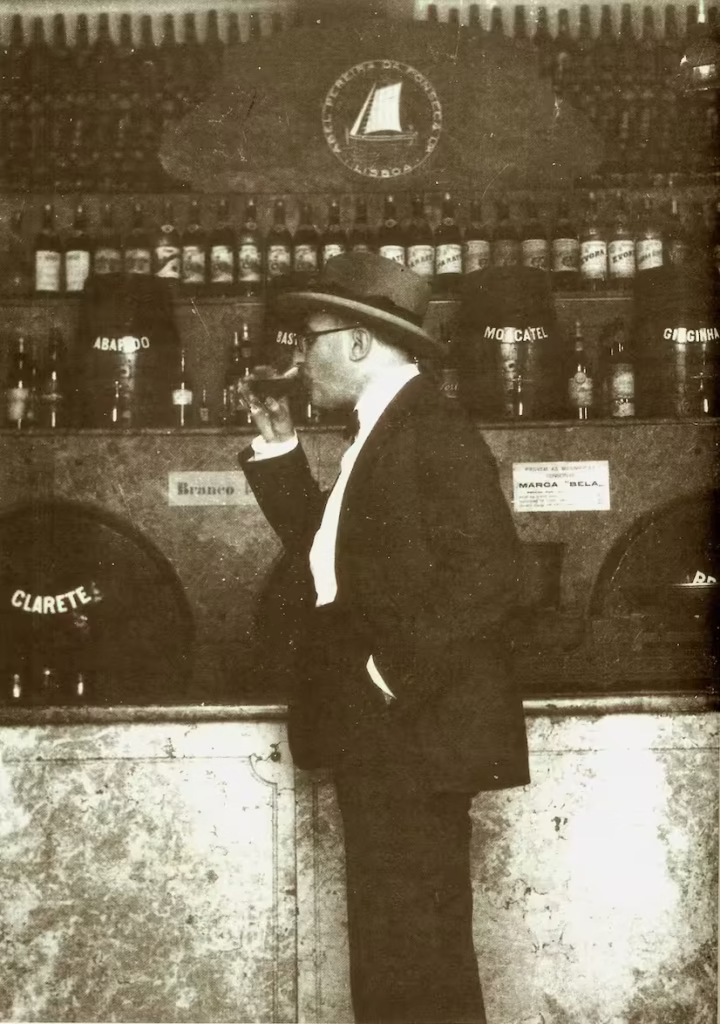
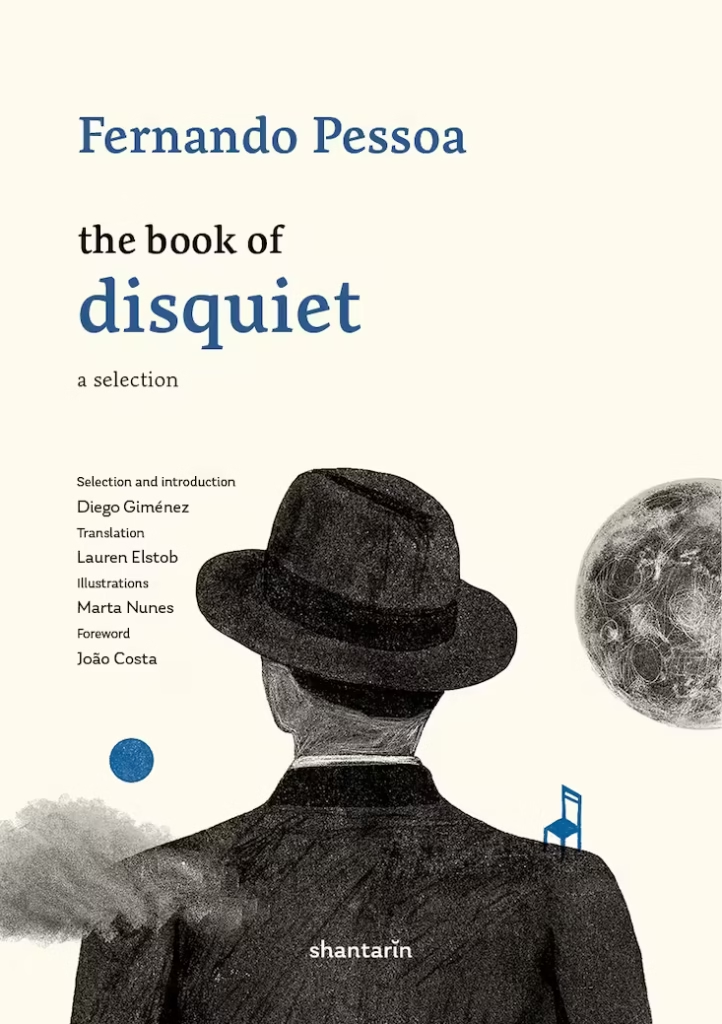
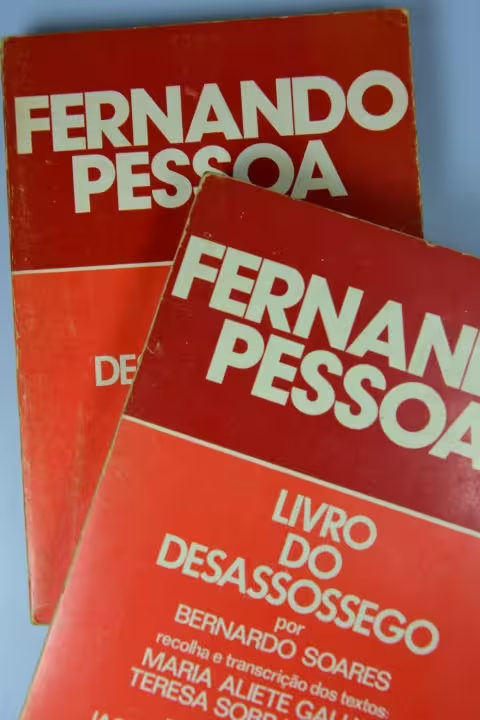
Žarko Paić
Žarko Paić is a Professor at the University of Zagreb, where he teaches courses in Aesthetics and Media Theory. He publishes frequently in philosophy, social sciences, and art theory. His publications include Theorizing Images, eds. with Krešimir Purgar (2016), and Technosphere Vol. 1-5 (2018-2019), White Holes and the Visualization of the Body, (2019), Neoliberalism, Oligarchy and Politics of the Event – At the Ege of Chaos (2020), Aesthetics and the Iconoclasm of Contemporary Art - Pictures Without a World (2021).