

Velázquez and the End of the Representation
Abstract
If we wanted to describe what characterizes the history of painting from the Baroque to the implosion of colors and the loss of perspective in modern art, perhaps we should perform a necessary operation: reduce the image to thought in conceptual matrices. Thus, we would obtain two mutually opposed and, paradoxically, related attempts to talk about the world from the essence of painting in general. Both are formally linked to Spanish painting. The first is the path established by El Greco through the mystical field of divine sublimity, as in Christ’s sacrifice and bodily suffering on the cross. In contrast, the second path aims to create the illusion of pictorial representation within the pure rationality of the so-called referential painting of the aristocratic era in European history, with Diego Velázquez as the leading representative. Two paradigms of the image seem to correspond to paradigms of thought: one that invokes and depicts the unpresentable in the image of the mystery of Christ with the aspiration that the phenomenal world takes on the metaphysical dimension of the rule of the Platonic idea in the world, and the other that shows that only through the mental construction of the world can the highest degree of enlightenment be reached in the image as a perfect aesthetic illusion. The author attempts to arrive at a thesis on the rational mysticism of painting through Ortega y Gasset’s analysis of Velázquez’s painting Las Meninas, which represents the greatest achievement of the concept of representation in the art and aesthetics of the classical era, but also its end in the autopoietic painting of the late avant-garde in the 20th century.
Key words: Rational mysticism, Velázquez, representation, painting, rebirth of the image, sublimity
1.
If we wanted to describe what characterizes the history of painting from the Baroque to the implosion of colors and the loss of perspective in modern art, perhaps we should perform a necessary operation: reduce the image to thought in conceptual matrices. Thus, we would obtain two mutually opposed and, paradoxically, related attempts to tell about the world from the essence of painting in general. Both are formally linked to Spanish painting. The first represents the path established by El Greco through the mystical field of divine sublimity, as in Christ’s sacrifice and bodily suffering on the cross. In contrast, the second path aims to create the illusion of pictorial representation within the pure rationality of the so-called referential painting of the aristocratic era in European history, with Diego Velázquez as the leading representative. Two paradigms of the image seem to correspond to paradigms of thought: one that invokes and depicts the unpresentable in the image of the mystery of Christ with the aspiration that the phenomenal world takes on the metaphysical dimension of the rule of the Platonic idea in the world, and the other that shows that only through the mental construction of the world can the highest degree of enlightenment be reached in the image as a perfect aesthetic illusion.
Metaphorically speaking, El Greco would be Plato here, and Velázquez would be Aristotle, given the essence of the matter in question. Of course, Platonism is no mysticism, just as Aristotelianism is no rationalism. Our conceptual grasp of reality is often a necessary intellectual appropriation that begins with the abstraction and reduction of reality’s complex structure. However, one thing is undeniable. In European painting from the Baroque to modernity, we encounter an obvious opposition between God in the image and man as the subject of rational anthropo-technology. This metaphysical-antimetaphysically, “The War of the Worlds” happens only in the internal “logic” of the art of painting as what is happening: a historical secularization and profanation of the world. However, the question is why, for this depiction of the conflict between the otherworldly and the here-and-now, idea and reality, mysticism and rationality in the downward trajectory of the metaphysics of European nihilism, as Heidegger would say when dealing with Nietzsche, (Martin Heidegger, Nietzsche: Seminare 1937 und 1944, GA, vol. 87, V. Klostermann, Frankfurt am Main, 2004, p. 45), we decided to take painting as a medium of thought, and not literature? The greatest Spanish philosopher of the 20th century, José Ortega y Gasset, offers us an explanation in his essay ” The Rebirth of the Image,” in which he also says this:
“Even Plato emphasized the muteness of the painter. The entire magic of painting is summed up in this duality: the desire for expression and the determination to remain silent. To paint means to decide on muteness firmly, but a muteness that does not mean deprivation or lack. The painter decides on muteness precisely because he wants to express what speech, by itself, can never say. ” (José Ortega y Gasset, “The Rebirth of the Image,” in: The Dehumanization of Art and Other Essays, Litteris, 2007, p. 89. Translated from the Spanish by Dunja Frankol)
Literature, therefore, as well as philosophy, due to its focus on language and speech, seems unable to fully reach that pictorial phantasmagoria with which only the conflict between mysticism and rationality always appears as a conflicting dialogue of the sacred and the mundane. Why is this duality so immersed in the network of all our intellectual efforts in approaching immediacy without any substitute means of conceptualization? The simplest answer would be because both the supersensible and the sensible belong to the same indistinguishable origin of the very thing of thought and Being. The beginning of metaphysics in the Greeks, with Plato, establishes this duality, starting from the mystery of logos as speech that the idea uses to introduce the divine into the apparent splendor of intra-worldly beings. However, language can never encompass the mundaneness of the world itself, just as wisdom must use all intellectual means, from paradox to aporia, to establish, through language, a confidential relationship between the meaning of Being and its appearance in beings, and the essence of the Human. In other words, language fails only insofar as it metaphysically wanders between worlds as a nomadic mission of humans in search of the primordial union of this necessary duality. Language, therefore, speaks through its ineffability, just as the image in its muteness indicates and shows what arises from the essence of thought and Being. In the case of the conflict between the mysticism of the image and its profane rationality, which enchants with the beauty of forms, colors, and figures, the relationship between El Greco and Velázquez represents, for any future consideration of the pictorial turn (iconic turn), the turning point in meaning.
Why? Simply because painting, of all the forms of visual art, is today, in the age of the technosphere, the only remaining skill in the mastery and suffering of the very essence of painting as a metaphysical event of sublimity. When one tries again and again to clarify why painting is inherently riddled with a mystery that has accompanied it since its very beginning, one tries to see how much of that is involved in that which connects the epiphany of the divine in the world with the shattering of the profane production of meaning, for which, with the advent of science and technology since the modern age, there is no longer any room for mystery or any transcendent power of representing the unpresentable. All of this reached its highest point of crystallization in the avant-garde destruction of painting in Malevich’s Suprematism. (See: Žarko Paić, Aesthetics and the Iconoclasm of Contemporary Art – Pictures Without a World, Springer International Publishing, Cham, 2021.)
It seems as if all our fascination with the pictorial possibilities of human cognition of object X comes from something that cannot be conceptualized by speech and narration, although in principle philosophy is not only for Plato, but also for Heidegger and Whitehead, the only spiritual power equal to divine cognition, and the only one in the form of theoriae thatapproaches the ideal of absolute knowledge of being-God-world-man. Ortega y Gasset, however, finds in the essence of the image something that cannot be more sublime than the meaning of Being. Instead, he advocates a semiological solution to this problem.
“The charm of painting lies precisely in its eternal mystery, which we constantly try to decipher, searching for hidden reasons in everything we see, and that is why a multitude of meanings pour out of canvases, wooden panels, drawings, engravings, and frescoes. In a word, the image constantly sends us signs. ” (José Ortega y Gasset, “The Rebirth of the Image,” in: The Dehumanization of Art and Other Essays, p. 91.)
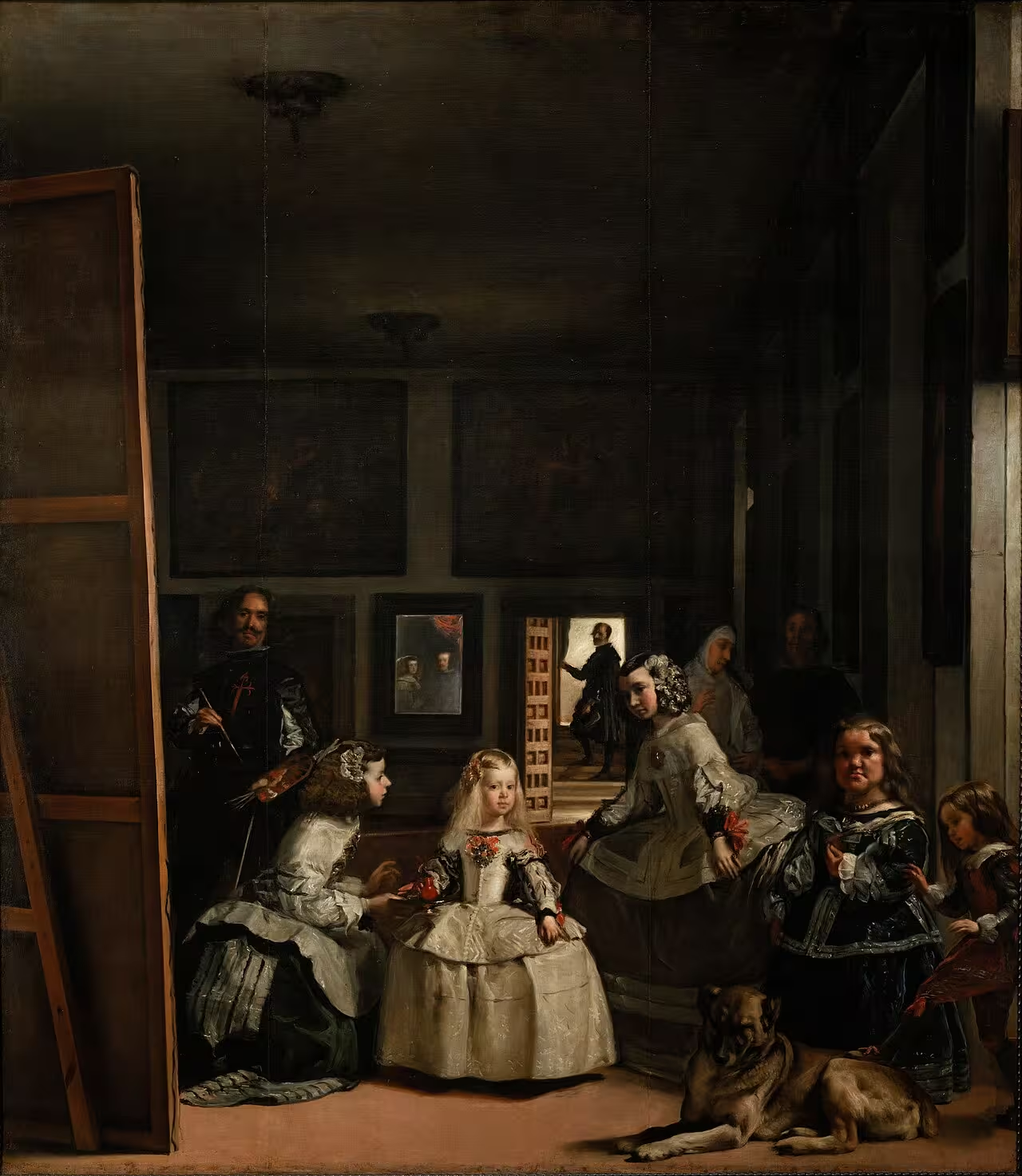
There is something problematic about this quote. Namely, Ortega y Gasset deals in the essay ʺThe Rebirth of the Imageʺ precisely what is the epistemological turning point for the history of European painting. We are talking about Velázquez and his way of painting, which begins with a methodical and rational composition of the space of the image itself and thus brings into play the power of representation, which is no longer a continuation of Greek and scholastic mimesis, but an autonomous field of production of the meaning of the image itself. For that to happen in Las Meninas, the idea of painting as art, rather than merely painting something external as an objective reality, had to lead Velázquez to achievethe highest level of conceptual-categorical reduction of the picture’s meaning. He had to place the picture from the metaphysical space of the “eternal riddle” of the conception of the world into the spatiality of the designation of the world of art as a representation, and not of something as something, but of the very being of art as the being of the picture in general. The most significant and lucid statement on this Velázquez, the ” invention” or, better said, the thought operation of the pure reduction of sense to meaning in Ortega y Gasset’s analysis, is this.
” Painting for painters, for example, the art of Juan Paloma, is not something particularly unusual in an age like ours, which also has physics for physicists, inaccessible to other mortals, law for lawyers (Kelsen), politics for politicians (professional revolutionaries), but we do not know what such a thing could have meant around 1640. Such a significant change cannot be explained simply by the emergence of a new style. Rather, it could be said that the very meaning of what we consider painting has changed… ” (José Ortega y Gasset, “The Rebirth of the Image,” in: The Dehumanization of Art and Other Essays, pp. 108-109.)
Indeed, around 1640, we do not expect the advent of modern art, with its key concept of the autonomy of the work of art, to occur. It is not, therefore, only what the artist thinks in his autonomous creative activity, in contrast to the Greco-Christian idea of art as a mimesis of the mythic-religious image of the world. There is a radical change in the very concept of the work of art. The transcendence becomes immanence, and thus the work becomes its own thing of thought and division, not a mere imitation and service to the divine authority of creative power through beauty and sublimity as fundamental aesthetic categories. The autonomy of the work of art separates the artist from the divine vicar and makes him an autonomous producer of art as a desacralized aesthetic object. (See: Boris Groys, Art Power, The MIT Press, Cambridge, Massachusetts -London, 2008, pp. 93-100.)
But the matter is even more puzzling because Ortega y Gasset largely points to another essential feature of this modernity par excellence. Namely, it is about the concept of indeterminacy as incompleteness. This is what causes that radical change in the very essence of painting, from the non-autonomous mimetic production of meaning to the autonomous production of meaning. Meaning belongs to the metaphysical secret that arises from the mystical nature of Christ’s apparition, appearance, and sacrifice on the cross. It is no coincidence that in the Spanish Baroque, the entire background of El Greco’s symbolic activity in painting is reduced to what Victor I. Stoichita, in his brilliant work The Mystical Eye – Vision and Painting in the Golden Age of Spain, attributes to the “concept of vision or metadiscourse of the imaginary”. (Victor I. Stoichita, Das mystische Auge – Vision und Malerei in Spanien im Goldenen Zeitalter, W. Fink, Munich, 1997, pp. 29–46.)
The issue here cannot be the mutual relationship and dialogue between the two understandings of painting, that of El Greco and that of Velázquez, about the psychological characteristics of the approach to art which necessarily expresses the inexpressible in painting insofar as it is always and only the agony and suffering of the bodily exaltation of Christ or, on the other hand, the splendor and luxury of the high class of the Spanish aristocracy in their frozen moment, which speaks more about the collective narcissism of that so-called golden age than about the power of social representation in the hierarchical order of government. The problem is that the upheaval or change in the very essence of painting began as an aesthetic revolution in the 17th century. This upheaval, as the early Michel Foucault showed, will fundamentally change the concept of science and power, introducing what he calls episteme into modernity as the true sign, meaning, and signified of the end of man. (Michel Foucault, The Order of Things: An Archeology of the Human Sciences, Vintage Books, New York, 1994)
How much did Foucault himself contribute to Velázquez’s famous painting Las Meninas from 1656? established as a breakthrough image for understanding what belongs to the essence of modernity does not need to be emphasized. It is enough to say that, with this image, this way of understanding, painting enters the center of what Foucault calls mathesis and taxonomy. What does this mean other than that modern painting, in accordance with the universal idea of the autonomy and incompleteness of the work as such, is first and foremost an attempt to establish order as an order of thought based on a system of signs. When Ortega y Gasset claims that painting emanates its own enigma. It is no longer a metaphysical mystery requiring the mystical eye of a visionary. Still, it is rooted in the way of articulating a new kind of knowledge we call the order of representation. Instead of mystics and visionaries who grasp the presence of God in the painting by intuition, as St. Teresa of Avila or St. John of the Cross did, the twist is that the new order of knowledge now requires a hermetic doctrine of the knowers, based on mathesis and the taxonomy of complete rationality. Painting for painters, as Velázquez and especially his paintings from the period to which the paradigmatic Las Meninas belongs, shows us that the great work of secularizing thought in the modern age denotes simultaneously the creation of an empty sacred place at the very core of what remains of painting’s metaphysical mystery. What remains is the second fundamental concept of modern aesthetics ꟷ sublimity (Erhabenheit).
2.
Let us return for a moment to Ortega y Gasset’s reflections from the essay ” The Revival of the Image. ” It is clear that any change that radically alters the essence of art must have far-reaching significance for painting and for the concept of the image in general. Beyond both language and image lies the metalinguistic and meta-pictorial. It is something disturbing and uncanny that belongs to the essence of art. There is no doubt that this should be creativity understood metaphysically, in the sense of mimesis, as creatio ex nihilo,by which God creates this world and humans in it as his vicegerent on earth. However, creation cannot be only a theological act of founding art in something that art makes possible at all, but also an autonomous field of producing new worlds, as the Greeks denoted by the term poiesis. Therefore, when style changes in the so-called historical epochs of art, in this case, the style of the Spanish Baroque, we encounter a radical reversal in the very essence of the image. It is not at all unusual that what Foucault attributed to the so-called classicism in his genealogical studies on the emergence of modernity in the West belongs to the conceptual-categorical framework of rationalism.
A thought that no longer thinks in a way that describes and depicts the already existing real order of the mythical or religious picture of the world rests on mathesis. universalis. In the 17th century, Velázquez undoubtedly created the conditions for painting to become an autonomous act by the artist as a producer of the new, a construction, with his painting Las Meninas. Hence, the painting born with the emergence of modernity is always a representation of what is, admittedly, posited as reality by the observer’s illusion. Still, at the same time, this and such reality becomes the true reality of scientific and technical mathesis and taxonomy. Ortega y Gasset, in his reflective narration, explains that “painting for painters “, with which expression we try to encompass the essence of Velázquez’s intervention in European painting, can be nothing other than that which evokes in the observer “calm and a certain indifference”. (José Ortega y Gasset, “The Rebirth of the Image”, in The Dehumanization of Art and Other Essays, p. 113.)
What disturbs us even more in all this is that, apparently, the artist’s own lifestyle is responsible for this, not at all extravagant, not at all heroic, not even bohemian, not at all prone to excesses. It is as if he lacked that raw, Dionysian strength and desire for scandal, and Ortega y Gasset ironically adds that precisely those observers foster such an attitude.
“Who demands that the painting flatter them or merely pretends to care so much about them that it must immediately pounce on them or at least perform some circus act by writing in front of them, as good old El Greco does. But art historians, people by the nature of their profession necessarily sensitive to such things, must have encountered behind this calmness and detachment a hinterland of a completely different appearance, fierce, tough, merciless, and infinitely sublime and closed, such as does not exist, as far as I know, in any painter in the entire history of art.” (José Ortega y Gasset, “The Rebirth of the Image,” in: The Dehumanization of Art and Other Essays, pp. 114-115.)
So here we are in trouble. Because if what the Spanish philosopher of life says in a measuredly elegant way and from the perspective of thinking about the essence of modernity as an inevitable process of losing the human in art with the arrival of an era in which technology rules over man in all aspects of appearance is correct, then we can no longer consider the duality between the sacred and the secular, mysticism and rationality, as something irreconcilable as such.
Quite the opposite: in the 17th century, which Stoichita, in turn, calls the golden age of Spanish painting, we see the birth of a classical epoch of thought. For its image, it has precisely the union of the divine and the human as a mirror image of mathesis and the taxonomy of the sublime. To be ahead of one’s time, which of course applies to Velázquez and not to El Greco, means to have the possibility of viewing the entire history of painting from the perspective of that understanding of the image that no longer arises from the mystical eye of God’s omniscience, but from the union of the imaginative-representational power of human creativity in which construction precedes natural perception. Although, of course, Velázquez himself is known as a painter of so-called religious motifs, just like El Greco, in him the mystical, the divine as an epiphany and as the sacrifice of Christ on the cross is mediated by the knowledge that the image in which the image of God is depicted is always and only just an image, and not the living presence of God as the condition of possibility of all living religiosity. The sacred, therefore, demands its place in the image as representation, not in iconophilia with the overtones of the mysterious event of Christ’s transubstantiation. The image that gives Classicism, or the Golden Age of Spain, its paradigmatic power to create the illusion of the gaze becomes the one with which Velázquez reconciles the representable and the unrepresentable as such. In other words, instead of the mystical sublimity that comes from the eye of God and requires the ecstatic body of the observer as its witness to that which transcends the power of language to tell of the event, the sublimity is now conditionally “rationalized,” becoming an uncanny calm and indifference. But what – the painting itself, the observer, or the painter who created this painting?
In one place in his Diaries, the great modern painter Paul Klee says that objects now perceive him. Changing the perspective of the gaze, therefore, requires entering into the very way of representing the object of the gaze, which is in a complex network of interactions. In the painting Las Meninas, what Klee claims is undoubtedly at stake. But with the difference that the figures in the painting are those who observe the author of the painting and thus contribute to the demystification of the very idea of representation. The Baroque painter Luca Giordano called this painting a “theology of painting”, and Sir Thomas Lawrence added in the 19th century that the painting represents the pinnacle of the ” philosophy of art”. Here, we do not intend to address the iconographic structure of Las Meninas. Nor is it our aim to promote Velázquez as the originator of the already-mentioned direction in thinking about painting at the end of the 20th century, known as the iconic turn. (See: Žarko Paić, Art and the Technosphere – The Platforms of Strings, Cambridge Scholars Publishing, Newcastle upon Tyne, 2022.)
In contrast, the instruction on ” a painter for painters” or “a painter of the idea of painting” presupposes an attempt to understand what this radical change in the essence of art truly signifies, which with Velázquez, instead of iconographic fidelity to language as a Christocentric referential framework of religious or sacred painting, has become an autonomous field of emanation of a multitude of hidden meanings. The entire historical framework of metaphysics is thus turned and inverted. Instead of the divine picture of the world, we encounter a new rational mysticism of sublimity from which the blinding brilliance of the torment and suffering of Christ’s body in the sacrificial crucifixion on the cross no longer shines. Still, a new table of meanings emerges, connecting mathesis and the taxonomy of sublimity without sacrifice. This process represents a historical-epochal emancipation of art from myth and religion, even when, as in the case of Velázquez, the scene in his painting The Vision of St. John of Patmos from 1618 perfectly coincides with what Ortega y Gasset meant by calmness and indifference.
There is something else extremely interesting in his analysis of Velázquez’s innovative solutions, not only in this emblematic painting of classicism. When the view of the painting is repositioned, then the imaginary protagonists of the narrative in the painting, such as St. John of Patmos, Mary Magdalene, Christ on the cross, his disciples and all other figures from the referential framework of the Old and New Testaments, are not replaced by aristocratic calmness and indifference in the figures of court infantas, courtiers, princesses and princes. In El Greco’s paintings, we had the gazes of mystics and visionaries into the heights, and the ecstatic suffering of the body, with a gaze full of despair and anxiety. This gaze opens the possibility of confronting the sublimity of the unpresentable as such. Velázquez amazes precisely by filling the empty place of the sacred with a mirror image of a dramatically created representation. For the first time, the era of mastery truly emerges as a union of rationality, technique, and sublimity that does not arise from the experience of the divine, nor from the apology of omniscience, but from the event of the interaction of the painter and the gaze of the figures who perceive him in the painting.
For the first time, therefore, mastery does not refer to the natural art of constructing a painting from the openness of the eye in the image of mystics and saints. Now, in this vacated place, the emptiness of the world’s worldliness comes through the images of the ruling aristocratic class, family portraits, and the bourgeois drama of collective existence in modern society. The painting depicts a representational event of the world’s complete profanation and de-substantialization, beginning with the essence of modern art: autonomy and indeterminacy. Ortega y Gasset, in his distinctive style as a philosophical semiologist of life, shows the consequences of this turn from painting the suffering of a sublime body to the mastery of painting as a sublime complex of rational mysticism of the image that becomes a representational event.
“The painter’s fingers,” says Bellini, an Italian writer from the same 17th century, “are pensosa, the thinking fingers, the fingers that think and in which the entire charge of one’s existence is summed up, like in the switch of a dynamo machine before the spark is about to flash. And this is precisely what we need to revive, to see again how it happens, acts and comes into being, so that we can claim to see the brushstroke truly. ` (José Ortega y Gasset, “The Rebirth of the Image” in The Dehumanization of Art and Other Essays, p. 117.)
Mastery signifies the mediation between the inspiration of genius and the technical skill required to construct the painting itself. Everything is interconnected without the correlation of this mental grasp and what the body experiences in the rapture and indifference of its movement, the meaning of painting, not only figuration, but also abstraction, and the destruction- deconstruction of the painting itself, cannot be found. The entire 20th century unfolds through the process of dissolution and disembodiment of the medium of painting, which, as we see, began in the 17th century with Velázquez. The same applies to Pablo Picasso and Francis Bacon. The thesis about the painter’s mental fingers is identical to what Gilles Deleuze says of film directors: yes, they think in images, and instead of an easel and a brush, they use a film camera. (Gilles Deleuze, Cinema 1: The Movement-Image, University of Minnesota Press, Minneapolis, 1986, “Preface”)
Thinking cannot be the prerogative of philosophers who think conceptually, nor of artists who intuitively think in their medium of expression. That is why Ortega y Gasset can rightly speak of thinking that arises from the body rather than from a speculative core of thought resembling divine self-consciousness. However, what seems most important for our consideration here is the possibility of this mystery of the image’s rebirth. How, then, is it at all possible that an image from distant times, which may even be completely uncontemporary because they do not mean much to us for understanding the problems of art and the technosphere in the 21st century when everything is heading towards dematerialization and the transformation of man into a thinking machine or artificial intelligence, constantly suggests hidden signs and secret meanings? In the other direction, how is it possible for an image to transcend its historical-epochal rootedness in space and time?
We will approach the answer to this question indirectly. First, we will try to see if the same applies to language, or rather, to narration in philosophy and art. The Greeks, from Anaximander to Plato, saw the essence of things in general in the essence of the original as the primordial. The difference from our contemporaries is that, for them, the past was closely connected with the present to the extent that the future was, of all the ecstasies of time, the only fulfillment of time as a living past. It is therefore no coincidence that the understanding of being among the pre-Socratic thinkers relates to that which signifies the primordial first beginning, which is at the same time initial and founding as the One-All ‒ arché. Without a relationship with the origin of Being, it is impossible to think of its growth, development, and end. However, what has its end in the singularity of being is not the factual end of Being, because everything moves, and nature (physis), as a model for understanding Being, has neither beginning nor end in the cosmic sense. Hence, the original language of mythical tradition is also the original image of the harmony of time in the ecstasies of being, presence, and future. (Martin Heidegger, Über den Anfang, GA, vol. 70, V. Klostermann, Frankfurt am Main, 2005)
The one who developed this most penetratingly in contemporary thought is Martin Heidegger, starting with his major work Being and Time (Sein und Zeit), to his last writings, lectures, and notes in the late 1960s, when he turned to the reflection on the art of painting in the works of Paul Cézanne and Paul Klee. (Martin Heidegger, “Zur Frage nach der Kunst”, in: GA, vol. 74, Zum Wesen der Sprache und der Kunst, V. Klostermann, Frankfurt am Main, 2010, pp. 193–195) What does this tell us about the idea of the pictorial turn at the end of Western metaphysics? Nothing other than that the primordial and original in the understanding of the relationship between language and image cannot be reduced to some predetermined signifier. Throughout the history of metaphysical thought, language has had the task of establishing logos as the fundamental signifier, so everything else could only be what belongs to the a- logos, in one way or another co- belonging to it, but of a lower rank. After all, in Hegel, as in Plato, art is on a lower level than religion, because the rank stems from the idea that belongs to philosophy, and not from the feeling with which we directly experience the pain, suffering, and joy of the world.
Thus, the divine epiphany of the early Greeks was always accompanied by bodily ecstasy and the frenzy of those who foretold the future in signs of the hermetic revelation of fate. Image, despite being closest to the essence of apparent visibility, was considered a deceptive illusion, and language alone could tell the truth of being, even though, as Ludwig Wittgenstein best reflected, its ” essence ” was in showing things, and not in expressing the eternal truths of the logical foundation of the world. (Ludwig Wittgenstein, Philosophical Investigations, Basil Blackwell, New York, 1958)
When we have all this in mind, it is easy to see that both language and image cannot be destroyed in time, except by “sucking ” them into themselves, like Duchamp’s ready-made. The bottle dryer stands at the foundation of modernity in the age of the technosphere. It is the logic of numbers as the symbolic rule of the law of quantification and computation, with which thinking as computation begins, and on which rests the infinite power of transforming information into an event. Artificial intelligence, therefore, necessarily transforms language and image into numbers.
Counting down as a calculation determines the limits of language and image, and time flows irreversibly from the whole of the ecstasy of past-present-future as a homogeneous eternal present of moments ( nunc stans ). Yes, the original flows through time, and the greater the emptiness of this empty time of technically constructed reality, the greater the need of us today for the mystical secret of sublimity, as well as for the rational mysticism of the image that has transformed the divine as sacred into the secular play of the mirror image of time. The problem, however, is that painting that responds to the challenge of time denotes the reign of number as absolute in the form of the technosphere, already always late,as, after all, language, which FriedrichHölderlin sang about beautifully in his elegies.
3.
Spanish Baroque painting was obsessively focused on conveying God’s presence in the image, seeking the possibilities of the “spiritual eye”. Moreover, this activity was considered a prerequisite for combining the mystical concept of holiness with the corporeality of human existence. The saint does not just live a different way of life from ordinary mortals. He sees things completely differently. The mystical view of God also requires a different language from the usual narration (logos, ratio). At the beginning of his book entitled The Mystical Eye: Vision and Painting in Golden Age Spain, about that exceptional event in the pictorial art of 16th and 17th century Spain with magnificent works and El Greco as a paradigmatic painter, the art historian Victor I. Stoichita reaches for an explanation of the term/word visio in St. Thomas Aquinas in the “Introduction”. According to his understanding, it has two meanings: (1) the perception of an object by means of the eye as the sensory organ of vision and (2) the internal perception by means of the mind or imagination (cognitio et imaginatio). For Stoichita, on the other hand, this is the beginning of what he calls “meta-pictoriality”. In this, the religious problem of the image is permeated with the cognitive-theoretical one. (Victor I. Stoichita, Das mystische Auge: Vision und Malerei im Spanien des Goldenen Zeitalters, W. Fink, Munich, 1997, pp. 9-12.)
Namely, in the golden age of Spanish painting, painting begins with a search for the immediacy of experience, overcoming the gap between what is seen with the senses and what arises from the supersensibility of experience. There is no doubt that so-called religious painting from the Middle Ages to the period of high modernity in the 19th century is nothing other than “Platonism by other means”, to use Nietzsche’s formula for the essence of Christianity. However, this painting is not so “innocent ” in the sense that it lacks divine inspiration behind its magnificent achievements. It is almost in the same way as Velázquez’s innovation in Las Meninas the result of a deeper connection between the two ꟷ poiesis and téchne, speaking in Greek terms for the essence of art, i.e. creatio and imaginatio, since painting, since the High Middle Ages, no longer becomes an imitation of the original in the sense of mimesis as a copy, but in the sense of a creative vision of what only the human imagination of production can bring into reality. We see that the task of painting, as a religious way of attaining the sublimity of God’s existence in human form, is much more than merely delineating what is already always present in the canonized works of the Old and New Testaments.
To come to terms with the pictorial turn at the outcome of Western metaphysics, which is crucial for modernity under the sign of the rule of the digital image immersed in the virtual reality of numbers, it seems necessary to see how and why the secularization of mysticism in classicism also occurs as a change in the essence of the concept of the sublime. Without this, it would not be possible to understand the emergence of this concept in Spanish Baroque painting, nor its adoption in the completely changed context of postmodern pictorial art at the end of the 20th century. The sublime, namely, is not beauty raised to a higher potency as purposelessness without purpose, if we remain at the level of Kant’s definition from the Critique of Judgment, but rather that which cannot be grasped either by a concept or by the means of language. The sublime is the ineffability that arises from the relationship between the divine and the world in the appearance of beauty itself as the beginning of the uncanny (Unheimliche), as the poet Rainer Maria Rilke would say in The Devin Elegies. (Žarko Paić, “Rilke’s Testament: Nihilism as Unheimlichkeit – Notes on the Devin Elegies“, in Nihilism and Contemporaneity ꟷ In Nietzsche’s Footsteps, Litteris, Zagreb, 2021, pp. 385-430.)
The essence of sublimity must therefore be able to appear as it depicts the inrepresentability that Jean-François Lyotard speaks of when he tries to show that only this concept from Kant’s aesthetics can still preserve a way of thinking from the history of metaphysics that could eventually approach what is already inhuman in itself, which is modern technology based on information and communication networks of image mediation. (Jean-François Lyotard, Le différend, Minuit, Paris, 1983; Jean-François Lyotard, “Newman: The Instant” and “The Sublime and the Avant-Garde” in The Inhuman: Reflections on Time, Polity Press, Oxford, 1991, pp. 78-88, 89-107.) See on this: Žarko Paić, “The Politics of the Aesthetic Turn: Lyotard’s Thought Between Project and Program”, in: The Third Land: Technosphere and Art, pp. 261-302)
The sublime, therefore, is meta-linguistic and meta-pictorial, and, as such, it is only indirectly possible to reveal it through language and image, in appearance, through the signs of its silent and iconoclastic presence. If for Kant the sublime lies on the border of the conceptual and the non-conceptual because it arises from the mysticism of divine epiphany, then it seems completely understandable why its borderline is placed in the area of what is indefinite and ineffable, like the mystery of the metaphysical transition from the world of ideas to appearance, as in the case of Christ’s mystery of incarnation and disembodiment. In the encounter with the sublime, human cognition loses its rational dimension and falls into the realm of mystical indication of what is visible only to the chosen ones. What remains of this secret, which Stoichita, dealing with El Greco and other Spanish painters oriented towards the divine, considers, is nothing other than the play of the spiritual eye in the light and darkness of an exceptional moment (kairos). Namely, the contact between man and the divine denotes a mystical experience that transcends confinement in the temporal structure of eternal permanence and immutability. Sublimity appears like a lightning strike, so it is not surprising that such a moment is sought to be preserved in memory as something forever present and therefore stored. Memory always denotes the unconscious automatism of dreams and perceptual moments, and it belongs to what we call the archive of history, preserved from destruction over time by the collective matrix of mediation in technical devices such as books, art galleries, treasuries, museums, and files.
What, then, would be the fundamental problem of painting if not the problem of time? Neither in the religious painting of the Spanish Baroque, nor in the beginnings of modernity with Velázquez as the paradigmatic artist of the combination of poiesis and téchne as creatio and imaginatio we see nothing but the magic of the fingers of thought that transcend the secret of language only because the sublimity needs the inexpressible in the presentable the inexpressibility of that beauty which leads the spiritual eye into the realm of bodily suffering. It cannot be important whether this suffering arises from the pain of singularity and individuation through the act of birth or is the result of the drama of Being. It seems to be as necessary for painting as death.
The entire history of metaphysics in painting represents the history of suffering and death elevated to a sublimity that opens a new horizon in the transition between the sacred and the profane. That should be a reason why the metaphysics of painting is marked by transgression.
Painters like El Greco and Diego Velázquez constantly cross the boundaries of these entrenched dualities between the divine and the human, between religion and art, between imagination and the technique of painting, the painting itself as an event that connects eternity and temporality in points, surfaces, and colors. But there is something else that makes the sublime a much more dramatic act of aesthetic experience that seems to have disappeared from the structure of contemporary art. This is nothing other than the original act of art’s emergence in cult and ritual. It is about sacrifice and victim. There is no sublime without the suffering of the body as a metaphysical experience of the pain of life itself. This is what will no longer be the subject of Velázquez’s painting of serene calm and indifference. But it will be the permanent atmosphere of the composition of the painting for El Greco and the idea of the embodied logos that appears to man in its mystical transubstantiation as a sign of his sacrificial destiny. Sacrifice is always a matter of mimesis, as Jean-Luc Nancy has put it, because it takes place within the natural cycle of thebirth and death of beings. (Jean-Luc Nancy, ʺ Unsacrificeable ʺ, Yale French Studies, No. 79/1991, pp. 20-38)
The time of sacrifice and victim belongs to the mythic-religious environment of the painting. However, all this will change when the scientific-technical construction of the world “rationalizes ” the mysticism of life and reduces it to the remnant of the metaphysical experience of suffering and pain in bodily existence. Indeed, Las Meninas, with which Velázquez opens the door to the modern way of understanding painting as a mirror of a psycho-social event from which the drama of Being has disappeared and in its place has been replaced by the emptiness of iconoclasm in the form of a multitude of so-called styles of the historical avant-garde from cubism, futurism to dadaism, with the sole exception of surrealism with the greatest painters of the 20th century such as Picasso and Dalí, represents the true beginning and end of every possible representation. Why? Because it is about the rational mysticism of the idea of painting as a mastery of the representable, the irrepresentability of the image itself, not the living presence of its characters and figures.
The image becomes, therefore, more important than life, and art becomes the supreme illusion of its contemporary emptiness in the indeterminacy of all existing features of human beings. When the image, in its visual transparency of life, exiles language to an exile, to a desert island, or to an endless desert, everything becomes pure indifference as a sublimity without sacrifice. Even the body of human suffering is no longer worthy of a picture. What remains of all is the painting of sand resembling desert dunes, like the late Francis Bacon, or the painting of the gruesome gas chamber for the extermination of Jews in Auschwitz, like in the painting by Luc Tuymans, pure iconoclasm of nature and the monstrous technology of death at the end of what we call history. Ortega y Gasset saw this clearly when, instead of summing up the mystical narration of meaning, he viewed the time of the image from the perspective of painting’s signs and meanings. It no longer emanates any higher meaning because it lacks the referential framework of myth and religion that enabled it to do so.
What it does have encompasses a system of signs into infinity, a whole open sea of meaning after a pictorial turn with a horizon on which traces of a different eternity can be discerned from that with which, in the golden age of Spanish painting, it was still possible to observe visions of pure sublimity with a spiritual eye, without fear of falling into the technical abyss of indifference. Signs are signposts to a possible different history of painting and to a possible different vision of art, no matter how much this seems like a perfect illusion to our age, tired of itself.
Bibliography
Gilles Deleuze, Cinema 1: The Movement-Image, University of Minnesota Press, Minneapolis, 1986
Michel Foucault, The Order of Things: An Archeology of the Human Sciences, Vintage Books, New York, 1994
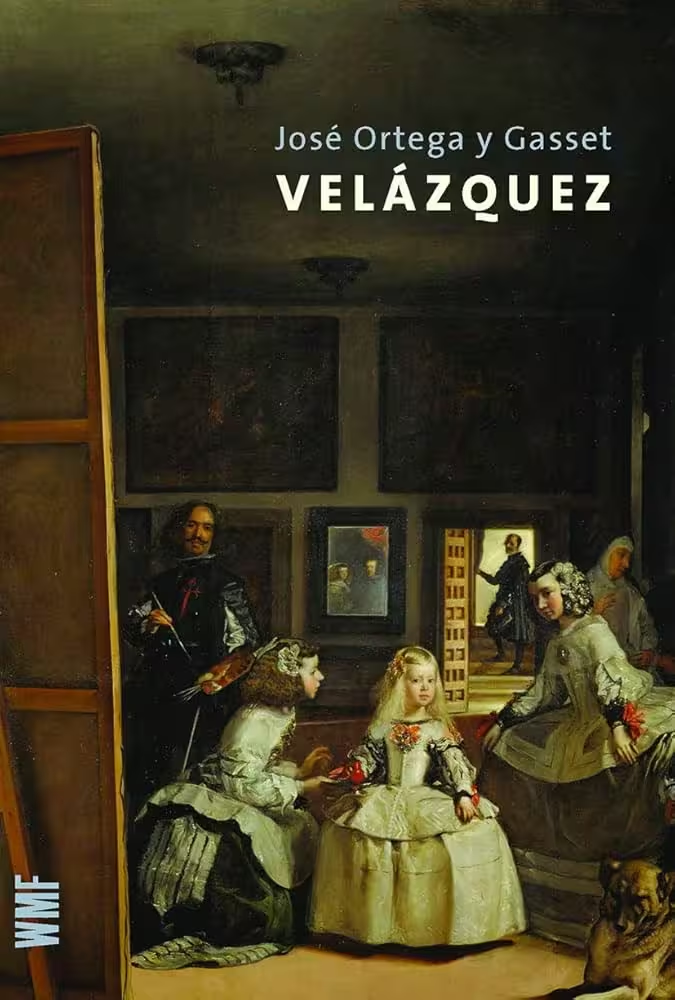
José Ortega y Gasset, “The Rebirth of the Image,” in: The Dehumanization of Art and Other Essays, Litteris, 2007 (Translated from the Spanish by Dunja Frankol)
Boris Groys, Art Power, The MIT Press, Cambridge, Massachusetts -London, 2008
Martin Heidegger, Nietzsche: Seminare 1937 und 1944, GA, vol. 87, V. Klostermann, Frankfurt am Main, 2004
Martin Heidegger, Über den Anfang, GA, vol. 70, V. Klostermann, Frankfurt am Main, 2005
Martin Heidegger, “Zur Frage nach der Kunst”, in: GA, vol. 74, Zum Wesen der Sprache und der Kunst, V. Klostermann, Frankfurt am Main, 2010
Jean-François Lyotard, Le différend, Minuit, Paris, 1983
Jean-François Lyotard, The Inhuman: Reflections on Time, Polity Press, Oxford, 1991
Jean-Luc Nancy, ʺ Unsacrificeable ʺ, Yale French Studies, No. 79/1991, pp. 20-38
Žarko Paić, The Third Land: Technosphere and Art, Litteris, Zagreb, 2014.
Žarko Paić, Nihilism and Contemporaneity ꟷ In Nietzsche’s Footsteps, Litteris, Zagreb, 2021
Žarko Paić, Aesthetics and the Iconoclasm of Contemporary Art – Pictures Without a World, Springer International Publishing, Cham, 2021
Žarko Paić, Art and the Technosphere – The Platforms of Strings, Cambridge Scholars Publishing, Newcastle upon Tyne, 2022
Victor I. Stoichita, Das mystische Auge: Vision und Malerei im Spanien des Goldenen Zeitalters, W. Fink, Munich, 1997
Ludwig Wittgenstein, Philosophical Investigations, Basil Blackwell, New York, 1958

Žarko Paić
Žarko Paić is a Professor at the University of Zagreb, where he teaches courses in Aesthetics and Media Theory. He publishes frequently in philosophy, social sciences, and art theory. His publications include Theorizing Images, eds. with Krešimir Purgar (2016), and Technosphere Vol. 1-5 (2018-2019), White Holes and the Visualization of the Body, (2019), Neoliberalism, Oligarchy and Politics of the Event – At the Ege of Chaos (2020), Aesthetics and the Iconoclasm of Contemporary Art - Pictures Without a World (2021).