

1. A synthetic form of chaos or about the contemporary novel
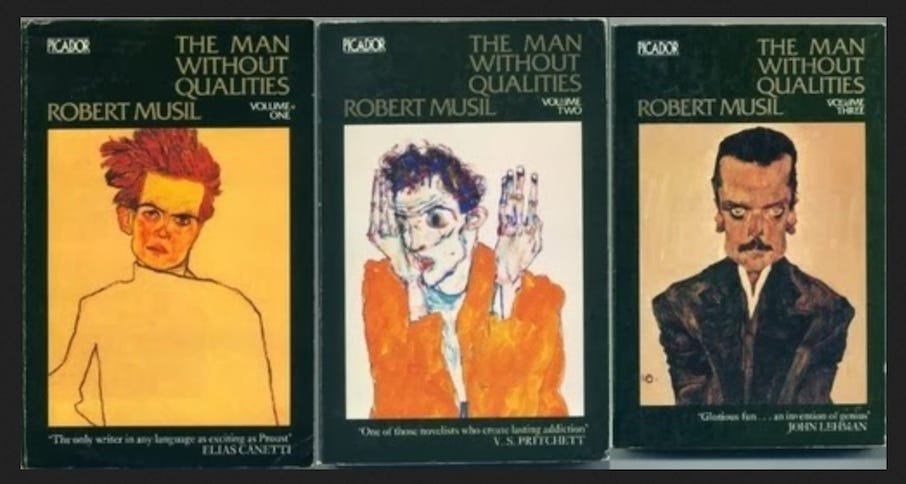
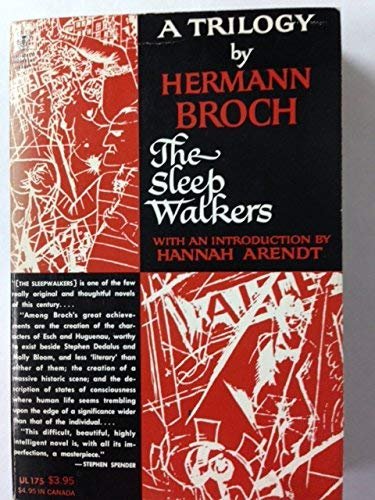
When did this process of uniting all the separate forms of discourse and literary narration that flow into the turbulent and swirling confluence of the contemporary novel begin? Reading paradigmatic novels of early modernist ideas such as Broch’s Sleepwalkers and Musil’s Man Without Qualities is not difficult to discern the common feature of this process, which seems to carry within itself the determination of a synthetic form of chaos in the paradoxical aspiration of reaching a new mythology or a new absolute that, from the essence of art, will rival the triumph of modern science as a driver of technological progress.
It is about the fusion of poetry and prose through the highest reflexive moment of literary mediation, which has been established since Montaigne in the form of the essay. However, the beginning of this process of synthesizing all previous forms of narration known from classical antiquity through Hellenism, the Middle Ages and Enlightenment modernity appears decisively with the German Romantic movement in 1800, a turning point in the entry into the era of capitalist modernity, which have been characterized by the ambiguity of the concept of rationalization as congenially understood by the founding father of sociology as a social science, Max Weber: (1) as enchantment and (2) as disenchantment of the world.
The most important Romantic thinker besides Novalis, the philosopher and writer Friedrich Schlegel, says the following about this in his “Paris- Cologne Lectures of 1803/1804”:
„The novel is the most original, the most distinctive, the most perfect form of romantic poetry, which differs from the old, classical one, where the genders are strictly separated, precisely through this mixing of all forms.” (Fr. Schlegel, History of European literature (Paris- Cologne lecture 1803, 04), KSA, vol. XI, p. 160.
Romanticism also appears in Hermann Broch’s essays on the spirit of modernity as the starting point for the historical avant-garde’s efforts in the first half of the 20th century to reconcile the irreconcilable: art and life. However, while romanticism requires the creation of a “new mythology” or the construction of a “new God” that will enable art to free itself from the yoke of its own unreasonable freedom, which nothing else can solve except aesthetic autonomy, hence the fatal separation of aesthetics and ethics, which is why Broch himself, in the novel Sleepwalkers and perhaps even more so in the experimental novel The Death of Virgil, agrees with the writer’s ethical imperative against all romantic “aestheticization of life”, for the avant-garde there follows an inevitable fall into the abyss of the politicization of the world by agreeing with revolutionary communist movements.
Mythology and revolution are by no means separate spiritual-political categories connecting the ancient and modern eras; they are linked by an idea that extends beyond the autonomous sphere of art. This idea cannot be nothing other than a celebration as an event of the divine entering the world, first as a return to the sources of the sacred, and second as a secular-profane realization of this sacredness in the new social conditions of radical secularization that ideologically began with the French Revolution and Robespierre’s proclamation of an atheistic new religion as a cult of liberation from the total enchantment by the evil demons of the past. Modernity, therefore, appears as a process of revolutionary disenchantment with reality itself as life in the social conditions of techno-capitalism. However, every disenchantment with the mythical is at the same time a new enchantment that, instead of gods and God (polytheism and monotheism), embraces a substitute deity of ideology and politics, or the hypnotic action of mechanical technology, and, in the 21st century, the digital technosphere.
If we return to Schlegel’s account of the novel, we see that his premise has far-reaching implications. The synthesis of everything that was separated in the classical era, as the Brothers Grimm would say, “when wanting was still a tool”, certainly presupposes that the emergence of a new literary form such as the novel is no longer something both indifferent and indifferent to the ethical-political reality of the modern world. And this means that diagnosing the novel’s situation in the Romantic era primarily requires “faith” in the salvific power of a “new mythology” that will make possible the synthesis of the primordial and the modern. In other words, this aesthetic or poetic messianism “believes” that synthesis is progress towards the coming future, not reflected in the technical perfection of objects in the surrounding world, but in the necessary spiritual change of the human being from his fundamental freedom as an ontological event par excellence.
What does Romanticism, and Schlegel in particular, “believe” in when he speaks of the novelty of the novel as a synthetic form of literature that connects all other genres, but in such a way that poetry is the ruling arché or principle of articulation of all possible paths of this synthesis? Is it the novel as a “new order” ꟷ or? Here we propose a stunning answer, simply fascinating in its definition of the contemporary novel’s essence, drawing on the tradition of the novel of ideas and the paradigmatic works of Hermann Broch and Robert Musil. The German literary theorist Monika Schmitz-Emans, an expert on Romanticism, especially Schlegel and Novalis, says the following about this in her contribution “The Novel and its Conception in German Romanticism” (Tvrđa, No. 1-2/2025, p. 147, translated from German by Boris Perić):
“In his ‘Literary Notes,’ Schlegel even calls the novel ‘formed artificial chaos’ and emphasizes: ‘What should be considered essential in the novel is the chaotic form. “Goethe, of course, would not have gone that far.”
In this dispute, we will not discuss the reason why Schlegel’s idea of the novel in Romanticism denotes merely his “utopian fantasy” or perhaps a prophetic credo of what will come not only in the 20th century with the reach of the novel of ideas, but primarily in the 21st century when the novel quantitatively experiences its unimagined flowering, just like music in all aspects of its global reach to the listener. It is not just a matter of mentioning the following. Namely, according to some interpreters of Romanticism, Schlegel advocated a new kind of “absolute” that opened the possibility of a poetic-philosophical synthesis of feeling and reason beyond any Kantian metaphysics of reason. When the “absolute” cannot be in the Hegelian sense of the unity of substance and subject, and the “novel” as a modern form of depicting and presenting reality in the medium of narration coincide, then something extremely challenging for further analysis occurs: the possibility of establishing something that could be said, in Schlegel’s terms, to meet the requirements of the “absolute novel”.
This, of course, becomes a complete impossibility of reaching eternity from the essence of Romanticism as a “new mythology,” in the sign of a different understanding of both the absolute and the novel. For, if Schlegel “believes” in the power of the messianic event of the novelistic consciousness, starting from the founding power of poetry, then it is contradictory and aporetic to speak of “chaos” and “chaotic form”. There must be some premonition or hint that the novel strives for the establishment of a “new order”. However, it is obvious that Romanticism, in its reversal of the essence of modern metaphysics and in particular the concept of mind as a synthesis of reflection and speculation, modeled on Fichte’s “science of the transcendental Self “, places it more in the realm of what is not logical consistency, but rather an intuitive aesthetic cognition of the “absolute” which consequently elevates art itself and its forms of narration to the throne of the “new absolute”. Hence, Schlegel’s entire theory of the novel becomes, conditionally speaking, an inconsistent process of the aesthetic absolutization of that which ultimately cannot attain a “new order” and therefore remains in the zone of „new chaos”. For the concept of chaos is certainly no longer that of the era of classical art and mythology among the Greeks, but rather one that appears as a prelude to all contemporary scientific determinants of indeterminacy and contingency.
In any case, Schlegel left us something that cannot be omitted in the analysis of the contemporary novel, if we define this structure by the emergence of various prose works from the 1960s to the present day, from the cybernetic structures of thought and action in the era of the media paradigm with television, which are marked by the novels of American writers Thomas Pynchon and Don DeLillo, to the emergence of the technosphere in the 1990s, when the most significant novel of the late 20th century appeared, The Elementary Particles by French writer Michel Houellebecq. (Žarko Paić, Montaigne’s Cut: Essays, Antibarbarus Publishing House, Zagreb, 2004.)
It is about the opinion of a synthetic form of chaos.
Let us now look at how chaos is thematized in contemporary novels in general and how it was conceptualized within postmodern literary theory. Of course, after that, we will try to present concluding propositions about the relationship between romanticism and modernity, the “new mythology” and the “new disorder” that requires insight into the world’s reasonlessness as chance, to use Wittgenstein’s language. Chaos in contemporary novels is often approached through the prism of deterministic chaos theory. This scientific paradigm explains how complex, seemingly random systems are governed by a fundamental order.
This “ordered disorder” is explored by literary theorists such as N. Katherine Hayles, who argued that chaos theory influences how we understand texts, interpret meaning, and even create new literary forms by challenging traditional dichotomies of order and disorder. Contemporary authors use the principles of chaos to create complex characters and narratives, demonstrating how deep structures can produce startling, complex outcomes from simple beginnings. The 1980s and 1990s witnessed a significant paradigm shift in various disciplines, and chaos theory emerged as a new way of understanding systems and order. Rather than absolute disorder, chaos theory reveals inherent structures and patterns within seemingly random encounters. The new scientific understanding of chaos has been enthusiastically embraced by literary theorists, who draw parallels with poststructuralist thought and apply it to literature.
Authors explore concepts from chaos theory by presenting characters, plots, and social systems as complex, self-organizing entities. Chaos principles can influence narrative structure, creating nonlinear stories or complex metafictional elements that reflect life’s unpredictability. Contemporary novels often explore themes of identity, social change, and personal transformation through the lens of chaotic systems, revealing how small actions can lead to unpredictable outcomes. Rather than exclusively negative chaos, many contemporary novels reflect a scientific understanding of “ordered disorder,” in which complex patterns emerge from what appears disordered or from a metastable equilibrium, as described by the French cybernetic philosopher Gilbert Simondon. (N. Katherine Hayles, “Chaos as Orderly Disorder: Shifting Ground and Contemporary Literature and Science”, New Literary History, Vol. 20, no. 2, Technology, Models, and Literary Study (winter 1989), pp. 305- 322)
If Schlegel saw the formal structure of the novel in Romanticism as a synthesis of separated fragments that mythopoetically guide the logic of storytelling, then the contemporary novel from the 1990s to the present has become precisely the new “absolute” consisting of networked fractals of essays and prose, poetry and para-scientific models of narration. There is, however, no “new messianism” in this, because it is difficult to expect that after Musil and his epistemological skepticism in the power of narration as a substitute for philosophical reflection, some form of “new order” will be built and that novelists will once again become “priests of cosmopolitan chaos” as a continuation of Hölderlin’s Hyperion by other means.
What eventually exists is that the novel of ideas has become a complex transversal framework of all possible syntheses of that which has always been synthesized, up to the novel about synthetic drugs and the synthetic life of the inhuman, because nothing inhuman is any longer foreign to the novel, which has nothing to do with reality or imagination, that constructed chimera that we no longer expect to find in literature, because it has occupied all the possible and impossible spaces of the visual anti- theodicy of the global evil spirit of what is still we call a metaphysical bad conscience of the world.
No one expects anything from literature anymore except, as always, to provide a reason for enjoyment in the text, and to do so without the need to resurrect the long-vanished ghosts that inhabited the space-time of German Romanticism in the stories of E.T.A. Hofmann, thus leaving the contemporary novel, against its will, instead of a salutary escape from the mousetrap of conscience of ethics and politics, with the most sublime thing of all, which has become the true zeitgeist in both film and life ꟷ the experience of horror.
2. A novel without a world: disbelief, the network and the technosphere
In her insightful essay “The novel is dead ꟷ long live the novel!”, Helga Mitterbauer—Austrian essayist, literary theorist, and professor at the University of Graz—asks whether the novel still retains existential legitimacy and highlights several cases worth examining. Building on Jean-François Lyotard’s thesis that, after the collapse of modernity’s grand ideologies, the age of “meta-narratives” gives way to their breakdown, she also invokes Nietzsche as a key thinker of the reversal and end of metaphysics, after whom everything accelerates and implodes into a realm of signs and information.
“By abandoning faith in God, Nietzsche abandoned faith in definitive truth, as James Joyce alludes to in Ulysses, giving Boody Daedalus to recite the blasphemous table prayer ‘Our father who is not and heaven ‘. This shaken and insecure nature of the subject is clearly expressed in Franz Kafka’s characters. The powerlessness of the individual also results in the omnipresence of an anonymous order, which has long since ceased to be rational, but has escaped the control of the subject. This powerlessness towards structures of order that cannot be influenced is particularly vividly illustrated in Kafka’s America, using the example of road traffic in New York.” (Helga Mitterbauer, “The novel is dead – let the novel live!”, in: Dražen Katunarić (ed), About the novel: (A selection of texts), Litteris, Zagreb, 2019, pp. 215-216. Translated from German by Boris Perić)
What connects Joyce’s Ulysses and Kafka’s America? The answer I offer is necessarily “philosophical” and refers to the period of the end of metaphysics in language as a sense no longer of being as presence, but of the event as a radical destruction of language itself in the disbelief by which the “world” is regulated in its chaos and entropy as a network governed by the technosphere. All the expressions that emerged after Nietzsche’s death in 1900 about the arrival of the period that he defined in his books during his lifetime and in his Legacy as European nihilismseem to have been devalued in their own functional usefulness that was worn out by the excess of repetition in everything and anything from society, politics, culture to art and life itself. These expressions are modernity and postmodernity, as well as the increasingly frequent use of the concept of contemporaneity.
What characterizes the essence of nihilism? Precisely what we find in the absolute modernity of novels like Ulysses and America, and these are the processes of complete disbelief and deification of the world, the emergence of networks of governing relations of interaction between systems, not people, as is commonly mistakenly thought, and the rule of the technosphere which, like Duchamp’s aesthetic object called “Bottle Dryer”, absorbs both the pre-modern technique of handicraft and the modern technology of mechanical reproduction. The world is, therefore, a nihilistic structure of networking functions and non-human structures, and this is the fundamental problem that, in its implosion of information, affects the situation of the novel in the 20th and especially in the 21st century. Therefore, Musil’s novel Man Without Qualities clearly shows that we are dealing with an era that, in the language of post-metaphysical thought, is becoming defined as the disappearance of the subject of traditional storytelling about what the “hero” of the novel experiences and what is considered his area of relationship to reality. The so-called modern novel in the 20th century represents a paradigmatic case of the triumph of the city over rural landscapes. This city can truly be considered a new “subject” of the language of storytelling only because it itself has transformed from a medieval inn and setting of religious-sacred space into an autonomous extension of the world as a scientific-technological utopia/dystopia.
Let’s look at examples: apart from Joyce’s Ulysses, which takes place in Dublin in 24 hours, these are the most significant avant-garde works: Alfred Döblin’s novel, Berlin Alexanderplatz, and Lawrence Durrell’s tetralogy, The Alexandria Quartet, a postmodern deconstruction of the world as a synthesis of Hellenism and a new understanding of time that presupposes Einstein’s theory of relativity and quantum mechanics. What marks the disappearance of the “subject” is no praise for the concept of objectivism and the rule of the principle of reality over the imaginary and symbolic. Instead, everything that is so fruitfully shown in Deleuze’s “ontology of becoming” is at work when the concepts of simulacrum, multiplicity, and difference replace the classical metaphysical concepts of One and monism, transcendence and God, constancy and immutability. Many characters, rather than one “hero,” pass through the pages of modern novels. Still, in such a way as in Musil’s Man Without Qualities, their singularity unfolds as a “great narrative” of a novel-idea, not as in Proust’s novel-river.
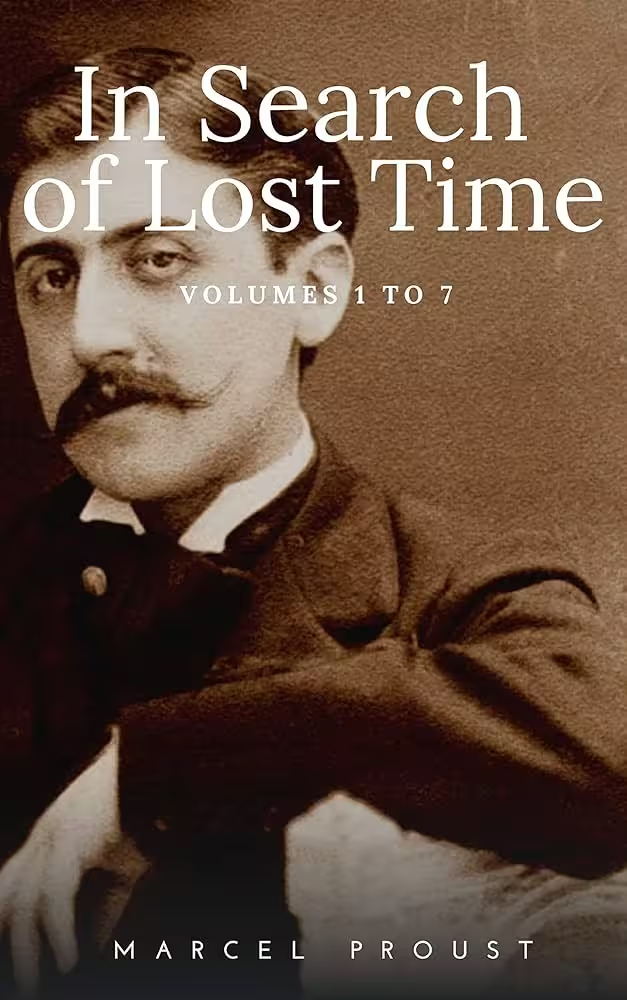
The end of the subject paradoxically brings to the displaced center of narration a new discursive mode by which the “hero/heroine” becomes the link for the abolition of the distinction between so-called reality and fiction, truth and illusion, on which classical aesthetics and the very concept of art (of depicting/representing the world) rested. Perhaps the best example of the latter might be what characterizes the complete de-subjectification of the novel as a literary form of disintegrated metaphysics after Proust and his project In Search of Lost Time. This case reflexively connects philosophy and literature, through an existential reversal at the very essence of the end of metaphysics. Who, then, is this abolished and displaced and overcome “subject” without its “substance” as inaugurated with the novel-idea in Robert Musil and in Hermann Broch with his Sleepwalkers? None other than the dark and unknown, mysterious and utterly uncanny (Unheimlich) Other who can no longer be reached by the concept of modern philosophy as a continuation of the self and egoity by other means, because the other is the irreducible Stranger as in the emblematic novel of one of the most significant thinkers and writers of French existentialism, Albert Camus.
The other becomes a stranger in the absolute space of disbelief within the networked technosphere, which, instead of language in its triumphal march through the world, introduces an image without a world as a fundamental signifier.
Literature, like philosophy, in its explorations of the “new,” necessarily turns to the discovered techniques of thinking in the essence of language, through concepts that have been established as fundamental orientational signposts since the modern age, thanks to Descartes and Spinoza: these are research, method,and experiment. All three concepts come from the scientific calculation by which the world is produced as an object and construct of processing. After the death of God and the reign of the superman in the era of realized European/Western nihilism, the novelistic condition becomes the result of a multitude of discovered “new” techniques by which classical storytelling, which was metaphysically rooted in the logic of the mythical and religious image of the world with a first beginning (arché) and the final purpose of all events (telos), cannot be only abolished and overcome, but also redirected in all possible and imaginable directions. Thus, we have what Helga Mitterbauer defines as follows:
“Marcel Proust opposes chronological logic to the act of remembering, Joyce to the concept of simultaneity, Musil and Broch essayism, Döblin and Dos Passos montage and collage, Joyce, Virginia Woolf and Hans Henny Jahn’s internal monologue, which is based on association. This is also shown in the tenses used; for example, the preterite is abolished: “Behind the historical perfect, the demiurge always hides.” Roland Barthes vividly summarized the fact that storytelling in the past is rejected as a technique that constructs a misperceived illusion of uniqueness, linearity, and chronological logic. (Helga Mitterbauer, ibid., p. 220.)
Once again, it is worth recalling. When the “subject” of narration is abolished and overcome, which always turns from a “hero” into an “anti-hero” in one way or another, like Josef K., the main character of Kafka’s novel The Trial, it would be illusory to think that the “world” about which Kafka narrates looks like something untouchable in its so-called objective reality. To the same extent, if not more radically, the perspective with which the previous “world” as the horizon of meaning is brought to the extreme limits of meaningfulness, to that wall of time itself that becomes the fundamental problem of the novel and its awareness of presence in the spirit of its epoch, changes. What is it that holds the “new world” in some, as the French philosopher of cybernetics Gilbert Simondon would say, meta-stability? It means the abolition and overcoming of the “substance” that signified foundation and essence, impermeability and immutability, permanence and constancy.
With the disappearance of the classically structured “subject” and “substance”, as Heidegger best formulated it in the most significant discussion of the 20th century, the one from 1938 entitled programmatically The era of the worldview, the era of the “new” emerges, which must necessarily be reckoned with all the relics of the mythical-religious “worldview”, even when in a philosophical and literary sense the question of God takes on the character of an ethical-metaphysical solution, as in the most significant novel-idea of modernity in general, such as the novel by Fyodor M. Dostoevsky, The Brothers Karamazov. Everything, therefore, occurs as an anti-logos of events and as an anti-metaphysics of existential reversal in the novel through a relatively large number of technical procedures for the destruction of the idea of time and the deconstruction of the idea of space (for example, from Ulysses to America). Opposition and challenge are not just the keywords of the historical avant-garde movement.
It is about rejecting the canon that has been established over the centuries, and the emergence of the novel by Cervantes is actually the beginning of this long-term process of purification as the de-subjectification and de-substantialization of the “chivalrous picture of the world” as a language that takes place in the text, the crystallization of a sublime speech that transcends the boundaries of everyday life and, in contrast to the vulgarity of the “folk”, constantly strives around elitism against the mass profanation of the “holy scripture” of the idea of literature. That is why the modern novel also represents an anti-tragedy because, in the guise of a “new comedy,” it becomes a space of irony and cynicism of a completely inverted “world history” in the very concept of “true reality”, as is the case with Hašek’s The Good Soldier Švejk. There is no doubt: the correlations between the “new” understanding of time and space in the 20th and 21st century novel refer to its adoption of speech as a hybrid language of the elite and the masses in the narrative of space-time, which, with Joyce and Kafka at the beginning of this process of transforming the novel from a “river” (consciousness) into a “network” (ideas), to Pynchon and Houellebecq at the end of the “meta-story”, reaches the very matrix of the technological singularity of the image as a “new language” of realized nihilism.
When asked by Helga Mitterbauer whether the novel still has existential justification, my answer should be clear: No! But the point is not in justifying an already extinct concept of contemporary philosophy such as existence, but in the fact that despite the complete hyperproduction of novels in the 21st century, we no longer have anything “new” that was not already experienced in the idea of chronological dispersion and spatial distortion at the very beginning of its destruction and deconstruction in Proust, Joyce, Kafka, Musil, Broch, Durrell, Sartre, Camus and other groundbreaking writers. Isn’t it truly paradoxical that the progress and development of the novelistic form came to an end only with the act of disintegration of the fundamental metaphysical concepts of the modern age, such as subject and substance? Where do we really go next with the idea of the novel?
Further does not have to mean “forward” in the sense of the unconditional arrival of the future as progress and development of the same, which bores and becomes a superfluous repetition of nothingness. Further can, although seemingly absurd, mean a return to the past, but not to one that was always marked by linearity and fidelity to stable, eternal metaphysical principles. Isn’t historical thinking always also a questioning and reckoning with the canon and dogma of the so-called historical truth as established once and for all? Borges was right. We, we contemporaries, give birth to our famous predecessors and grant them the power of credible contemporaneity now when they are forgotten or dropped from sight in some general craze for univocity that no longer worries us so much as makes us indifferent to everything “new”.
Therefore, it is necessary to return to the true provocation and subversion of the idea of the novel in the era commonly called the Enlightenment, but with a completely different way of thinking and telling that is closer to the idea of the contemporary novel of the 21st century than to its sublime age of neoclassicism and storytelling that relied on a neo-baroque style on the border between ornamentation and undermining the order of meaning. Is there a better witness to this radical subversion than in the very course of metaphysics that appeared in philosophy and literature with the name of the Marquis de Sade? In his “Reflections on the Novel”, he states these propositions in a truly striking way:
“Oh, you who are embarking on this thorny path, do not lose sight of the fact that the novelist is a man of nature; she created him to be her painter; if he does not fall in love with his own mother as soon as she brings him into the world, let him not write at all, we will not read him; but if he feels that burning thirst to depict everything, if he trembles and opens the bosom of nature, seeking in her his art and drawing his models from her, if he possesses the ardor of talent and the enthusiasm of genius, let him follow the hand that leads him; having discovered man, he will paint him; let him, seized by his imagination, abandon himself to it, let him depict in bright colors what he sees; a fool picks a rose and tears off its petals, a man of spirit smells it and paints it: that is what we will read. (…) In a word, is the man of the 18th century the man of the 11th century? Let us conclude with the positive statement that the novels we offer today are completely new and not a beautiful decoration on familiar grounds. This quality may be of some value at a time when everything seems to have been done, when the exhausted imagination of writers like that can no longer create anything new, and when the audience is offered only compilations, excerpts or translations.” (Marquis de Sade, “Reflections on the Novel”, in: Dražen Katunarić, (ed.), On the Novel (Collection of Essays), pp. 24 and 28. Translated from the French by Danijel Bučan.)
One can go further, but what further if the research, method and experiment with language was completed in an era of no longer a “picture of the world”, but an absolute visualization of the condition as an event that the novel cannot reach in its pursuit of the scent and image of a rose, as ingeniously described by the author of the novel Justine, a kind of founding father of the modern novel without whom we cannot imagine the space-time of literature as absolute freedom.
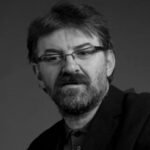
Žarko Paić
Žarko Paić is a Professor at the University of Zagreb, where he teaches courses in Aesthetics and Media Theory. He publishes frequently in philosophy, social sciences, and art theory. His publications include Theorizing Images, eds. with Krešimir Purgar (2016), and Technosphere Vol. 1-5 (2018-2019), White Holes and the Visualization of the Body, (2019), Neoliberalism, Oligarchy and Politics of the Event – At the Ege of Chaos (2020), Aesthetics and the Iconoclasm of Contemporary Art - Pictures Without a World (2021).