

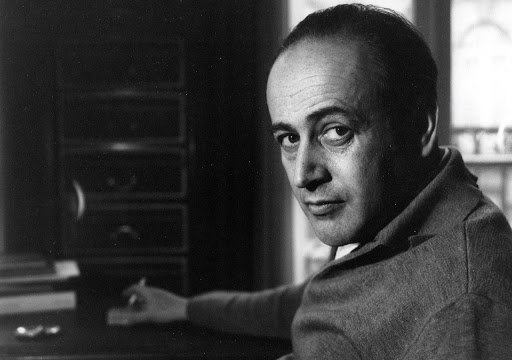
Paul Celan in the Corona of Time
In his acceptance speech on the occasion of receiving the literary prize of the Free Hanseatic City of Bremen in 1958, Paul Celan also said these words:
“Thinking [Denken] and gratitude [Danken] are words of the same origin in German. Whoever follows their meaning is guided by the meaning of the words gedenken [to remember], eingedenksein [not to forget], Andenken [memory], Andacht [piety].” (Paul Celan, Speech on receiving the Literature Prize of the Free Hanseatic City of Bremen, in: Gesammelte Werke in fünf Banden, eds. v. Beda Allemann and Stefan Reichert with the participation of Rudolf Bücher, Frankfurt/M.: Suhrkamp 1983, Vol. III, pp. 185-186.)
The unique way of telling, even in a case that many writers consider merely incidental, marks Celan as a demiurge and alchemist of words. It is not at all surprising that this is what the poet inherited from both Hölderlin and, even more so, from the greatest thinker of the 20th century, Martin Heidegger: the vow and responsibility of language as the essence of the human. And when one is born into the world and bids farewell to it, only the words from which we are created remain. Poets have been conveying this secret of the truth of language for time immemorial. For thinking as gratitude in the language of primordial telling is as if a fateful framing in a “memory” or recollection of an event that once happened and forever remained historically irremovable. Every remembrance protects the present from forgetting the past. Thinking and telling as a received “gift” necessarily speak some special gratitude from which a trace of “piety” beyond the theological-religious meaning is revealed. It is what gives language its “sacredness,” even when it is tainted by the terrible events in the world, without which it has no reason to exist. This speech by Celan represents no “exception” in his notion of language as poetry and thought. Moreover, it can almost be considered a “rule”. However, a rule does not arise except through the act of an exceptional event that permanently breaks it, renders it fragile, and makes it no longer maintainable as it once was. What is Celan really “singing” about, and why can his poetry still be considered today as one that has a “future” in an age of the world’s insignificance as a catastrophe?
It seems enough to draw attention to Ruth Franklin’s review in the journal “The New Yorker” of November 16, 2020, in which she pays tribute to this poetry, which, after Celan’s entire work was translated into English, points to the necessity of a new reading of his work. This poetry belongs to the “post-Holocaust world” and not only refers to the issue of the terrible sacrifice of the Jews and the testimony of the historical trauma of the project of the destruction of a people. Recently, several significant studies have been published on the interpretation not only of Celan’s poetry as a connection/relationship between French surrealism and German expressionism with the tradition of Jewish retelling of sacred texts, but also attempts to clarify his relationship with Heidegger, which has particularly attracted attention after the publication of the so-called Black Notebooks (Schwarze Hefte) in which Heidegger expresses undisguised anti-Semitism. (See Žarko Paić, “Metapolitics and Evil: Heidegger’s ‘Spiritual Nazism’, in The Return of Totalitarianism: Ideology, Terror, and Total Control, Palgrave Macmillan, Cham, 2022, pp. 67-103).
Celan is not a “poet of poetry” like Hölderlin, but of the end of poetry as the art of representing the world itself at its end. The poet does not sing about a world of catastrophe. He expresses the event of the ineffable in the language of the unimaginable and the unpresentable in the monstrosity of an event more terrible than death. In doing so, he does not aim for the forbidden zone of the sublime. Quite the contrary, with the event of poetry after the “end of art” as mimesis and representation, Celan is left only to sing the openness, emptiness, and freedom. Let us never forget that poetry in the 20th century is obsessively directed at the same thing, which is the fundamental question of philosophy. It is, of course, about the problem of time in a deeper sense than the metaphysical tradition of the West. This seems true not only for Celan, but also for Thomas S. Eliot, Osip Mandelstam, Fernando Pessoa, and Paul Valéry. Time no longer flows like sand from an hourglass, but like “sand from urns,” as the title of Celan’s first collection of poems from 1948, The Sand from the Urns, reads.
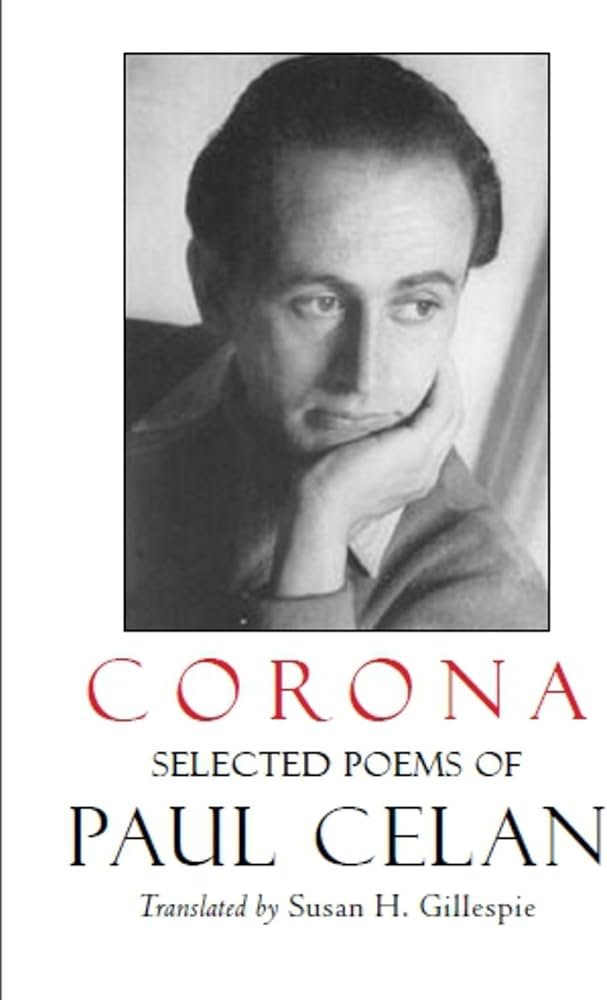
However, unlike their distant predecessors, poets in the era of technical nihilism and catastrophic events encounter something that was denied to the humble tradition’s language. Now, language is being technologized and dehumanized, becoming a mere medium of communication, left at the mercy of the banality of everyday life, handed over to the boredom of industrial work and mass-media ecstasy. Something else becomes unavoidable in the process of language destruction. This should be precisely the “real” object and inner experience of Celan’s dedication to caring for language that fatefully determines its narrator. In a poem from the collection Poppy and Memory (1952) entitled “Corona,” the poem sings about the time of the coming.
The corona means the spindle of time. It is that circularity of spheres in the cosmic and natural flow that appears in its three ecstasies: the past, present, and future. Poetry expresses the ecstaticity of time in the event. It emerges from itself with the help of words that free the time of the moment and the pressure of the present. By expressing itself in the event of the ecstasy of presence with the poetic word, the world is transcended. What makes a mystery and secret here, from the very beginning of the emergence of the words poiesis and techné for the essence of art among the Greeks, denotes the relationship between words and time. Putting words together, the poet sings about what has always been as if it were “here” and “now”. Let us recall the scene when Odysseus, on his return to Ithaca, stops by the Phaeacians and at the court of their king, listens to a rhapsode singing about the sufferings of his companions and himself under the walls of Troy. Odysseus’ hidden weeping opens within itself the mystery of tears over what happened the first time in the past, as the real, and the second time in the poem, as the symbolic.
The time of symbolic tears always refers to past events. What has already been returns to the present thanks to art as the secret of the reversibility of time. This expresses the time that arises through the revival and immersion in the essence of language. The question of dates, marking a moment in time, traces and records, naming and signatures, becomes, to that extent, the timing of the poem in speech (the moment) and language (the coming).The time that Celan speaks of goes beyond the vulgar actuality and transience of things “in” time. To think “of” time means to think “of” the event of the creation of the world from the essence of poetry. In the poem “Water and Fire” from the first Celan collection, Poppy and Memory, these words are engraved in eternity:
The table surges night after night,
and above me, the banners of nations flood,
and beside me people row the coffins ashore,
and below me the sky and stars are like at home around Midsummer!
And I look over to you,
fire-surrounded sun:
Remember the time when night climbed the mountain with us,
remember the time,
remember that I was what I am:
a master of dungeons and towers,
a breath in the yews, a reveler in the sea,
a word to which you burn down.
(Paul Celan, Water and Fire)
Testimony: “The world is gone; I have to carry you.”
Poets are mediators between two worlds. One is that which rests on the past of myth, while the other belongs to the future as a vision of the coming. Between the prophet and the thinker, but in the difference between prophecy and thinking as reflection (Besinnung), man dwells poetically on this earth (dichterisch wohnet der Mensch auf diese Erde). Thus sings Hölderlin in the elegy Patmos. (Martin Heidegger, “… dichterisch wohnet der Mensch … “in Vorträge und Aufsätze, Klett-Cotta, Stuttgart, 2009, 11th ed., pp. 181-198.) In this difference of worlds, poets are mediators between two times. The past sung in mythical narration has never passed because it speaks of origins and foundations. The future expressed in the speech of visions and predictions cannot be petrified in the past of what is to happen, nor is it sealed in the Messianic hour of arrival. The time between the beginning and the coming dwells in expectation and hope. But it is the only time that has within itself a trace of presence. The touch of the real remains bound to the “now” and the “here.” Between heaven and earth, the immortal and the mortal, the poet’s destiny is to bear witness to the gift and loss, the appropriation and disappearance of language itself. In the elegy Mnemosyne (II), Hölderlin sings:
We are a sign that is not read.
Without pain we are and have almost.
Lost our tongue in foreign parts.
Here we are primarily interested in the inner spiritual connection of Hölderlin and Celan, the German and the Jew, the great poets of the festival in the event of (German) language from the very essence of telling the world. What unites the poets of the center and the periphery is the doubling of language and its interweaving in transformations: from the mythical rebirth of the German people from the spirit of primordial poetry (Hölderlin’s Germania and the Rhine) to the symbolic post-apocalypse of language in the sacrificial writing of history (Celan’s Death Fugue). One is, of course, the one who establishes the possibilities of different thinking as singing in the era of the disappearance of history from the horizon of metaphysics in general, and the other is the one with which the thinking of another and different history opens up after the monstrous event of the end of history (Auschwitz).
What seems crucial in the experience of the poetic language of both Hölderlin and Celan stems from the very nature of poetry on the verge of falling into an abyss without history. In the stanza of the elegy Mnemosyne, which is about the muse of memory, Hölderlin mentions signs and the other world. Signs are empty and meaningless. A person reduced to meaningless signs has no place in the world. Moreover, he does not have his own time. Because what determines his place and time does not reside far away. It is the closest experience of proximity. And this experience becomes possible only when language, in its openness, sings of its own proximity to the world, its trust and touch, harmony and balance, agreement and coexistence with the rocks, plants, and animals with which it cohabits. Without this relationship, language disappears into the darkness of the unknown.
If it has already become common to claim that Paul Celan represents a poet-thinker, then his poem Great, Glowing Vault, in which the horror and ineffability of the events of the suffering of the Jews in Auschwitzis revealed in the irreducible language of balance between enigmatic symbols and the invocation of the occult secret of language, has remained a document of the deepest possible philosophical analysis in the writings of Hans-Georg Gadamer and Jacques Derrida. (Hans-Georg Gadamer, Wer bin ich und wer bist Du?) – Ein Kommentar zu Paul Celans Gedichtfolge »Atemkristall«, Suhrkamp, Frankfurt/M., 1973; Jacques Derrida, Schibboleth pour Paul Celan, Galilée, Paris, 1986.)
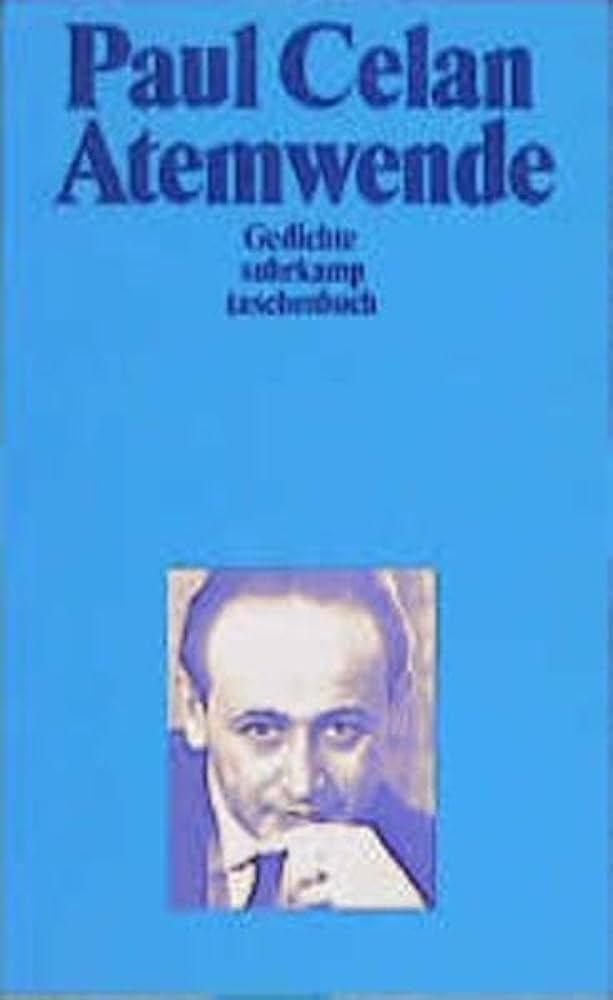
This poem from the collection Breathturn (Atemwende) 1967 sounds like:
GREAT, GLOWING VAULT
Great, glowing vault
with the
outward- and away-
burrowing black-constellation swarm:
into the silicified forehead of a ram
I burn this image, between
the horns, therein,
in the singing of the coils, the
marrow of the curdled
heartseas swells.
What
Doesn’t he
butt against?
The world is gone, I have to carry you.
Poetic activity cannot be reduced to the performative power of language. When language has the character of an event, then the relationship between people in situations and contexts is practically reshaped. The performativity of language, namely, stores within itself the eventfulness of events as a new situation and a new context. The productive power of language corresponds to the performative power of the body. However, Celan’s poetry does not use speech as a means for some other purpose in naming the world. Despite the silence and economy of expression, which sometimes plunges into the ineffability of narration, as in Beckett’s dramatic works or John Cage’s aleatoric compositions, language sings, invoking words with which the divine and the sublime have been named since ancient times. (George Steiner, Grammars of Creation: Originating in the Gifford Lectures for 1990, Faber and Faber, 2001, pp. 164-171).
The world Celan sings about is not only gone. That world has essentially lost its meaning. In the process, it has disintegrated into fragments of memory. Merging in images-words that evoke the ram, candlestick, and heart in endlessly multiplied numbers, the world is like an image in the eye set on fire and burning. The fire spreads through the vault, a great glowing vault. Between the burning sky and the earth in blood and flames, even the stars can no longer have the color of a golden-yellow glow. The stars become black in the constellation, like a flock of birds in the drawings of expressionist painters. The burning of the earth and the burning vault speak of the world’s end. It is a disaster event. Nothing will ever be the same with him. The poetic speech in Celan’s poem ambiguously, enigmatically, and secretly emphasizes the last, but most important. What happens after a disaster?
After the Holocaust, memory looks like a poppy in the black heart of history. Poppy and Memory is the name of a collection of Celan’s poems published in 1952. It also includes the famous poem Fugue of Death with the unforgettable chorus “Death is the maestro from Germany”. Anselm Kiefer, a German painter and conceptual artist, thematized in his paintings the problem of memory and memory after the events of the disaster and the Holocaust. Black poppies and abandoned fortresses in the desert define precisely the state “after Auschwitz” as a break with history. (see Lisa Saltzman, Anselm Kiefer and Art After Auschwitz, Cambridge University Press, New York, 1999) Holocaust (Greek: olokauston – burnt offering, burning of the whole animal in a ritual act) or the Hebrew Shoah, in a symbolic sense, refers to the systematic and planned extermination of the Jews. It is a pogrom.
The Holocaust has the monstrous and inexpressible nature of the image of a burning earth. The world in flames becomes a desolate “scorched earth”. The traces have disappeared; only the memory, in words and images, of the world that has gone remains. When the world is no more, what remains is the testimony of it. The search for the destroyed traces of speech with which the poet no longer establishes a community like the Greek rhapsodists or, like Hölderlin, solemnly sings the second beginning of the people from the indestructible language of the poet and thinker at the end of the poetic epoch becomes the trauma of the truth of language itself. What remains is far from the foundation of a “new” world. Celan says, “I have to carry you.” Who? The world that has gone or You, the indefinite other with a singular face, whom Lévinas, in his unconditional ethics of compassion, calls the face of the absolute Other?
Once again, we are faced with a dialogue with Heidegger, who, in his lectures on space, construction, and poetry in an era defined by the rule of the setting (Gestell), and who deals with Klee and Trakl, comes to that strange word Unheimlich. This word appears later in Klee’s writings on the essence of art – Kunstlosigkeit (artlessness). The defining characteristic of contemporary art is that it is impersonal and artless, because it no longer has in itself either a “who” or a “what”. The problem that the poet and the thinker face is that the “secret encounter”, which remained shrouded in the enigma of silence after Celan’s visit to Todtnauberg and his conversation with Heidegger, no longer comes from the world as an alienation that must be opened up with the help of words, or it will remain forever in the abyss. The French philosopher Philippe Lacoue-Labarthe concluded his analysis of Celan’s poem “Todtnauberg” by stating that the encounter ended in disappointment for Celan. (Philippe Lacoue-Labarthe, Poetry as Experience, Stanford University Press, Stanford, California, 1999, pp. 1-37) The reason lies in something that transcends both thinking and poetry (An-denken/An-danken).
The word that Celan sought from the master of thinking was one and only: Forgive me! Forgiveness for participation in indifferent observation, or rather silence towards the most terrible event in history, the extermination of the Jews in Auschwitz. The word Forgive! was absent. The meeting ended in silence. And what remains was, in Heidegger, the expectation of a second beginning from the very essence of art, from poetry. The thought of the coming God beyond metaphysics meant, at the same time, the arrival of a new poetry: “Only God can save us.” Celan expected nothing, even when he expressed faith in the Word as that almost eternal which belongs to poetry in the sense of a deeper saving hope. Invoking absolute poetry is not about faith in the saving as a messianic final blow of justice and truth. The testimony refers to traces of precisely that which in Celan’s grateful speech “Meridian” from 1960 constantly eludes and is absent.
These are the last words from the poem “Great, Glowing Vault”: The world is gone; I have to carry you. Let us pause for a moment on the disappointment after the dialogue. In “Meridian,” it is as if we are listening to a poetic translation, or rather a translation, of Heidegger’s lectures on poetry and art from the late 1930s to the late 1960s. (Paul Celan, The Meridian in Collected Prose. Translated by Rosemary Waldrop, Routledge, New York, 2006). What seems, however, specifically Celanian is that irreducibly poetic in the distance from thinking as speech (An-denken);it seems not to be contained even in the great “pathos” of the impossible, utopian encounter with the Other to which absolute poetry aspires. The poetic proper becomes something without which neither Heidegger himself, nor Freud’s psychoanalysis, would have had such a powerful and enigmatic concept, almost untranslatable into other (foreign) languages. That is the word Unheimlich. Heidegger derives this word interpretively from Hölderlin’s poetry and his performances of Greek tragedies, especially Sophocles’ Oedipus the King.
Oedipus at Colonus lives in exile. He can never return to his homeland, his homeland, his place of roots. As a blinded and abandoned older man, without a homeland, he is aware of his Uncanny and unconscious transgression of the boundaries of the Law that connects heaven and earth. Gods and mortals, Oedipus becomes A-theos. This is not a label for a godless person in the vulgar sense of a worldview acquired by denying faith in God. On the contrary, A-theos is someone completely isolated from the community, like a stranger and an alien in no man’s land. To be without “one’s” country means to be condemned to eternal wandering in search of a third country. Kafka, in The Diaries, speaks of the impossibility of messianic hope in the promised land. This is why all the suffering of human existence in this one country arises: …because there is no third land for Human.
If this were truly the case, then Celan, in his demand for absolute poetry, finds himself like Kafka in the search for the “third” between the two: the world as alien and the end of the messianic hope for the return of the “second history”. The difference from Heidegger cannot be only that Celan, in his faith in the Word, frees poetry from the creation of a new earth or a second beginning of history. With his poetry, the epoch of apocalypse as the aletheia of history ends. The history first stopped in the catastrophe of the events under the “great, glowing vault” in Auschwitz, and the second time in the event of witnessing the world that has departed. What remains should be something the most difficult. Perhaps we are witnessing a new destiny for life after the end of poetry. Life on the edge between the absolute and unconditional rules of technology in the form of a posthuman state (artificial mind and life) and the testimony of the language of thought in the form of reflection and singing (An-denken/An-danken) seems to be the only thing left.
No man’s land and no man’s rose that still blooms…
Poetry emerges from the soul of the world (psyché). Why does poetry appear so decisively linked to the event of the openness of the world? Heidegger, in his discussion of language, says that language speaks. Man understands himself as the agent of speech, not its subject. (Martin Heidegger, Unterwegs zur Sprache , Klett-Cotta, Stuttgart, 2003, p. 20) When language speaks, man appears in the open world. Secularity bestows thought on the world in its two modes of appearance (An-denken/An-danken). As another place or abode of the meeting of heaven and earth, of the divine and the mortal, the world revolves in the circle of the eternally same. Poetry, in doing so, constitutes the essence of language because the world rises from the realm of everyday speech about the world to singing “to” the world itself. In other words, poetry cannot be just another form of sublime speech above everyday things, but, through poetry, the voice conveys meaning about the world itself in its openness. All the arts arose from poetry as the creation of the new in the singularity of appearance. Human existence is impossible without a poetic relationship to the world itself. Does this mean, however, that the world appears through the work and event of poetry, or is poetry merely a mirror play of another world?
Celan’s answer can only be this: when the world becomes alien, what remains is telling (poetry). The answer is, therefore, Hölderlinian. In the poem “Great, Glowing Vault,” the last words signal a farewell to the old world that has passed away. If we recall the words from the Apocalypse of John, spoken by Jesus Christ: “For the old world has passed away; behold, I make all things new” (Revelation 24:4), then what remains is revealedin what is to come. The island of Patmos has the symbolic power of naming what is said in Scripture: (a) as a testament and (b) as a mission of an absolutely new and different world. But what is to come denotes nothing other than what is essential in relation to what has passed away. The world that has passed away cannot disappear forever into nothingness. What remains is memory and remembrance. Without this, poetry can no longer sing, just as rivers cannot flow without the power of their source.
To proclaim the event of a world that has passed away means, therefore, to bear witness to the event in the poetic language of the coming one. The weight of this mission is immeasurable. Celan leaves no doubt that under the great fiery dome, the freedom and contingency of Human demand the creation of a “new” world by bearing witness to the one that has passed away. Poetry constitutes the “essence” of art. And when the language of remembrance and gratitude (An-denken/An-danken) can no longer be maintained without a crack between the poem and the speech of the event itself, then Great, Glowing Vault becomes the boundary between the world and the other. The terrible event of the extermination of the Jews in Auschwitz cannot be reduced to anything in history. Analogies no longer apply. Therefore, language can no longer necessarily return to the symbolic power of enunciating the event itself. That is the most terrible thing. Lyotard calls it more terrible than death itself. The world after the catastrophe can no longer be built on the same metaphysical foundations. And thus, hope and faith in the absolute (God?) have become unreliable.
Only the language of a different opinion, worthy of the magnificent tradition of the West (from the Greeks, Latins, Jews, the Middle Ages, Shakespeare, Hölderlin, to Celan), carries poetry into the future. By bearing witness to the traces of language as an absolute, poetry saves the world from the dark foreignness. It is not a consolation, but neither is it a flight of words into their own chambers of beauty. The messianic invocation in Celan forever loses its secret power. Instead, the language of German destiny itself becomes the language of sacrifice and testimony, just as the image of the “scorched earth” (Nigredo) in Kiefer’s paintings becomes more terrible than the event of the Nazi burning of Jews under the great red-hot vault. Absolute poetry, in its own narration, invokes the language of freedom and destiny: The world is gone, I have to carry you.
Leibniz’s question: “Why rather be than nothing?” has been addressed in Celan’s poetry over the years, beginning with Poppe and Memory (1952).In Nobody’s Rose (1963), he carried on a dialogue with the ineffable. Unlike the concept of the sublime in the tradition of modern aesthetics from Burke, Kant to Lyotard, it seems that the ineffable should be approached differently than by thinking about the representable inexpressible. However, having reached the extreme limits of expressibility, Celan’s telling had to become like a mute voice that still only passes through this alien world without its poetry, without its language, without that Platonic rose with which poets invoke the harmony of the divine order of the world and the human place in it. In no man’s land, however, that nobody’s rose with which Celan disappeared after sinister years of depression and treatment in a psychiatric clinicstill blooms despite everything.
He could not settle down anywhere, neither in Vienna nor in Paris, nor with the great Austrian poet Ingeborg Bachmann, nor with his wife Gisèle Lestrange. Born on November 23, 1920, as Paul Anzel in the town of Chernivtsi in Bukovina, whose parents were executed in a concentration camp, he raised the German language as Paul Celan to the highest heights of sublimity and reflection. After all, his biography deserves a special examination, and that is where we should stop here. On April 20, 1970, he committed suicide by jumping into the Seine River in Paris. From the various chronologies of his life and encyclopedic entries about his work, the following remains a mystery. Although he left no suicide note, an open biography of Hölderlin was found on his desk with a particularly prominent sentence:
“Sometimes this genius darkens and sinks into the bitter well of his heart.”
Poetry about the world’s Homelessness is addressed to those who still want to hear language sing in its beauty and sublimity, even when everything has become dark and catastrophic and heading towards its end. Paul Celan remains the most powerful voice of this absolute freedom to speak about a world that is still open to its last possibilities. Without poetry, life is, of course, possible. Only such a life is nothing more than the meaningless duration and boredom of the utter banality of events. The language on which Celan left his indelible mark could be nothing more than the power of witnessing the truth, the memory, and the persistent struggle against forgetting the events of tragic history. As in “Song in the Desert”, everything begins and ends with the language of mystery.
In vain you paint hearts on the window: among the multitude is God,
wrapped in a cloak that once slipped from your shoulders
on the stairs, at night.
Žarko Paić
Žarko Paić is a Professor at the University of Zagreb, where he teaches courses in Aesthetics and Media Theory. He publishes frequently in philosophy, social sciences, and art theory. His publications include Theorizing Images, eds. with Krešimir Purgar (2016), and Technosphere Vol. 1-5 (2018-2019), White Holes and the Visualization of the Body, (2019), Neoliberalism, Oligarchy and Politics of the Event – At the Ege of Chaos (2020), Aesthetics and the Iconoclasm of Contemporary Art - Pictures Without a World (2021).