

Summary
The article situates metaphysics and its traditional “grounding” of the idea of art as mimesis and representation. It demonstrates that with the advent of the technosphere as a synthesis of calculation, planning, and construction, cybernetics has been realised in the very immanence of life. This also leads to the reign of technoscientific research into life itself, starting from the combination of genes and information, which “produces” artificial reality. The fundamental concept that prevails in modern times is synthetic production. At the same time, aesthetics and art no longer maintain their autonomy but instead become a synesthetic whole in which changes are constantly occurring in the very “being” of the creative process of thinking and acting. With the disappearance of man as the creator of the artistic world, a multitude of possibilities for synesthetic metamorphoses of life, which has already become artificial life, arise. When philosophy is realized in cybernetics, the age of technoscience emerges; when art is discovered in the becoming machine of thought, this same age becomes the aestheticization of life.
Keywords: synesthetic age, technosphere, cybernetics, singularity, art, visualization of events
1. On the creative essence of poiesis
With the emergence of the technosphere and its current applications, such as ChatGPT, we can no longer remain indifferent to the ongoing progress in technological thinking. Suppose Heidegger explicitly demonstrated in a 1962 lecture that both technology and science are correlative in their relationship to the world as a spatio-temporal self-development of battle and thought. In that case, it becomes clear that the essence of this relationship lies in the synthesis of technology and episteme. (Heidegger 1977: 747) This synthesis, however, becomes only possible when thought is directed towards the task of creating something new. Therefore, poiesis denotes the condition of the possibility of the monstrous synthesis from which the technical object emerges. The Greek meaning of this keyword, which refers to the essence of the technosphere, is production. In the logic of AI self-creation, it simultaneously creates a whole new artificial, technical world. This production is never blind or neutral. Instead, it is a matter of “creating” that which is not in nature and which spiritualizes nature itself, like a temple or a cathedral or a nihilistic wasteland like industrial capitalist production that pollutes the earth and the air. Producing something involves deconstructing a being as a work, thereby making it the means to an end in the production process itself.
Therefore, it is not poetically possible to think outside of thinking itself as production, because this would mean that the means-end model or the principle of teleology is neutralized and suspended. In thinking about the technological thinking of the 1960s, as I have shown in many cases so far in my books on the problem of the technosphere, Heidegger opened the possibility, on the trail of Heisenberg’s equations of indeterminacy, to understand atomic or nuclear energy outside the logic of causality and the principle of teleology. However, Heidegger did not fully develop this consequence for future thinking because he understood technical and technological thinking only as the rule of the so-called calculating thinking (Rechnen), rather than as the possibility of a completely different expressive thinking (Dichten). Although in the late years of his life he devoted himself to analysing the paintings of Cézanne and Klee, he did not derive from this that painting and pictorial thinking become a synthesis of poiesis and techne, starting from the autopoietic nature of Being that is no longer merely technique or technology. Therefore, the film could not represent anything to him other than what the essence of art reduces to — a nihilistic circle of chalk through the Gestell asthe essence of technology. (Paić 2018: 221-275)
Let us pose a question that goes beyond the metaphysics of Western thought. Why is the creative essence of poiesis divided into technopoietic and autopoietic categories? Suppose the second is the ontological “product” of the first. Does this mean that the technosphere and nucleus are established as a necessity of thinking in the essence of metaphysics, as cybernetics? In a seminar with Fink on Heraclitus in the 1960s in Freiburg, Heidegger spoke about information and cybernetics. Poiesis refers to the production of beings out of Being, or by this process of creating something new, taking place in such a way that Being should be understood as the possibility of the technical realization of the world. The possibility precedes the actual state of affairs. Suppose the likelihood of what Heidegger calls technological thinking in the 1962 lecture above is not merely a thought experiment about what will happen with the emergence of the technosphere.
In that case, the problem is that poiesis, in its two aspects of the creative power of the emergence of the new purposeful and self-purpose, also marks the place of its own metaphysical “meaningfulness “. No, we can no longer grasp what is truly happening intellectually in the technosphere using traditional metaphysical concepts and Greek-Latin linguistics. If what I am saying is correct, should we perhaps “invent” a new language for thinking which, according to its “ultimate intentions”, is not and cannot be technological? As a final note to this item, it is worth noting that this is not Deleuze’s language, either in terms of the fractalization of thinking. It is therefore a future transversal language for event visualization as rational intuition.
2. About navigation as event visualization
Let us pose the question that Heidegger also posed in the seminar on Heraclitus that he held with Eugen Fink in 1966/1967 in Freiburg. What is cybernetics, and what is its fundamental concept – information? For Heidegger, cybernetics appears in a double meaning: (1) it is a continuation of modern science and technology; (2) at the same time, the place of the metaphysical fourth of Being-God-World-Man lies at the centre. (Heidegger and Fink 1970: 26 note) The meaning of cybernetics is the one that comes from the Greek language and refers to the management of a ship as a navigation through the known-unknown area of the world and to the controller-helmsman who manages the technical equipment to steer the boat towards the desired destination. If, therefore, cybernetics denotes the universal substance of Being, then the cyberneticist embodies the essence of managing the world as such.
This ambiguity becomes the ontological difference between Being and beings, or at the same time, the difference between what belongs to the universal activity of a situation and the activity of a special and singular subject. There is no essential difference here compared to other ontological relationships, such as those between genus and species, or between singularity and its corresponding term, for example, philosophy and philosopher, technology and technologist, or poetry and poet. The difference arises when the metaphysical set of Being-God-World-Man, which Heidegger discusses as the structure of metaphysics, is realized in cybernetics as a universal theory of the scientific and technological age. Then this quaternity ceases to be valid, and the quaternity takes its place: information-feedback, control-communication.
Why does Heidegger claim that cybernetics is the place of philosophy as well as metaphysics, and that the realized technical world is nothing but the mission and destiny of what was initially opened in the pre-Socratic era of thought with the concept of logos in Heraclitus? The answer is straightforward. Cybernetics, as an information system, is the purposeful management of the world as space and time, the realization of cause and effect as means to purpose. However, cybernetics, rather than metaphysics, assumes leadership and direction of historical “progress” and “development”. Well, now that direction is no longer anything humane, too humane, but instead belongs to the uncertain realm of the inhuman. The helmsman no longer guides the ship through the stormy oceans according to the arrangement of the constellations and the drawn road signs on the mappa mundi. Still, satellite navigation and the automatically guided rudder do it.
In other words, the man-as-controller replaces the dispositive of the technosphere as an artificial intelligence that automatically and self-guides the ship to the desired destination. Of course, nothing guarantees in advance that the “mission” will be successful, as there is always the possibility that the trip could end fatally for the ship and its crew due to a storm disaster or an unforeseen problem with the navigation devices. The primary difference between philosophy and cybernetics lies in the former’s emphasis on folk conceptions of the meaning of life and death, whereas the latter focuses on systems and control. At the same time, the latter is a non-human matter of technosphere thinking, with one important addition, which presupposes a departure from Heidegger’s analysis of the essence of information. Namely, Heidegger views information as instructions for use and as a system for delivering information itself. This concept encompasses the essence of metaphysics as the fate or destiny of history and the essence of cybernetics as the universal science of the technical age. Alternatively, the technosphere is not only the realization of metaphysics in the pragmatic language of cybernetics, as the artificial life of algorithms, but also the “third”.
Tertium datur marks a new direction in history which is no longer in the sign of managing the sense of Being in the sense of uncertainty and indeterminacy of events from the coming future. Instead of the neutralized and suspended messianic-eschatological dimension of the “holy future” of the event, everything is played out in the irreversibility of the feedback loop of the technosphere as a prediction with a measure of probabilistic “exactness” of what has the characteristics of a contingent event. Therefore, cybernetics can no longer be a universal science of modernity, as it represents the realization of Heidegger’s Gestell, which is the essence of technology. Instead, we encounter a navigation that leads through chaos and entropy, aided by the technological singularity, with Rimbaud’s “waving ship” serving as a nomadic, wandering project of becoming other and different from Being as such. Cybernetics encompasses the notion of information, as Norbert Wiener called it, the tertium datur, the Great Third, that which becomes fundamentally different from matter and energy. Therefore, information cannot be a Being, but a universal form of technological and genetic construction. This was well defined by Carl F. Von Weizsäcker when he said that information in physics denotes “a higher level of abstraction” (Weizsäcker 1974: 52). What does this mean other than that information should be understood as a condition for the possibility of the creation of matter and energy and that in its tautology it determines which is no longer anything human or inhuman, but this auto, that itself which transcends the limits of metaphysics. The technosphere is a system of information, a recursive contingency of events, whose “essence” lies in the process of realizing technological singularity. What is the essential difference, however, between the management of history from the horizon of metaphysics as cybernetics and the navigation of post-history from the trans-classical logic of the technosphere?
3. On the matter of thinking and thinking as a thing
The technosphere should be understood as a cybernetic system whose “essence” manifests as the triad of calculation, planning, and construction. In the metaphysical sense, this triad encapsulates what Plato and Aristotle meant by the concepts of theoria, praxis, and poiesis. The mathematical logic used by theoretical physics and cosmology in the study of the secret origin of the universe and its “natural” laws is a theoretical thinking that calculates the being of being by placing it a priori in relationships between quantities, as in the case of Einstein’s theory of relativity and the famous formula E=mc². Alternatively, cybernetic thinking is not an ontology; thus, nature is not left in its natural state, as ancient Greek philosophers and mathematicians such as Thales and Pythagoras did. Instead, a changed structure of physis is theoretically calculated by practically transforming its state or substance through analytical planning into the possibility of the subject acting as a performative implementation in the production of the new. Praxis, therefore, designates a system of cybernetic “postulates” that functions as a feedback loop, recursively repeating what appears irreversible at the technological level of realizing computational thinking.
Cybernetics reaches its peak in the management of the world as a techno-poietic ” human garden and non-human environment”, which it controls using a system of information that enters the system of contingent events. Hegel provided the best example of classical ontology by examining the origin and cultivation of a rose. In contrast, the best example of cybernetic anthropology is the cloning of a human embryo’s stem cells using the technique of prenatal selection. Cybernetics, therefore, in the construction of the “new nature” as “artificial life” from the logic of artificial intelligence’s operation, forever destroys all the concepts and categories of metaphysics into fragments and replaces them with the rule of the autopoietic network of the technosphere if we examine how autonomous technical objects in the artificial world function, which no longer surrounds us but has become an immanent “essence” of a rigid world, we will see a visualization of events on the interface of our computer, in a car, or a drone. Calculation is the quantification of a situation, involving the algorithmic determination of real-world problems, such as traffic.
Analytical planning involves simulating risky environmental events that can alter the situation, such as when sensors indicate a 67% probability that a specific road section will become slippery due to snow. At the same time, construction involves designing reality as a visual event in the virtual reality model, where the drone’s navigation device alerts us that the landing strip of an autonomous object is sprinkled with gold and ash. Thinking as calculation is the construction of something new that is not like things; rather, it is a matter of thinking to design a new nature that connects the artificial and the living in a cybernetic way. (Paić 2018, Paić 2022a and 2022b, Paić 2023a and 2023b)
What is the Unheimlich in this concept of the technosphere, other than the realisation of metaphysics in a thing that thinks differently from us, but is programmed to learn and create by itself, that we cannot do so quickly and so effectively? The entire problem of the technical world in which we humans exist, along with the diapositives and apparatuses of the non-human, lies in the infinite acceleration of the system and the environment, and the appropriate mnemo-technology for the event of singularity. A simplified, popular measure of satisfaction in this new world cannot keep pace with the biological demands of life’s frantic acceleration. Therefore, it is necessary to continually improve physical performance through various techniques, including cryonics and uploading. Of course, the necessary consequence of this process of life is the latent immortality of “forgetting the battle”, as Heidegger would say, or the emergence of Alzheimer’s syndrome, because the so-called biological brain wears out and can no longer remember what it was able to grasp the total techno-grammatization of life flawlessly.
Thus, the pursuit of immortality presupposes an a priori change in the structure of people’s DNA, as well as genetic engineering and transhumanist life-enhancing techniques that stem from the field of neurocognitive hyperplasticity of thought. To “save” us from the imminent destruction of the earth and the galaxy we inhabit, as the physicist Frank Tipler shows, we must move into space as posthuman beings and “colonize” other habitable planets through superintelligence spiritual machines. These cannot be “people” like us, biologically mortal and physiologically vulnerable, but only those who, in the technosphere, constantly transform the boundaries of AI and thus “spiritualize” the universe itself with completely different telos thoughts from metaphysics, cybernetics, and transhumanism. (Paić 2023a) What emerges from all this is that the thinking of the technosphere becomes the one that brings the fourth into play in the triad of calculation, planning, and construction, but this can only be thinking as a rational intuition that thinks a contingent event from the coming future differently from its openness than philosophy as metaphysics. This means having a “vision“, but not preaching prophetically what will inevitably fail in time. This also means thinking of the future as not ideal. Futurism, a proto-avant-garde artistic movement, was not a form of SF creation but rather a manifestation of critical probabilism and post-digital constructivism.
Everything occurs in the brain, encompassing both the perfect and the imperfect world, and this becomes even more sublime when the thinking that gives it meaning reaches the pinnacle of new thought. If we ask whether the technosphere has its thinker as a philosopher who, following in the footsteps of Heidegger and Deleuze, sets this marvellous adventure of spiritual Being in general, the answer is positive. No, it’s not “I”; it’s someone else, as Arthur Rimbaud wrote in 1871 in Letters of the Seer, because “I” who could think this must already be “crazy” enough to think what can no longer be considered “philosophically”. Therefore, this “I” feels beyond the system of the technosphere, because its “essence” cannot be anything technical, but also nothing that belongs to the metaphysical organization of the union of téchne and poiesis. Thought cannot be a thing, nor is the thing of thought manifested in the reality of calculation, planning, and construction. What does it even mean to think of the technosphere if it already has a different opinion?
The primary issue in the modern relationship between technology and science concerns their structural connection, which cannot be fully understood within traditional epistemology. Namely, it is the Kantian perspective on a priori and a posteriori cognition, which logically and temporally precedes something and determines its empirical implementation in space and time. Following the pragmatic turn in analytic philosophy, with William James and John Dewey, it became evident that the last remnants of Kant’s transcendentalism, particularly the distinction between the noumenon and the phenomenon, were crumbling. The logic of scientific research could not be God’s design of the mind in a laboratory experiment that must be proven a posteriori by a series of inductive methods, but rather the process by which something new emerges from the logic of pure contingencies. Let’s translate this into the language of general self-understanding. Before the experimental phase of research, there is what Deleuze calls the “plan of immanence “, but these are hypotheses of research, a project challenge of thinking that rationally and intuitively seeks the possibility of discovering something new by “shuffles the cards for solitaire”, that is, examines a series of cases of the probability of the emergence of what assumes not the existence of the new, but its becoming. (Deleuze and Guattari 2017)
This difference makes a fundamental ontological distinction between the old, static metaphysics, which rested on the idea of an object that does not move and stands as a thing-in-itself (Ding-an-sich), and cognition, this new dynamic or process cosmology, as an ontology à la Alfred N. Whitehead and, consequently, Gilles Deleuze. The existence of the object of knowledge means that the scientist’s thinking always denotes mimesis and representation of the permanence and eternity of Being in the form of nature, which is disguised. On the other hand, becoming (devenir) denotes the process of emergence, which in theory of emergence refers to the creative construction of a team of scientists who are no longer looking for an existing object in space and time, but find it as a dynamic and quantum object X in space-time as an emerging new object of research. This “quantum revolution” in technoscience might often be associated with the famous onco-mouse. Donna Haraway has described a way that goes beyond the classical distinction between “nature” and “culture,” or between organic and mechanical, in the mechanistic notion of “life” in general. Although even within the philosophy of science, classical scientific methods and experiments differ from those in these sciences in terms of laboratory procedures for measurement and visualization, this difference has not yet been adequately explained theoretically. She described the so-called mouse, created through laboratory genetic engineering and designed by Philip Leder and Timothy A Stewart of Harvard University. Such a “mouse” carries a specific gene called the activated oncogene. In formal “ontological” terms, this is neither natural nor artificial, but a hybrid product of applying new technoscientific methods to produce a being with a transformed identity.
We can also explain this case from the perspective of trans-classical logic, which is applied in modern cybernetics through the scholastic term tertium quid. The “third”, therefore, exists because of techno-genesis as a hybridization of substances. Consequently, it might not be surprising that many philosophers of science still struggle to grasp this new ontological-epistemological situation with their outdated concepts fully. When we face the onco-mouse as a research paradigm for a new object X, which is created by the technoscientific construction and merging of gene-information-code, but not by the act of discovery of what is already an ever-existing work of God or nature, we see that the essence of this revolution lies in research as becoming – emergence using the techniques of synthetic bio-cybernetics by which the living and the artificial create the hybrid. (Paić 2023a: 73-93)
Suppose we could pose the question of the aim of the rigid oncomish, or the tendency toward the emergence of a multitude of hybrid beings in the process of techno-genesis of new worlds. In that case, this question, as in Aristotle’s Nicomachean Ethics, requires an answer to why and what in terms of the well-being of man in the community. After all, this should also be a question about the meaning of creating artificial intelligence, without which technoscience no longer exists. It is no longer a question of technology using the human body as a model, but rather the human brain as a model for the technosphere. Why does something that does not exist as a living being with its natural purpose and meaning of existence become itself, thereby changing the essence of the living being and giving it a different appearance (eidos) and a different set of possibilities for implementation? Suppose this is because it improves and prolongs the life of the man himself, as he is at the service of hybridizing people’s biological traits through the technical alteration of his bodily substance. In that case, this formally answers the question of whether it “makes sense” from the perspective of anthropotechnics, in Sloterdijk’s terms. (Sloterdijk 2009)
From the standpoint of geophilosophy, as Deleuze and Guattari would put it, this act of techno-genetic construction represents a necessary process that creates the possibility of becoming human and becoming machine, transcending the limits of biological evolution and the natural boundaries of the world. (Paić 2022c: 256-260) In the first case, following Aristotle and Western metaphysics, the ethics of scientific appeal in modern times still begin with the fiction of so-called purposefulness. of the subject as a mark of man, and everything else is judged from him. The well-being of man also enables him, if necessary, to survive in different forms of existence, such as posthumanism or transhumanism. In the second case, in the footsteps of Deleuze, the theory of emergence is not the starting point of bio-techno-ethics, man as the original subject of will and decision-making about the world in general, which the sciences supposedly serve for his purposes, but rather the starting point beyond any a priori teleology of God-nature-man.
Everything occurs through a process of self-justification and self-management within the context of bio-cosmo-technological evolution, which Nietzsche views as man serving as a bridge between the animal and the superman. Opposing this and departing from it from an individual standpoint is legitimate and possible only within the limits of one’s decision to live without accepting the benefits and harms of the technosphere’s unconditional progress. This is outdated ethical fundamentalism, because Onco-mouse and ChatGPT are as helpful and essential as satellite navigation in ship or aircraft travel. Still, they help quickly search for information about the likelihood of surgery for a person with a serious illness, such as how people with a stroke will soon be able to communicate with others using AI.
The problem, of course, is that, thanks to techno-genesis, we can also expect that the hybrid beings of the technosphere will become like animals and humans as we know them: harsh, angry, aggressive, indifferent, and devoid of empathy towards others. The fear of a future where humanity is no longer the measure of all things, but immensity and emergent chaos take precedence, is not easily explained, as even the poet Hölderlin said there is no measure on earth. Still, Sophocles understood humans as demonic, monstrous beings on earth. So, do we want to ban the production of laboratory onco-mice and “preventively humanize” the development of AI in the name of human dignity, which no one knows how to define without falling into religious pathos and the bioethics of false mercy?
Let’s forget about these illusions. What emerges from the being of the technosphere is a way of thinking that transcends the stations of the biological apocalypse. It is only essential to preserve freedom as a way of thinking that does not glorify technoscience as a new Apollo or Athena, but as a pragmatic tool for the possible-really-necessary hybridization of life, which is techno-logicalized not because we want it, as Fernando Pessoa sang in the futuristic phase of his poetry, but because it is the machine learning of humanoid “onco-mice” that synthetically enables man to maintain still his existence on the tasks of thinking in the age of complete entropy and chaos. This is not an ethical-aesthetic imperative of man in a posthuman condition but becoming-man as an experiment in freedom within the totality of the technosphere.
4. STELARC as a guide to technological singularities
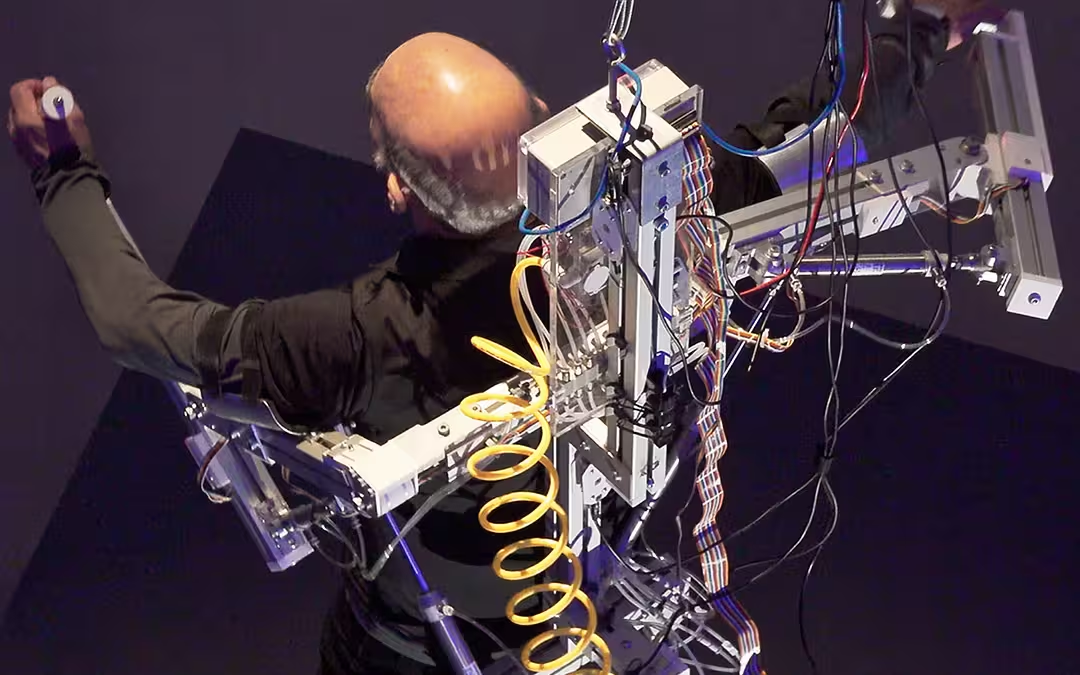
The entire body of experimental work by the Australian performance artist STELARC from the 1980s to the present can be understood as a roadmap toward technological singularity. (Paić 2022b: 191-219) German philosopher and promoter of transhumanism, Stefan L. Sorgner, in his book on posthuman art, puts this problem in the context of an affirmative new aesthetic, showing that in addition to STELARC’s research into the relationship between the body, technology and society, it is essential to keep in mind that this “new” art is no longer a deconstruction of the body, but an exploration of new possibilities of applying the non-human to the popular. (Sorgner 2022)
Synaesthetics presupposes a completely transformed relationship between the body and the technosphere, given the notion of a common sensibility created by real-time connection to the Internet. Regarding the purity of the concept of the technosphere as synaesthetics, both STELARC and Ken Rinaldo are paradigmatic artists in exploring the relationship between new technologies, robotics, and human thinking, acting, and feeling in the space-time of disembodiment and technological singularization. Acting synesthetically involves connecting to the network and communicating with thinking machines whose logic is synonymous with Rinaldo’s 2000 work, Autopoiesis. This work explores a new approach to expanding the sensitivity of communication between connected robots. (Paić 2022b: 205-209) The state of robotics currently constrains his work, although it has advanced significantly with the emergence of autonomous systems and ChatGPT. When one thinks synesthetically, it becomes evident that the traditional understanding of aesthetics as a philosophical discipline dealing with beauty, the sublime, the folk world, and art is no longer valid. Moreover, the aesthetic battle was already established as such by the cybernetic “aesthetician” Max Bense in his Aesthetics.
„Every transcendental theory of consciousness (in the sense of G. Günther) belongs to a more general metaphysical theory within which the correlative sign theme and the correlative mechanics of communication (in the sense of communication theory Shannon and Wiener) make corrections. Aesthetics in the sense of the theory of aesthetic battle can be derived from the rigid system of previous, more general theories. Because consciousness not only transforms the signs it receives, but also produces them. Signs are real products of consciousness, manifestations, and information that it publishes. We objectify these free, original manifestations in an aesthetic battle. In aesthetic production, consciousness truly becomes the residue of possible worlds in which nature and objects exist, and the residue of possible worlds in which nature and objects exist, and the residue of the possible loss of a world that no longer needs nature and objects.” (Bense 1978: 106)
The entry of the fourth area to which the concept of aesthetics refers can only be that which is non-human or that which belongs to the technosphere as a synesthetic sensibility of artificial intelligence. Therefore, we can no longer maintain either the concept of the body or the concept of technology as we are used to thinking in a dualistic, Cartesian or pseudo-Marxist way, however, the body is not a biological given of origin and the necessity of being rooted in nature as nature naturans and natura naturata, instead imbuing with a new technological singularity that transcends the limits of modern technology as a realization of the law of causality and the principle of teleology. We can no longer think of what “is” in terms of the concepts of battle and being, in their ontological, ethical-political, and aesthetic senses, because the technosphere constructs a posthuman state that transcends nature, the human world, and art in a metaphysical sense. What both Stelarc and Rinaldo do can only formally be called “art” because the sensuous shining of an idea, as Hegel would say in his Lectures on Aesthetics, does not occur. The reason lies in the fact that the technosphere itself can not only be a work of art or an event but can also autopoietically create new artificial worlds and perceive them as synesthetic constructions.
Here, it seems that it is becoming clear that with synesthetics we are only prolonging the life of the clinical death of a discipline created in modern philosophy, which even Kant could not justify in his third criticism for the simple reason that the concept of the beautiful and sublime cannot be the non-conceptual one that shows and teaches, shows and represents through the impossibility of reaching it by logical means because it belongs to the realm of the ineffable. The synaesthetic area is therefore the fertile ground for the emergence of something new from the spirit of techno-poietic construction. The only thing that can be said about it is that, like synergy, it is the place of all the practical activities of man in the process of shaping the world. Instead, the technosphere does not enter the world, synaesthetically, in any of its modes of existence. Still, it is networked like Kafka’s rhizomatic writing machine, as seen in the unfinished novel America, where behind every hotel door lies nothing beyond —not a sublime object of the world of life, but only and only another and new door. And so to infinity. (Deleuze and Guattari 2020)
First, the notion of synesthetic without sensibility is questionable. This means that the new aesthetic configuration of the technosphere, involving calculation, planning, and construction, profoundly influences the so-called original human approach to art throughout history. However, it is, of course, about the body as a matrix of feelings, without which it cannot exist as a people. Aesthetics as a philosophical discipline emerged in the 18th century. Its main concepts are beauty and sublimity. Its origin lies in the rise of rationalism and the scientific-technical justification of nature, which loses the mythical-religious features of deity and epiphany, becoming the subject of philosophical reflection and speculation. Well, as Kant was the first to put it clearly, but Hegel, who followed in his wake and found out much more radically, nature appears in this way of thinking at the same time as a philosophical and a scientific-technical construction.
Philosophical construction should be determined as the essence of reflection, with which everything we can think of at all becomes the object of reflection. Hegel’s absolute is a dialectical synthesis of substance and subject, battle and thought as a construction. This conjunction is apophantic and explicative. Therefore, nature in the sense of natura naturans becomes a construction of the pure mind, or at the same time, folk thinking, which is no longer a mere observation of what happens in nature, but the beginning, in the ontological sense, of any future emergent technology that changes the essence of nature and the essence of man. Thus, the aesthetic experience can no longer be an illusion of beauty and sublimity, whether with the help of Kant’s idea of the moral postulation of God, without which there is no rational justification for the a priori cognition of Being. Thus, there is no self-purpose of nature as the source of all artistic imagination and creativity, be it with the help of Hegel’s idea of the absolute spirit, which is not, as both theologians and philosophers mistakenly think, a theodicy in the discourse of modern philosophy. Still, the concept of God itself should be theologically subsumed under the philosophical mantle of the Absolute.
Thus, with Hegel, aesthetics should be over because there is no longer a reason for the separation of nature and spirit. Still, art becomes, in principle, that which has passed according to the highest requirements of the present, which is entirely under the rule of the scientifically established place of history. What else can characterize sensibility and feeling if what STELARC problematizes in its works is the triad of flesh-metal-code, that is, understanding the body as a technological construction?
It seems to me that the key to the relationship between the posthuman body and folk-too-folk onto-pathology with suffering and the entire repertoire of ecstatic sensibility is hysteria, as in Francis Bacon’s painting Study after Velázquez’s Portrait of Pope Innocent X from 1953, in terms of the autopoietic interaction of thinking itself as a vision and program. Who here still thinks “what” and “how” – the pure will of a man who, from the abyss of life processes, constantly feels himself as a body and the world, or an autonomous brain-as-an-object of algorithmic construction that synthesizes the new reality of the non-physical singularity of the machine? We see that even for Ken Rinaldo, the thing became a pure installation of the inhuman in the autopoietic relationship between the machines of thought. Man is no longer the subject of a posthuman body, but, as STELARC sovereignly demonstrates, an interactor in the process of mutual interpenetration between flesh and metal through digital code.
Instead of Hegel’s machine of Aufhebung and its powerful historical reflection, which renders the essence of aesthetic insight into the very life process of the mind and creates a work of art such as the Bacon painting, it is now a matter of programming thought operations. (Deleuze 2005) Reflection, as a way of thinking, incorporated the concept of vision, with which the artist-as-philosopher combined intuition and rationality, much like Leonardo da Vinci or Diego Velázquez. The autopoietic interaction of the artificial intelligence that manages the posthuman body of the human, however, leaves the so-called will and mind intact in the realm of all kinds of sensory affections, or no more than that because the production of conceptual tools for understanding complex relationships such as 3D implantation of new organs in the body cannot be left to the whims of the popular will and mind, which is a proof that Schopenhauer’s position on the irrationality and brutality of violence in nature and man is more suitable for the essence of reality in modern times than Kant’s universal morality.
Namely, movement in a specific direction by the “third hand,” as seen in the well-known STELARC work, must result from the will as an interaction of battle and thought in the ontological sense. Construction represents an act of thinking and, in its determination, is the necessity of the will to create something new. To that extent, Heidegger was right when he proclaimed Schelling’s work Über das Wesen des menschlichen Freiheit 1809, the most significant work of German classical idealism. The reason is apparent. Freedom is the unconditional cause of itself as will because it is neither a Being nor a Being. This means that the fattening of the posthuman body is only meaningful if it is possible to determine who moves it, if we suspend and neutralize the idea of God in the metaphysical sense from Aristotle to Scholasticism, and what its “essence” is if it is no longer human nature in the sense of an essentialist or anti-essentialist understanding of the state of things. Furthermore, is the posthuman body the spontaneity and irrationality of movement in the sense of Schopenhauer’s and Freud’s will, or the instinct for survival in the sense of eros, or is it the rationality of movement in the sense of controlling the instinctive structure of the body, as Kant claims, or something completely different and distinct as tertium datur?
Vision, as a program, signifies the most substantial possibility of a posthuman body in a synesthetic sense. STELARC likes, however hypercritical it might sound from my point of view, related to the cyborgization of man and the exploration of the possibility of bearing pain in a new situation of transgression of the body after it is connected to devices or after it is brought to a state of mechanical crucifixion, or not on a cross like Christ. Therefore, his “new body” has not yet reached the autopoietic stage of displacement, in which an intelligent machine, interacting with a human, demonstrates not only rational thinking but also artificial intuition. Hence, the synaesthetic experience of the people’s existence is the one that, in the further development of the technosphere, will be brought before the wall of absolutizing the pure technological will, which can be conditionally called “good” or “evil”, or, in Nietzschean terms, beyond good and evil.
The posthuman body becomes therefore a stop on the path of this absolute singularity, which will either become a metamorphosis of art as a self-reflection of the animal-human-machine becoming Other and different, as in Deleuze’s ontology of processualism, or the constant progress of the same will be a sign of the unconditional will to power as pure evil in the form of the singularity of absolute knowledge. This technological Manichaeism does not mark my “forecast” of the future. Still, there is a simultaneous constancy in the change of what constitutes the logic of homo kybernetes, yet this is both one and the other.
5. On the techno-pathology of artificial life
Is the key to the relationship between the posthuman body and folk-to-folk onto-pathology, with suffering and the entire repertoire of ecstatic sensibility and hysteria, as in Francis Bacon’s painting Study after Velázquez’s Portrait of Pope Innocent X from 1953, to be found in the autopoietic interaction of thinking as a vision and a program? In readings of philosophical and theological analyses of the human body, such as Jean-Luc Nancy’s writings, Noli me tangere confronts the question of the phenomenology of touch, as well as bodily suffering and bliss. (Nancy 2017) Suppose we “brutally” reduce this new metaphysics of the body and its subtle sensibilities to the common denominator of cybernetics. In that case, we will see that everything alive feels the vibration of pleasure and suffering. After all, the experience of pain is necessary for aesthetic catharsis as a spiritual purification of the body from the presence of evil demons. Greek tragedy emerged from the understanding of pain and suffering, as Nietzsche demonstrated in his early work, The Birth of Tragedy from the Spirit of Music, published in 1872. (Nietzsche 1997) Their basic concepts arise from the psyche, such as fear and compassion, as Aristotle claims in Poetics. (Aristotle 2005)
Well, compassion extends beyond the aesthetic level of affection for a living creature, such as a human being. It enters a key ethical category, not of the Greek world, but of the modern world, characterized by total apathy and a lack of empathy towards the Other. No, not even musical messianism in Wagner’s operas, like Parsifal, would be possible without the primary experience of pain and suffering. (Paić 2025) Well, both feelings are related to the intensity of a person’s physical and psychological vulnerability. They cannot be absolutized as a condition for the possibility of aesthetics and ethics of vulnerability without what this state of tragedy enables in the first place, which is the irrationality of the facticity of the battle as an abyss between nature and spirit, will and freedom. To that extent, it seems self-evident why in my analysis of the technosphere, considering the experience of pure physicality, the so-called the posthuman state of fat pain and suffering requires a different “grounding” of the synesthetic event, which brings the relationship between man and thinking machine to a new catharsis beyond the metaphysical reach of Greek tragedy and Christian ecstasy and agony of the body.
What does this synesthetic event mean? This is what produces the feelings resulting from bio-cybernetic sensibility. A theoretical physicist and cosmologist, such as Stephen Hawking, and a philosopher, such as Jean-Luc Nancy, could provide further insight into this. Hawking lived and thought only thanks to the developed techno-medicine that allowed him to move while confined to a wheelchair and to speak using sound modulation. The famous scientist did not reflect on his own synesthetic experience of bodily pleasure, pain, and suffering, and he was not expected to do so. But Nancy stays on a grand tour, as in L’Intrus (The Intruder) (Nancy, 2000). In it, he reflects on his own experience of life with a transplanted heart, that ‘other’ within himself. A synesthetic event refers to the entry of another living being, such as a pig or a person who, upon death, donates their heart as an anonymous organ donor for future transplantation. However, the posthuman body represents a higher level of activity, as it is a technical object that, like an artificial brain, confers greater executive powers on the biological body in a complex bio-cybernetic situation. Instead of a pig or another human, techno-pathology will be a “progress” in medicine for the simple reason that metaphysics loves pain and suffering, the so-called. People’s historical tragedy is replaced by the pragmatism of transhuman uploading. (Paić 2023b) Instead of a bioethical-aesthetic “bed”, it is necessary to discuss the “installation” of an implant that functions operatively and is replaced when its expiration date is reached with a new, even better, and more expedient one. We know, of course, that the human and animal body is not a soulless apparatus and automaton. The technosphere, as a synesthetic event, becomes the site of onto-pathology; therefore, the logic of flesh-throwing-code, as Stelarc would say, lies beyond the tragedy of history and its glorious, heroic victims. (STELARC http:/ ) /stelarc.org/ audiogram.php )
6. Critique of mimesis
Criticism of the Platonic understanding of art, as a critique of mimesis, represents one of the so-called synesthetic peaks of Deleuze’s thinking. Although this concept is a trademark of metaphysics, by which art is thought of as an imitation of battle in its essence, and over time it connects antiquity, the Middle Ages, and, formally speaking, the modern age to the place of modernism with Cézanne, it seems impossible to separate it from the concept of representation. The imitative function of art must always represent something. The goddess Aphrodite, depicted on a ceramic jug, is not merely a figure from Greek mythology; she embodies the concept of beauty associated with a radiant appearance. Hence, imitating a Being seems necessary and meaningful. It, on the other hand, must be understandable to the observers directly, even if they know nothing about the mythological witnesses of the goddess born from sea foam on the island of Cyprus. Let us now examine how Deleuze and Guattari, in A Thousand Plateaus, argue that mimesis is an inappropriate conceptual tool for grasping the puzzle of art.
“No art is imitative; it cannot be imitative or figurative. Suppose the painter ‘shows’ the bird. This becoming-bird can only occur insofar as the bird itself is in the process of becoming something else, a pure line or a pure fight. Therefore, imitation destroys itself, because the one who imitates unconsciously enters into a becoming that is coupled with the unconscious becoming of what he imitates. So, we imitate only when our attempt fails. A painter or a musician does not imitate an animal; they become an animal. In contrast, the animal simultaneously becomes what they wanted, at the deepest level of their collusion with Nature. (…) The perfect square of Mondrian oscillates around a single point, producing a diagonal that reveals its latch and relates both sides to the room. To become is never to imitate. When he creates a bird, Hitchcock does not reproduce the bird’s cry but instead produces an electronic sound, akin to a field of intensity or a wave of vibration—a continuous variation, akin to the terrifying apprehension we experience within ourselves. ʺ (Deleuze and Guattari 2013: 341-342)
Who creates someone who imitates, if not the human animal, is it not a painter or a musician? Mimesis, however, for the essence of metaphysically understood art, becomes the inextricable, direct connection between Being and language in speech and image, in sound and the construction of a character that man always encounters in the surrounding and shared world. When Deleuze and Guattari break down this imitative function of art, they have in mind that traditionally the ontological Being, beings, and essence of man are understood starting from the way of thinking in philosophy, science, and art as a mirror image of reality, which has always been determined “here” and “now” as a mirror of reality. Indeed, mimesis, to be fair, was never for Plato, and the entire tradition was passive and merely reflective in the sense of a copy of the creation of God himself as a demiurge.
What is “imitated” seems more different from the original than like it. Is the likeness not the same, but only a likeness, that is, an eikon, a picture? Well, music is not a picture, but an imitation of nature as a total concert of chaos and purposefulness. Hence, the criticism advanced by Deleuze and Guattari targets not only mimesis as a fundamental concept of the metaphysics of art from the Greeks to the present, but also, primarily, the structure of traditional ontology. For Deleuze, art designates the same as it does for Nietzsche: a stimulus to life as a form of immanence. That is why becoming should be understood as the keyword of creativity that does not end in a fixed work. It is set in the very event of life-as-becoming art. And that life becomes, therefore, a singular event of artistic construction that does not imitate what it is, but creates what becomes birds, becomes women, becomes machines.
If philosophy is ‘constructivism’, then art also denotes the ecstasy of becoming. All this culminates in the understanding that art is not exclusively human. Anthropologism belongs to the graveyard of outdated conceptual tools. Still, among them, mimesis is, for Deleuze andGuattari, one of the leading ones that must be left to oblivion without delay. In one place, they claimedthat it cannot be music.
It is not a human prerogative: the universe, the cosmos, is made of ritornello. The question of music concerns the fattening power of deterritorialization that permeates Nature, animals, elements, deserts, and humans. ʺ (Deleuze and Guattari 2013: 346.)
When art is purified of all traces of self-creative emphasis, what remains? Nothing but the pure logic of becoming as such. Art as a creative life is the permeation of the synesthetic qualities of a being that forms the structure and configuration of ecstatic bodies in machine assemblies. What the biologist Jakob von Uexküll first described as the symphony of the surrounding world (Umwelt) now gives rise to a vitalistic understanding of art’s immanence as a process of becoming. It is not, therefore, the inhuman death of art. Still, the origin and openness of life offer a different designation of matter, energy, and information from the classic metaphysical concept of mimesis. Nature “sings” atonally; the universe is in disharmony, but the technosphere produces autopoietic sculptures that, networked with other systems, sound dissonantly like Tibetan musical instruments. Between the organic and the technical, there is nothing else but the metamorphosis of man into a spiritual machine. Therefore, the most characteristic art that can portray and convey this is the so-called seventh art, i.e., film. Running with film enters the openness and infinity of the space-time continuum, living in an infinite state. (Paić 2024) I do not doubt that, in a philosophical sense, for Deleuze, the concept of art-as-becoming arose from the synthesis of two seemingly opposing thoughts. However, in principle, they are closely given the perspectivist account of world cognition.
One is synonymous with the modern understanding of science, beginning with the mathematical theory of infinitesimals. In contrast, the other is synonymous with the contemporary experience of art, which emerges from the metaphysics of value often associated with nihilism. Leibniz and Nietzsche contribute to a new sense of art that transcends the boundaries of mimesis and representation. Everything lies in the expressions of dynamic forces, in the assembling of the irreconcilable, in the rational intuition of the artist as a self-creating genius who calculates, plans, and constructs life as a singular event of becoming Other and different. And that is precisely why art, as a presentation of the world, no longer has a place in the epoch of the technosphere, because there is no longer a “subject” of art as the display and representation of Being, beings, and the essence of man.
7. Conclusion
With the disappearance of man as the creator of the artistic world, a multitude of possibilities for synesthetic metamorphoses of life, which has already become artificial life, arise. When philosophy is realized in cybernetics, the age of technoscience emerges. Still, when art is discovered in the process of thought, this same age becomes the age of aestheticization of life.
Instead of God as the “intelligent designer” of the world, our fate is to be condemned to endlessly re-design the virtual actualization of the worlds. Let us therefore not condemn the imitative task of art. In this frantic acceleration of life, art remains the only semblance of salvation from the boring retro-futurism of styles that speak more to the emptiness of time than to the lack of inventiveness of today’s artists. What, after all, are we listening to in the so-called great music of composers like Mahler, Schumann, Shostakovich if not the eternal repetition of those differently the same, the time that disappeared and left us the traces of art as a singular event, without becoming. What, after all, are we looking at in the so-called contemporary art of concept-performative-instalation, if not a cinematic trace of duration in a time that seeks the immortalization of the body-without-organ in the living fire of immortality, without which every picture today is equal to the banality of life. He emerges from this labyrinth of art, and it’s as if life no longer exists.
Art is our past, as the last metaphysical philosopher of the West – G.W.F. Hegelꟷknew well. Art denotes, therefore, a living becoming of memories, word-image-sound from the depths of the world, such as light and darkness. Well, in the synesthetic age and its transgressions, “art” is no longer directed towards its source of irrationality. Instead, her “second life” in the form of a cybernetic technosphere appears as the self-production of virtual worlds that transcend all previous boundaries between science and art, between the mathematization and visualization of life as an event of complete singularity.
Technosphere as art? If I answer my question in the affirmative, then its task cannot be longer in any “negative dialectic” as it once was in the case of Adorno’s critique of Hegel. Instead, the technosphere as art signifies the tautology of making sense of the world in pure contingencies that both the “living” and the “artificial” synthesize as a circle of metamorphosis of events with which we depart into the space-time of “infinite speed” and the machine of oblivion, just like in Alvaro de Campos’s poem, Maritime Song, when this avant-garde heteronym of Fernando Pessoa sings passionately and energetically:
“Poetry has lost nothing. Now we have more to it
machines
with their poetry too, and a whole new kind of life
commercial, worldly, intellectual, emotional
What the machine age has brought to souls.” (Pessoa 1986: 158)
Nothing is lost, except for one thing: the simplicity of expression with which language dominates the image and the world in its indestructibility remains the pure chance of its irrationality that thinks and sings forever.
Bibliography
Aristotle (2005). Poetics. Zagreb: Školska knjiga. Translated from the Greek by Zdeslav Dukat.
Bense, Max (1978) Aesthetics. Rijeka: Otokar Keršovani . Translated from German by Radoslav Putar.
Deleuze, Gilles (2005). Francis Bacon: The Logic of Sensation. Minneapolis-London: University of Minnesota Press.
Deleuze, Gilles and Guattari, Felix (2013) A Thousand Plateaus: Capitalism and schizophrenia 2. Zagreb: Sandorf and Mizantrop. Translated from French by Marko Gregorić.
Deleuze, Gilles, and Guattari, Felix (2017). What Is Philosophy? Zagreb: Misanthrope. Translated from French by Marko Gregorić.
Deleuze, Gilles, and Félix Guattari (2020). KAFKA: In addition to minor literature. Zagreb: Matica hrvatska. Translated from French by Ugo Vlaisevljević.
Heidegger, Martin, and Eugen Fink (1970). Heraclitus. Frankfurt a. M.: V. Klostermann .
Heidegger, Martin (1977) „Neuzeitliche Natur und moderne Technik“in: Reden und andere Zeugnisse eines Lebensweges. 1910-1976. GA. St. 16. Frankfurt a. M.: V. Klostermann.
Nancy, Jean-Luc (2017) Noli me tangere: A treatise on softening the body. Fortress, no. 1-2. Translated from French by Maria Kopić.
Nancy, Jean-Luc (2020) L’Intrus. Paris: Galilée.
Nietzsche, FW (1997) The Birth of Tragedy. Zagreb: Matica hrvatska. Translated from German by Vera Čičin- Šain.
Paić, Žarko (2018) “Information and Telling: Heidegger’s contributions to the debate on cybernetics and nihilism”, in: Tehnosfera II. The “Black Box” of Metaphysics: Cybernetics and the Absolute Time of the Machine. 221-275. Zagreb: Sandorf and the Misanthrope.
Paić, Žarko (2022a) Art and the Technosphere: The Platforms of Strings. Newcastle upon Tyne: Cambridge Scholars Publishing.
Paić, Žarko (2022b) „Synaesthetic Without Sensitivity? Body as a Technological Construction “, in: Ž. Paić (ed.) The Technosphere as a New Aesthetic. p. 191-219. Newcastle upon Tyne: Cambridge Scholars Publishing.
Paić, Žarko (2022c) Thought as Event: How to Read Deleuze. Zagreb: Misanthrope.
Paić, Žarko (2023a) Prospects of the Upcoming Philosophy: Metaphysics-Cybernetics -Transhumanism. Zagreb: Misanthrope.
Paić, Žarko (2023b) The Superfluity of the Human: Reflections on the Posthuman Condition. Basel-Berlin: Schwabe Publisher.
Paić, Žarko (2024). On the Philosophy of Cinema: Images of Events. Zagreb: White wave.
Paić, Žarko (2025). Why Music? From an Artistic Religion to Total Work of Art and Beyond. Zagreb: Litteris.
Pessoa, Fernando (1986) Poetry. Sarajevo: V. Masleša . Translated from Portuguese by Mirko Tomasović.
Sloterdijk , Peter (2009) Du musst dein Leben ändern: Über Anthropotechnik . Frankfurt a. M.: Suhrkamp .
Sorgner , Stefan Lorenz (2022). Philosophy of Posthuman Art. Basel-Berlin: Schwabe Publisher.
STELARC http://stelarc.org/audiogram.php
von Weizsäcker, Carl Friedrich (1974) “Sprache als Information” u. Die Einheit der Natur. Munich: DTV.
Žarko Paić
Žarko Paić is a Professor at the University of Zagreb, where he teaches courses in Aesthetics and Media Theory. He publishes frequently in philosophy, social sciences, and art theory. His publications include Theorizing Images, eds. with Krešimir Purgar (2016), and Technosphere Vol. 1-5 (2018-2019), White Holes and the Visualization of the Body, (2019), Neoliberalism, Oligarchy and Politics of the Event – At the Ege of Chaos (2020), Aesthetics and the Iconoclasm of Contemporary Art - Pictures Without a World (2021).