

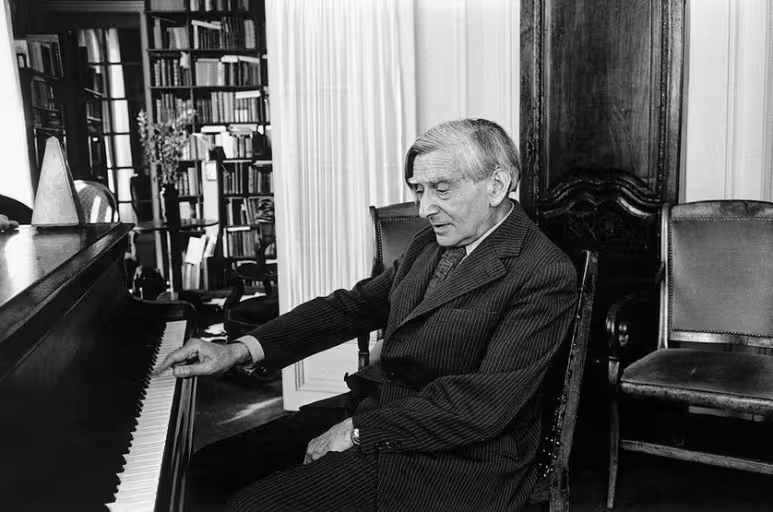
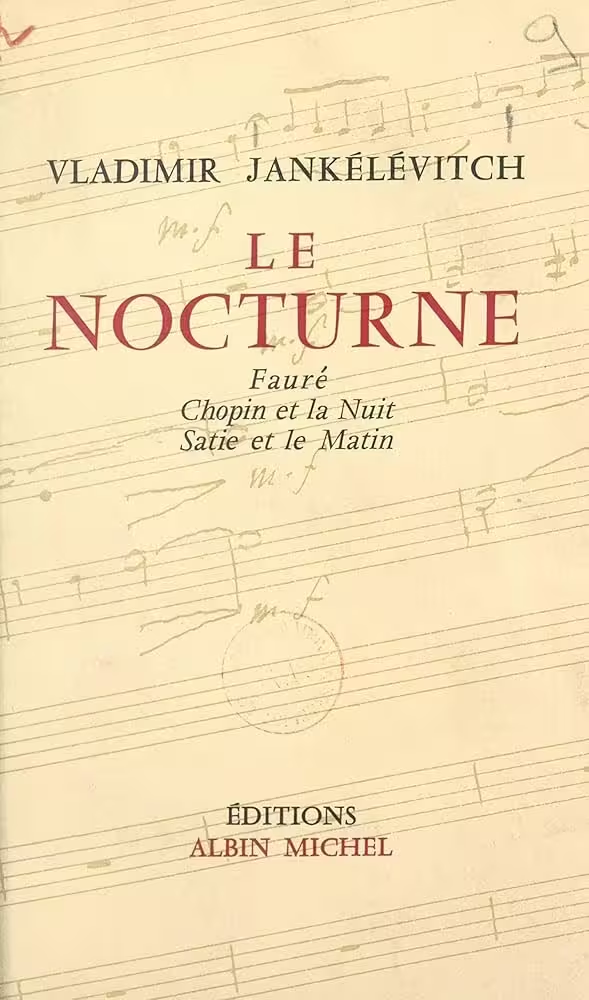
With “Nocturne” by Vladimir Jankélévitch, European Messenger, No. 29/2024. Translated from French by Mario Kopić and Dalibor Davidović
In 1942, Vladimir Jankélévitch wrote a book entitled Nocturne, dedicated to the issues of rapture and reverie, dreaming and flickering, those feelings that permeate the human soul in the encounter with its “nocturnal nature” full of passion and love madness, but at the same time a kind of romantic insight into the world beyond the rational labyrinth of organized life. Of course, Nocturne denotes praise for poetry and mysticism in correlation with the musical works of great composers and pianists, without which we cannot access the openness of the human soul to what is most intimate and painful, and without which the world makes no sense at all.
This book, I say with the authoritative experience of a sleepwalker, is stylistically perfect philosophical music, pure theoretical poetry.
“The mystery of the night will not be revealed to the bourgeois who spend it sleeping in their beds, but only to those lunatics whose protector is the moon and who seek shade because they love the light too much. Instead of the stupid Endymion, our nocturnal consciousness would summon Diotima’s Eros, whom Plato, to shame Agathon’s satiated, chubby and rich love, describes as a bohemian child, running, shaggy and a bit of a vagabond: he has no delicate skin, he does not like cotton wool and fluff, he has no permanent residence, but sleeps on the hard ground, he dreams under the stars, under bridges or on paths – χαμαιπ ετὴς ἀεὶ ” Love is a night bird and an incorrigible wanderer.”
In the selected small reading list of texts entitled “Music as Thinking”, together with texts by Wagner, Adorno, Dahlhaus, Schönberg, Derrida, Sloterdijk, Agamben, and other included authors, it shows how much thinking about music and musical thinking are intertwined with attempts at poetic and mythopoetic illumination of the world. Although music is usually and quite understandably always associated with mathematics due to the technical character of the origin of sound and the creation of melody through rhythm and assonance and dissonance, and this corresponds to the metaphysical concept of calculation in the sense of establishing the logic of numbers and their combinations in the tonal scale as well as in atonal experiments, one cannot deny what Schelling and Novalis, for example, take into account when they state, like Schopenhauer, that music as a condition of the possibility of music is the ineffable.
What does this mean other than that music “speaks” through music in a completely different language from mere speech and the instrumental character of human communication? That is why the essence of music is in this “mystery of the night” as Ungrund / Urgrund. It would be not necessary to specifically point out that Romanticism as a whole, that is, German, French and English, apart from the reversal of metaphysics that with the Enlightenment (turned) into the path of rationalism and worship of the cult of day and light from Descartes to Leibniz and Spinoza, was utterly immersed in what, since the pre-Socratic Greeks, had the characteristics of abyss and Dionysian passion, and above all, the obsession with the comprehensive “dark matter” that arises from the source of love as the unity of desire and desire for the absolute beyond any cognitive-theoretical reduction.
That is why Jankélévitch, in his wandering through the night of the mystery of music itself, masterfully connects both mystagogy and mysticism, both Greek mythology and romantic motifs so crucial for understanding what appears in the different musical forms of the nocturne in the piano compositions of Robert Schumann and Frederic Chopin, and especially in the French composer Gabriel Fauré, the harbinger of impressionism, the “French Schubert”. Reading the Nocturne in which Jankélévitch musicological and poetically, it presents a series of examples from classical and modern music about the themes and motifs of “little night music” and the enchantment of the mystery of dusk-midnight-dawn as a testimony to the triad of what unites the spirit-soul-body in the time of separation of illuminations and obscurations, we feel the merging of language, image and sound-tone-melody in fluid harmony. In addition, the selected musical notation helps those who are instrumentally trained to play the piano capture all the subtle vibrations of the soul that surrender in the night hours to the experience of what Debussy means by Clair de Lune.
Jankélévitch does not fall into any mystifications of what he inherited in his thinking in the footsteps of Schelling and Simmel. It is, of course, a different relationship to metaphysics, which always begins with the foundation of reason and the construction of a systematic discipline. I have already tried to show on several occasions that, unlike Adorno, undoubtedly the most significant philosopher and aesthetician of music of the 20th century, Jankélévitch’s writing represents a dive into what he explicitly gives to knowledge in thestylistically brilliant manner of a connoisseur of philosophy and musicology, a sovereign interpreter of musical history and the very variations in the composition and performances of especially French authors such as the big three: Fauré, Debussy and Ravel. The simplest way to put it is this.
Adorno was the paradigmatic music theorist of the historical avant-garde movements, and Jankélévitch is the one who thinks about the counter-direction of decadence in modern art and culture. For the avant-garde, the fundamental concept represents the body’s synesthesia in technical reproduction, with an emphasis on atonality and experimentation with sound. In contrast, decadence addresses the mental structure/disorder of life itself. Psyché becomes a kind of revolt against the irreversible history of the modern understanding and practice of music, which takes as its referential framework the critique of social relations in late capitalism. This inner rebellion and the path towards the deepest feelings of humanity through the synthesis of poetry, myth, and music is seen in the connection between Romanticism and Decadence. Therefore, Nocturne representsincredible praise to all aspects in which the Dionysian, lunar, is obsessed with the cosmic flow of beauty and sublimity in the discovery of landscape and nature as inspiration appears through the metaphysical dimension of Night. The mystery of the night lies in counterpoint to the veiling of the world and its mysteries, so at one point Jankélévitch expresses a thought that remains in memory forever.
A man is lonelier in broad daylight than in the moonlight!
There is something else significant in the Nocturne, and it attracts my attention beyond the undoubtedly masterful Jankélévitch’s analysis of romantic music dedicated to “nightly visions and performances”. Namely, any reference to “mysticism” when it comes to the connection between music and poetry from Schumann and Chopin to the French Impressionists is not self-evident. Our use of this term may be primarily contextual, and we apply “mystical” to everything that the so-called rational mode of explanation cannot account for. Moonlight seems so “mystical”, and then music that seeks to bring this lunarity to the culmination of a peculiar sublimity beyond the limits of language, that it is not even possible to say that the world itself is “mystical” as a case, as Wittgenstein used to say in his Tractatus.
But what exactly does mysticism mean, and what is its relation to Romanticism and its musical performances? Jankélévitch shows that this term can be used only when there is some thought at work about divinity, God, and the absolute. In Schelling’s philosophy of revelation, the matter is made clear. Mysticism can only “appear” through three modes: naturist, animist, and pantheist. Nature, soul, and the comprehensiveness of God’s existence in the world do not mean that music inspired by the moonlit and nocturnal atmosphere is also the manifestation of only one of the above-mentioned modes of the appearance of the absolute.
Nocturnals always refer to what is most obvious only to the “mystical ear” when listening to excellent piano compositions and concerts in which the “nighttime” shines with its tonality of the soul and opens completely new aesthetic horizons beyond those of everyday rationality. The entire pathos of “i-rationalism” and the abyss on which Schelling’s critique of absolute metaphysics, with its idea of a scientific foundation, is based, is also present in Jankélévitch’s Nocturne, which was written with the intention of praising what true art is as the kingdom of the psyche. Opposes the reduction of music to the manifestation of the world spirit. Here is an almost resolute statement against Hegel’s “reductionism” in the analysis of the essence of music, and nothing more can be said here except that the writer of Nocturne isa great thinker of intuitionism against rationalism.
“Hegel, who understands nothing about humor, sides with strong spirits against irrationality; in the enthusiasm of Solger, Novalis, and other Pierrots of the moonlit night, he only wants to see exaltation and reverie; he has not felt that something titanic and passionate that rises from the earth when midnight rules over all nature.”
Is, then, the music of the “nighttime” in all the variations that we can discern in the Nocturne, both in the musical sense of the sequence of Romantic and Impressionist poetics and in the philosophical passages with a multitude of known and unknown details from the history of metaphysics, the highest possible on the scale of pure sensibility and sensitivity? Judge for yourself by listening to Chopin’s works again. Nocturnes and maybe a little more by Schumann to start, and Fauré and Debussy to finish.
Everything else that can be said about it belongs to the realm of pure mysticism anyway, and this means that through the night and music, the possibility of a different perception of the world opens up, not necessarily a pessimistic one, but one that gives life the creative stimulus of the eternal pursuit of the absolute as an event of love and freedom.
Žarko Paić
Žarko Paić is a Professor at the University of Zagreb, where he teaches courses in Aesthetics and Media Theory. He publishes frequently in philosophy, social sciences, and art theory. His publications include Theorizing Images, eds. with Krešimir Purgar (2016), and Technosphere Vol. 1-5 (2018-2019), White Holes and the Visualization of the Body, (2019), Neoliberalism, Oligarchy and Politics of the Event – At the Ege of Chaos (2020), Aesthetics and the Iconoclasm of Contemporary Art - Pictures Without a World (2021).