

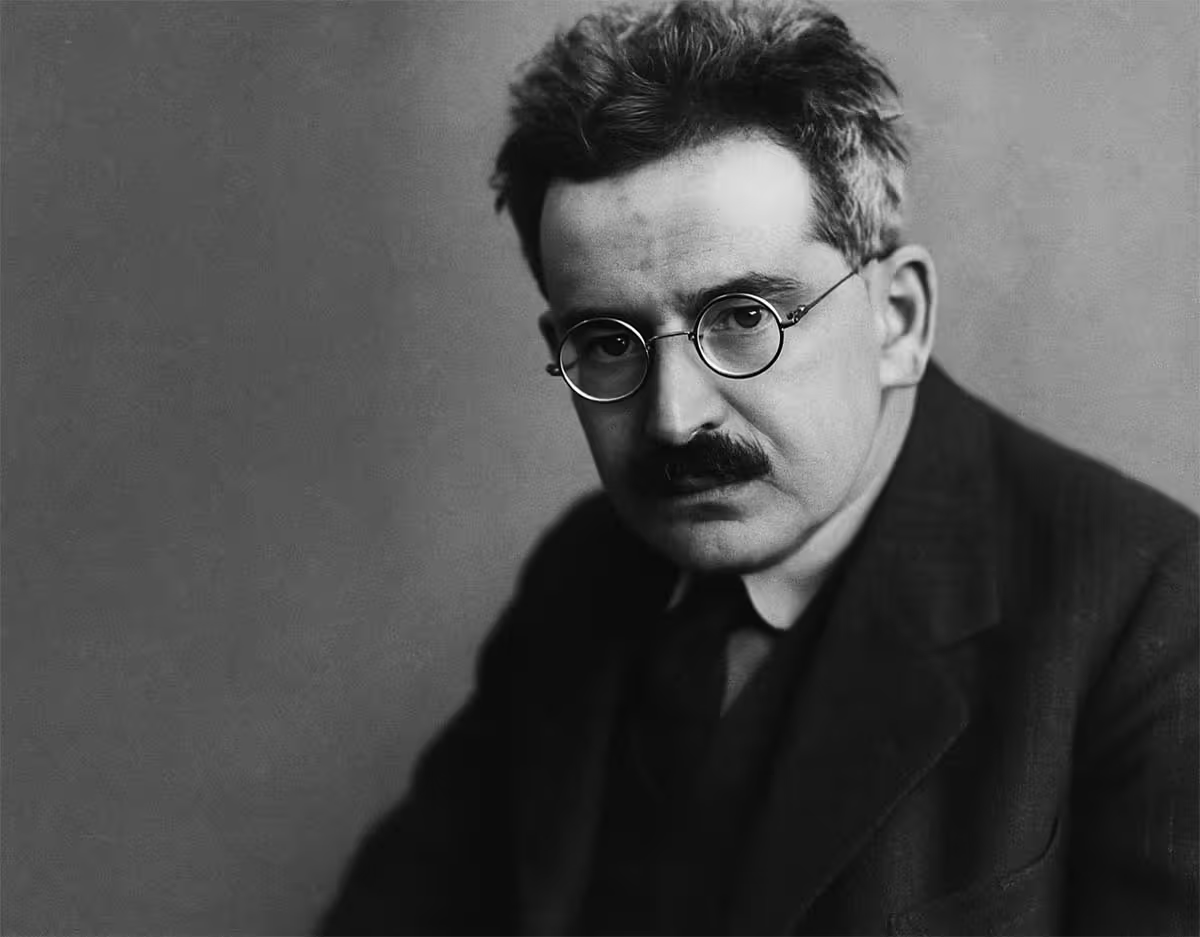
Walter Benjamin and his „aesthetics“
Abstract
The main topic of my analysis is the essence of melancholy as the death of tragedy in Benjamin’s notion of German Baroque drama. In the difference between the symbols with which we witness the unity and wholeness of Being as an idea with allegory, we are in a world of complex expressiveness. The symbol indicates what opens in its entirety. Allegory, on the other hand, represents a figure of speech in which the object itself denotes something that stands as a symbol for something else, but the other is not strictly defined in itself. It cannot be broken down and reconstituted without a complete breakdown of things. It is not uncommon, therefore, that in the trace of Benjamin, the figure of an allegorical representation signifies what is already in the sign of burning out of God’s presence. The fallen angel represents the most compelling allegorical image. If its “function” should be to transmit the voice of God into the world of creation, then its appearance is already to be the meaning of the impossibility of a connection between the two worlds, the sacred and the mundane. Therefore, what Benjamin does in interpreting art and artwork in the German Baroque is double recoding:
(1) German Romanticism with the ideas of Schlegel and Novalis;
(2) the German Baroque with the idea of the “mourning play” (Trauerspiel) as a proper art form, which, as in the modern theory of emergence in technoscience, significantly changes the direction of the development of European history.
The change is that the “mourning play” preserves the tragic form while its content is entirely new and modern. Benjamin understands the dialectical relation between form and content. It is not a form in the Platonic sense of the “eternal” essence of Being itself. If the fate of the Christian understanding of the world is “entelechy in the notion of guilt,” then the path to redemption from this matrix of the determinism of spirit, soul, and body leads through melancholy. The Greek notion of apathy or indifference should be distinguished from the Christian and secularized version of melancholia. While nothing can be done out of indifference except mere contemplation without an object that changes with its essence, melancholy presupposes a state before stopping the action. Moreover, these possibilities lie outside the logic of absolute necessity, which moves in a circle of predetermined options. For Benjamin, it seems necessary to dismantle every single remnant of this Greco-Christian determinism of “destiny.”
Keywords: melancholy, mourning play, German Baroque, allegory, tragedy, technoscience
Introduction
Why, for the theme of his habilitation work, written and prepared in 1925 and published in 1928, did Benjamin choose a seemingly extreme boundary theme from the spiritual history of German Baroque? The circumstances were such that the mandarins of the Germanist profession at the University of Frankfurt refused to bring this work to the last stage of the defense of the settings presented in an extremely original way, almost exemplarily academic and thoughtfully executed, because they did not understand his last intentions. Besides, as Benjamin himself wrote in the correspondence, they placed him in the realm of “aesthetics”, not Germanicism in the narrow sense of the word. The origin of the German Trauerspiel (Ursprung des deutschen Trauerspiels) is certainly a genuine form of discursive novelty. The question of the relation between the work of art and the truth of the essence of philosophical romanticism is directed from there to the existential relation of the sacred and the profane. Nothing is left to chance.
The connection of everything to everything shows that we need to look differently at events in their origins and disappearances. All the next steps on the path of the notion of the radical turn in time, with modernity becoming a disaster and art, through the political forms of totalitarian movements, significantly changing the way of existence in modern societies, are outlined in this work. This applies in particular to several newly created concepts: the method of the emergence of the “philosophical style”, the introduction of the idea of “authoritative quotation”, and the structure of the fragmentary text as a “mosaic”. With all this in mind, it seems obvious that Benjamin devoted himself to the Baroque because of his foreseeable absolute novelty within the eclectic-hybrid history of creation in a time of “homogeneous emptiness”, even more so because of the powerful analogy with what would become the fateful themes of art and philosophy of the 20th century. It is about melancholy and the collapse of the metaphysical assembly of the world. There is some historical “justice” in the ironic putting things in place. This text denotes a perfect example of the aesthetic reconfiguration of thought beyond the firmly established canons. Because of this, it may even have justifiably confused the orthodox Germanists. Just as in the case of Friedrich Nietzsche’s inaugural work The Birth of the Tragedy from the Spirit of Music (Die Geburt des Tragödie aus dem Geiste der Musik) in 1872, by which he lured classical philologists to interpret the original Greek and its gods. So both Nietzsche and Benjamin were thrown out of the academic game of classical philology and German studies, and philosophical thinking was opened for the coming times with a truly new approach. It does not linger even in this indefinable age of deceptive technological abyss.
1. The Dark Secret of Baroque
So why the Baroque and its dark secrets at all? We can approach the answer to this question by bypassing the question itself. Uwe Steiner points out that when confronted with the literature on German Baroque, Benjamin found himself in a position from which he could only “get out” by sailing to the other shore, that is, to prepare the ground for a change in the “aesthetic paradigm”. (Steiner 2010: 63) What does this mean? By no means should we be satisfied with the decision to pursue a different path in the emergence of modern concepts without a historical exploration of the hidden causes. There is no doubt that the relationship between Baroque and romanticism can also be interpreted as a “sovereign opposition to classicism” (Steiner 2010: 64). However, this proves something decisive for Benjamin’s approach to the problem of the “sovereignty” of a work of art as a link between truth and beauty in an era of “ruins”. This is no less than the internal relationship between aesthetics and politics.
This will be the key to understanding why, in the age of the decay or loss of the aura of a work of art in the age of its technological reproducibility, Walter Benjamin’s seminal writings, begin a new understanding of the idea of art at all, in the outcome of modernity, it happens that instead of a religious cult and ritual it is now “political theologyʺ of ‘Nazism/fascism and the ideology of communist Stalinism use the art for other purposes. Benjamin’s book Origin of German Trauerspiel (Ursprungs), specifically as an art form and discourse in the Baroque setting, follows the changes in the “aesthetic paradigm” in the modern niche, rather than the question of changing the “political paradigm”. Moreover, it will prove to be more enigmatic, more uncanny, and, at the same time, the reason for overriding all existing theories about the “autonomy” of art and work in historical time. In a sense, the revelation of what was hermetically sealed in the perfect texture of Benjamin’s writing until recently points us to the next clue in the interpretation of that dark secret of the Baroque. The trace leads directly to Carl Schmitt, the mandarin of 20th-century political theory, and his famous assumption:
“All significant concepts of the modern theory of the state are secularized theological concepts not only because of their historical development – in which they were transferred from theology to the theory of the state, whereby, for example, the omnipotent god became the omnipotent lawgiver – but also because of their systematic structure, the recognition of which is necessary for a sociological consideration of these concepts. The exception in jurisprudence is analogous to the miracle in theology. Only by being aware of this analogy can we appreciate the manner in which the philosophical ideas of the state developed in the last centuries.“ (Schmitt, 2015: 49)
What does the “political theology” of an official thinker of a “state of exception” have in Nazism with a “Marxist rabbi” and that the paradox is complete where it will not be expected at all? It is reasonable to infer that, in his political writings of the 1920s and 1930s, Benjamin alludes to Schmitt’s influential writings on sovereignty, the state of exception, and “divine violence” in explaining the relationship between revolutionary violence and dictatorship. It would not be expected, however, that Benjamin could construct his historical theory of melancholy concerning the art of the German Baroque in the 17th century as an aesthetic application of Schmitt’s doctrine of sovereignty. All recent interpretations of Benjamin’s early aesthetic theory can no longer ignore the facts. In a letter of thanks to Schmitt in December 1930, Benjamin expressed respect for his political thinking. This is especially true of the writings on “Dictatorship,” and it is acknowledged that, without Schmitt’s political philosophy, his research in the philosophy of art would be impossible. In interpreting “Benjamin-ability,” Samuel Weber convincingly demonstrated the close links between aesthetics and politics, and the notions of “exception” and “state of emergency” with those of sovereignty and the propensity of the German mourning play, in the difference and identity with Greek tragedy.
This letter did not appear in 1966 in the first issue of Benjamin’s Correspondence, as the scandal of closeness in the thought of the revolutionary Jew and Nazi political scientist would have far-reaching consequences for critical reading not only of Benjamin but also of the program of Frankfurt’s Critical Theory. (Weber 2008: 176-194) If we eliminate all these seemingly external circumstances, one thing seems undeniable. Is the idea of Origin of the German Trauerspiel only in the application of Schmitt’s political theory of sovereignty to the arts? Contrary to that assumption, it denotes a creative application of ideas in another assembly of action with an explicit instruction that the term “sovereignty” refers to the modern secularization of Christian apocalypticism and messianism in all fields of thought and activity. Art cannot be an exception in this process of falling into a time that determines the lasciviousness of worldly power, the age of cruel tyrants, and the allegory of Doomsday. The more autonomous the art, the more sovereignty is given to politics. And it would be entirely wrong to reduce this creative relationship of two, however significantly opposed thinkers, to the “appropriation” and “application” of the finished theoretical solutions. After all, as we will show in this book, Schmitt and Benjamin differ significantly in their understanding of political and politics, katechon and Messianism.
For Benjamin, the term “mourning play” (Trauerspiel) can be understood as an essence of the German Baroque. It is already clear that this means a special case or exception. In European history, the exception no longer confirms the rule. It may be overwhelming to say that he creates it again. Nevertheless, it seems reasonable to consider the possibility of detachment from the template, as in emergence theory. However, the Baroque, as well as Romanticism, cannot merely be reduced to the question of the style with which art history and literary theory seek to distinguish the “spirit of the epoch” from previous such tendencies in the roundness of time, such as the Renaissance, for example. For the first time in the history of the aesthetic framing of thought, Benjamin’s account of the Baroque is understood as a comprehensive historical-artistic and historical-political paradigm of thought and action. It is interesting that, on almost the same assumptions, but philosophically much more articulated, Gilles Deleuze, dealing with the Leibniz monologue and his thinking for the future concerning the concepts of the monad, assembly, and constellation, will show that “the metaphysics of the Baroque” represents a kind of introduction to late modernity. The reason lies in the use of experiments and plays as fundamental concepts. (Deleuze 1992) Thus, if the Baroque is understood only through the historical-structural organization of thought and action, then his “style” within the art of the European circle must be derived from the basic notions of life in the epoch of political sovereignty of secular monarchies in the 17th century. The irreducibility of the German Baroque to the concept Trauerspiel means that, instead of the Greek tragic heroism in the face of an individual with destiny in his own hands, mourning (melancholy) in the past comes to the fore. When the anti-hero becomes a figure of the “decadence of the epoch”, the illusion of history’s ultimate purpose is lost. It is no longer a mere imitation of the Greek original in the Baroque context. Instead, Benjamin introduces us to a dark age of mystical-philosophical conceptual play with a series of eclectically derived concepts: monad, mortification, digression, constellation, mosaic, other land, and origin. But it must be said at once that the eclecticism of style lies in its genuine originality. It is created exactly as we seek to refine Benjamin’s path of thought here. “Philosophical style” denotes writing as the construction of an assemblage of Being through the establishment of constellations of relations within society-culture. As a result, something “pre-existing and determinative in terms of symbols of classicism” is no longer considered “style”. In its place, we can see the “style” of mosaic fragmentation of storytelling. Now allegory replaces the symbol as the mourning play becomes the sovereign “genre” of modern tragedy. This is not a mere substitute for previous cultural roles. On the contrary, this is an aesthetic change in the ontological paradigm with political implications for the state of modern sovereignty. Benjamin says in Origin of the German Trauerspiel:
“If the modern concept of sovereignty amounts to a supreme executive power on the part of the ruler, the Baroque concept develops based on a discussion of the state of exception and makes it the most important function of the prince to avert this state. Whoever rules is from the beginning destined to be the possessor of dictatorial powers if war, revolt, or other catastrophes should bring about a state of exception. This assumption is characteristic of the Counter-Reformation. From the deep feeling of life of the Renaissance, its worldly-despotic element emancipates itself to develop, in all its consequences, the ideal of complete stabilization, a restoration as much ecclesiastical as political. And one of these consequences is the demand for a principality whose political-juridical status guarantees the continuity of the commonwealth that blossoms in feats of arms and in the sciences, in the arts and in the church. In the theological-juristical mode of thought that is so characteristic of the century, there speaks the decelerating hypertension of transcendence that lies at the bottom of all the provocative this-worldly accents of the Baroque. (…) There is no Baroque eschatology, and precisely for that reason, there is a mechanism that multiplies and exalts everything earth-born before it is delivered over to its end. (Benjamin 1991: vol II: 245-246; 2019: 49-50)
The dark secret of the baroque lies in the emergence of reflexive consciousness. It is not like Hegel’s “tragic consciousness” in the necessary separation between the beginning and the end of the journey of the absolute of history. The difference we have to detect is that the Baroque rejects any eschatology. In that vacant place lies the sovereignty to decide the life and death of the subjects. Everything then happens on a “case” basis. The state, politically and historically determined by the Counter-Reformation in Europe, denotes a breakdown of ideals and norms of order. When the Baroque German „Trauerspiel“ clears itself from the “mourning” of the inexorably lost past, we are faced with the absolute freedom of origin/source (Ursprung). The problem is that the sovereign entrusted with the power to change the order of life and death radically lacks the purpose and meaning of historical progress.
In this gap, he becomes bloodthirsty and a tyrant, because the power he possesses as a subject of “dictatorial violence” enables him to deal with subjects by inverting the order of creation. It now plays the main role as the negative pseudo-creator of the “case,” a new definition of destiny. In particular, Benjamin seeks to show, concerning sovereignty in politics and aesthetics, that the baroque, as a period of chaos, must ultimately create a kind of substitute order. The sovereign must produce new stability. It will do this by triggering a whole host of causes for the creative process. There is no doubt that the “mourning play” (Trauerspiel) was founded in the historical events of 17th-century Germany. But as an exception that no longer confirms the rule ‒ the bloody history of the emergence of constitutional monarchies in England and across Europe ─ it creates a new rule. Almost similar to the theories of contingency ─ complexity today influential in epistemology, it can be shown that Benjamin, in the wake of romanticism and Nietzsche, is considering a special case of German “cultural history”. It starts from its paradigmatic version of modern tragedy. Two leading terms belong to the relation of an assemblage of Being and the constellation of the relationship of time: melancholy and allegory. The former is related to the understanding of the world in Baroque cosmology and theology of the historical period, and the latter to the attempt to stop time in pictorial thinking through an analogy that cannot have the features of a symbol. The reason, of course, lies in the fact that eschatology in the Baroque does not exist, as we have stated in Benjamin’s text.
The symbol refers to the persistence of Being, while the allegory refers to the meaning of otherness and the Other as the volatile world of change. Unless there is an idea of the continuity of the development of time from the beginning point to the end of history by entering the niches of eternity, then time cannot be otherwise acquired except by the image of transience and disappearance. The language of decay and ruin is thus expressed in an allegorical “excess of the unutterable.” Isn’t this twist the beginning of the search for an image language that still lacks something intangible? Namely, something stunningly modern and more than that comes from all that has been said. Baroque cannot be merely a style of artistic production of sublime meanings in the face of the loss of soil beneath our feet, when chaos and emptiness inhabit the pursuit of the divine. Something uncanny is born in him. Through the gap between the sacred and the profane, the possibility of the new is created. It will only be necessary to mediate this “new” with the technological construction of life. After that, anything will become “profane illumination”.
2. Between Language and Image
What encompasses the relationship between language and image in early Benjamin’s thinking? We shall agree that the concern for telling throughout his work lies at the highest level of expression. It seems self-explanatory that the study of Novalis and romanticism was highly significant to the fragmentary and elliptical nature of the statement. But this would be even more true of the Origin of the German Trauerspiel. It finds new forms and discourses, conceptual figurations and sentiments. The intention is to break through the vicious circle of transcendental speech. If there is no vitality to individual work, everything is left at the mercy of the abstract form. The significance of language in the formulation of the setting on the sovereignty of the secular age of chaos, with which the Baroque builds a deceptive web of stable order, decisive for understanding the relationship between melancholy and allegory, seems already evident in the fact that Benjamin grips everything that belongs to the genre of modern tragedy. He dealt with the language as early as 1916 in two fragments, Trauerspiel and Tragedy (Trauerspiel und Tragödie) and The Meaning of Language in Trauerspiel and Tragedy (Die Bedeutung der Sprache in Trauerspiel und Tragödie). (Benjamin, 1991: II-i: 133-137; II-i: 137-140).
The language, therefore, is understood as almost platonic and Kabbalistic. We call it the world, not for mere communication. The original saying could only be possible due to the divine openness of the language by which things enter the world. If one understands the “nature” of language, then the task of philosophy should be to create events that show the world on the horizon of time as a creative play on the verge of mystical speculation and demiurgic experiment. The traces of Jewish messianism are intertwined here with the Greek notion of saying. It was preserved by tradition, and, in the romanticism of Novalis and Hölderlin, it reached its highest insight into the essence of art.
However, the meaning of language is refined. In the “mourning play” of Greek tragedy, language now serves as pure sound without meaning, a signpost of emptiness. In two language fragments, the metaphysical depth of the world’s creation is unfolded. Instead of naming the new from the essence of the saying that comes from the word of God as synonymous with the creation of the world, the work of emptying human language in the function of empty communication is at work. There is no doubt that Benjamin cannot be likened to universal semiotics that reduces language to a bare sign in the marking process. From the very secret of Jewish Kabbalism, exalted in the 20th century by his companion and friend Gershom Scholem, the revelation of the word of God depicts the world as a game of eternity and temporality through the niches of illuminations.
Therefore, it can be said that the downfall of language into a state of technical-sign communication without depth is responsible for the original fall of man from God’s truth of revelation in the glibness of historicity. Empty words no longer refer to the sanctity of speech that legitimizes the nature of things. Everything becomes an arbitrary sign. For this reason, the function of allegory in the Baroque can be understood only when one recognizes that the experience of the decaying metaphysical image of the world of response is dancing over the ruins—baroque time lapses between the psycho-drama of Trauerspiel and the experimental game with the technical language of machines.
In the “Epistemo-Critical Foreword”, in discussing the “traurspiel”, Benjamin restricts at the outset the task of “philosophical doctrine to historical codification.” (Benjamin 1991, vol. II-i: 207) The issue of rendering would be problematic, but not only because historical time and the system within the “philosophical doctrine” that accounts for what is happening here are historically encompassed here. The problem of systems and methods in Hegel’s Science of Logic (Wissenschaft der Logik) as well as in Marx’s Capital isof fundamental cognitive-historical significance. It does not matter how or in what way it depicts and represents what distorts the ground at our feet, becoming a complete history. However, the terms and categories of historical account, as Benjamin understands them through the speculative-dialectical development of Kant and Hegel, require a different mode of explanation.
Moreover, this is a consideration that places at the center the problem of the origin or emergence (Ursprung) of something such as the actual form of a modern tragedy in the German “mourning play” (Trauerspiel). The breakthrough to a new understanding of the relationship between the cognition of being and truth, which Benjamin seeks to present through his way of thinking in this debate, seems, at the same time, both extremely stimulating and, above all, controversial. Namely, to maintain at all an approach based on the revelation of concepts as figuration, which in the late 1920s and 1930s would be called “thought and dialectical images” (Denkbilder-dialektischer Bilder), it was necessary to show what consists of a changed relation of “universals” and “transcendentalities”, singularity and repetition in matters of cognition of Being and truth. In his interpretation, Rolf Tiedemann shows, in passing, that the notion of Being used by Benjamin, however, has hidden points of contact with Heidegger’s Being and Time (Sein und Zeit). But it is closer to a form of mysticism and an esoteric conceptual use, in the wake of Ernst Bloch’s 1918 book, The Spirit of Utopia (Geist der Utopie). (Bloch 2018)
The task of philosophy and criticism is therefore shown in the “presentation of the idea.” Its portrayal involves abandoning transcendental forms of abstraction. The Prologue attempts to go even further in considering the idea of criticism and the notion of a work of art. Instead of recognizing the romanticism of the Gesamtkunstwerk, the focus is now shifting. In the configuration of a complex game of concepts that come from all walks of life, meaning history, philosophy, art, social relations, mysticism, and the natural sciences, Benjamin builds a new edifice of a theoretical representation of reality from autonomous fragments. In other words, instead of ruling the abstract universality of concept and category, everything moves toward the profane path of grounding things. The distinction between concept and phenomenon appears to be a key point of departure from Kant’s dualism. This is already evident in his advocacy of romanticism in Schlegel and Novalis. But now everything is thickening.
Being formally Baroque, it is entirely gratifying that the depiction of the life of the term is taking place in the present time. Interpreting the past cannot be a conversation with dead shadows, as in Hamlet’s “spiritualistic encounter” with his father’s spirit; instead, the critical reckoning with the epoch that established itself as a period of “decorated style” takes place through the gradual removal of gilding from various Baroque theories in German history. In an analysis of the philosophical sources of Benjamin’s “cognitive-critical” phenomenology, Rolf Tiedemann arrives at a position that seems essential for further reading of The Origin of the German Trauerspiel. Referring to the ontological distinction between Benjamin’s understanding of the language derived from the fragments already mentioned and what constitutes the internal structure of the representation-presentation of a work of art in the Baroque in terms of language, it can be argued that it is the reverse of mediating reflection as an abstraction of the term in the immediacy of the language itself. Within the socio-cultural position in which the “mourning play” takes place, a paradigm shift occurs. In what ways can we detect this event? The abandonment of the theological-mystical structure of language in favor of the profane-materialist, and thus the Baroque, is understood by Benjamin in light of Schmitt’s stance on sovereignty and the state of exception. (Tiedemann 1973: 39-40)
How should this be understood? In simple terms, Benjamin starts from the changed status of language arising from the secularization of the divine. What used to be a telling naming of the world is now being transformed into a signed letter of wandering between worlds. The “mourning play”, however, is based on the invention of a consciousness that, instead of the classical tragedy, brings into the aesthetic content of the new Era of anti-heroism and the end of any hesitation about the purposefulness of Being as nature. The baroque world emerges as a space of “homogeneous emptiness”. In it, the word is no longer revealed as the secret of creation. Instead, it’s all wrapped up in the dark cults of human rule. Based on fear and dictatorship, everything becomes unstable. The chaos somehow still has to be “settled.” Otherwise, the greatest possible danger represents the collapse of the order. What still links the tragedy and the “mourning play” is nothing more than an awareness of the inability to radically abolish the “tragic essence” of humanity in historical progress. In this way, the antinomies of the mind become the antinomies of feelings as representations of progress and eternal recurrence. In the philosophical sense, the question of cognition becomes, therefore, an issue of critique of the concept of Being as something permanent and immutable.
Therefore, in this discussion, Benjamin touched on the taboo in medieval logic and ontology that persisted into modern times. He approached the “nominalists” or “particularists” in a peculiar way. Also, he did so by opting to portray in the philosophical discourse a concept that is no longer a term. But it still has the feature of a phenomenon in its irreducible singularity. This meant that the issue of Being and truth had to be debunked along the path of the deconstruction of both traditionally metaphysical understandings that reigned from Aristotle to Hegel. One starts from the generality and abstract deduction, and the other always assumes the specificity and the individuality of the “event” of a thing or Being. When a word becomes a “medium”, then the language takes on the meaning of transforming saying into communication. What constitutes the “essence” of language henceforth and has cognitive-critical consequences for all of Benjamin’s further derivations is the insight that the Baroque age, in its sovereign irrelevance, should be nothing more than a melancholy connection to the persistent Being in the allegorical depiction of time (eternal presence).
It is a time of mourning for the past, as the construction of something that is constantly being renewed progresses in its reproducibility. In other words, Benjamin realized that he needed to move between thetwo ontology-cognitive models. The other, with the notions of contingency and singularity, profanity and displacement, is only a conditionally “right” path to truth. But what is the truth other than the connection/relation of the assembly of art-politics-technology and the constellation of society-culture in the age of the decay of the metaphysical picture of the world? In one place of “Epistemo-Critical Foreword,” we come to an explanation. The method that must guarantee a true account of what the matter is about is summed up in a “contemplative mode of presentation.” Discussion (Tractatus) brings together a critical and philosophical notion of representation:
“The trauerspiel, as treated in the philosophy of art, is an idea. Such a treatment is distinguished from the literary-historical principally by the fact that where it presupposes unity, literary history’s obliged to demonstrate diversity. When developed conceptually, the differences and extremes that literary-historical analysis amalgamates and relativizes as evolving concerns acquire the status of complementary energies, with history appearing as only the coloured border of a crystalline simultaneity. “(Benjamin 2019: 15)
The distinction between idea and phenomenon, however much it appears to be a Kantian question of the subject as the source of transcendental cognition, now opens into a dispute between philosophy and literary theory. While the former concerns the idea of keeping history from purpose and plan, the latter, so far, presents many individual cases. It is an entire archipelago of events that should be treated as grass growing in a desert. The idea cannot be separated from the phenomenon unless the phenomenon itself is an isolated particle in the world of monads. In further developing his thought on the notion of “Trauerspiel” in “Foreword,” Benjamin emphasizes that Leibniz’s idea of a monad in the pre-established harmony of the universe represents a path of resolution between the general and the individual.
„The idea is a monad. The being that enters into it with its fore- and after-history gives, in its own hidden figure, the abbreviated and obscured figure of the rest of the idea world, just as, with the monads in the Discourse on Metaphysics of 1686, all are given obscurely in each. The idea is a monad: the representation of phenomena rests preestablished in it, as in their objective interpretation. (Benjamin 2019: 27)
Moreover, monads are only possible as a multitude in the One. Therefore, the metaphor of “crystal clear simultaneity” presupposes the existence of a heterogeneous space. The downside is that such a space for the emergence of the world in the Baroque era must narrow, becoming limited to the homogeneity of a particular void. When philosophy, as the cognition of art from heaven, descends into the underworld of empirical chaos, a kind of reversal of perspective occurs. History is no longer viewed vertically but horizontally. The image of simultaneity also signifies something of greater importance. It is, therefore, a transition from the mediation of reflection to the construction of the conceptual world of phenomena as contemplation. A new beginning, a reversal, a turn of perspective requires discontinuity in the composition of fragments. It is as if we are agreeing on a riddle, so when we encounter Benjamin’s fractal epistemology of a work of art, we encounter two figural notions that come formally from the art world, but which are essentially philosophical and conceptual. Both melancholy and allegory are “images”.
Isn’t it strange that the term melancholy can be more clearly understood from Dührer’s famous painting Melancholia I as captioned as it was from Klee’s painting by Angelus Novus than from a reflection on the language in which the term is expressed? Isn’t it even more unusual that melancholy cannot be revealed directly from the structure of the “mourning play” in German Baroque, but rather requires the mediation of language as an image that points to something else, which means that the language becomes an image script and the image becomes a new language? We still have no analogy for that language other than resorting to mythic and mystical parables from the Bible and the Talmud. However, in the „Foreword“, Benjamin seeks to prepare himself for a cognitive-critical confrontation with the tradition of metaphysics, which in all its forms is the same.
3. Melancholy and Boredom
What Plato represents in philosophy denotes the beginning of the separation of ideas and the world of phenomena. Thus, the metaphysics which Benjamin explicitly points out with a view of Leibniz’s Treatise on Metaphysics reverses itself. But not how it is in Heidegger’s thought turn (Kehre) to the indeterminate and instructive word/notion of “other/second beginning” like an event (Ereignis). The path is Benjamin’s thinking in a kind of aesthetic change in the paradigm of metaphysics itself. What was Nietzsche’s intention in properly disputing with Kant in Walter Benjamin’s habilitation file is continued by other means. What counts, however, is not simply the question of Being as the object in the modern sense, but rather the question of its historical rivalry within an era that has so far been portrayed only through the historical-artistic notion of “style.” Baroque is no longer a matter of art as “style”. Much more important is the era of the “philosophical style”, the Baroque. How do you explain it? Now, the chaos of a multitude of phenomena requires a sovereign right to another type of rule: metaphysical navigation from one world to another, from the realm of ideas into the ruins of phenomena.
Benjamin was one of the first to see that the age of “creative emptiness” had arisen with the Baroque. In the age of high modernity of late 19th-century capitalism, as it is portrayed in the Arcades Project/Das Passagen-Werk, this will lead to the most serious sickness: the decadence of the outdated “new world”. This malady is annoying because at the heart of the desire for progress lies the anxious repetition virus already seen. Melancholy and boredom are two halves of the same discontent; from the emptiness in the core of Being come dark waters. Allegory and montage, in turn, represent two artistic and technical means of presenting the time of universal mourning and boredom. Between them is a space-between. In it resides history as a sacrifice of physicality. By getting rid of the transcendental law of guilt, life becomes an empirical singularity of the heresy of origin. When eros and thanatos, the Angel of History and the Messiah of events, blend into it, we are given a “dialectical image” of history as a catastrophe and a possibility of salvation.
To understand Benjamin’s contribution to the philosophical debate on the essence of modernity, we must continually bear in mind that it encompasses the logic of mediation, transitions, and simultaneous reflection and contemplation that converge in hybrid circuits such as the “dialectical image” and “profane illumination.” Everything is already open in the systematic, methodically branched paths along the edge, forming a new center. Not coincidentally, the whole problem of distinguishing between tragedy and “mournful play” boils down to determining the relation between the future and the past concerning the “eternal present of the moment” or Now-time (Jetztzeit). The paradox is that Greek tragedy has an open history because it is guided by the notion of “fate”, subject/actor and goal/purpose (télos). The “mourning play” doesn’t have that. It is just one idea of mutual chaos. In the reconfiguration of human emptiness, it appears like a spook. And because it has no purpose or aim in the future as a space to inhabit another world, everything in it lies in the sign of mortification, the depiction of death, and the geometry of the pre-established harmony of the universe.
The main anti-hero is Baroque Hamlet. By simulating madness, he comes to the dark truth of the world. And the leading reflexive creator of the perfection of order as a network of conflicting monads is the philosopher–as-mathematician ofbinary code – Gottfried Wilhelm Leibniz. What Benjamin prepared in the analog age continues to make the much more radical and complex Gilles Deleuze possible in the digital age. In the metaphysical attire of the Neo-Baroque, he constructs multiplied sets of concepts. Let us return to the core of the “Trauerspiel” debate. As we pointed out earlier, in the “Foreword,” the method of digression and mosaic is established by playing with monads and mortifying text. In a formally written study on Baroque art, Benjamin, in this treatise, endeavors to relate the romanticism and expressionism of his time. In one place, this is particularly striking when it comes to the analogy of the Baroque and the present concerning the use of language:
“The analogy between the endeavor of this former age and that of the recent past and present day is especially apparent on the level of the language. Characteristic in both cases is a certain forcing of effect. The products of these two literary epochs do not so much emerge from communal existence as attempt, through violence of manner, to conceal the deficiency of valid productions in literature. For, like Expressionism, the Baroque is an age not so much of au then tic artistic practice as of an unremitting will to art. It is always thus with so-called decadent periods. The highest reality in art is the isolated, finished work. At times, however, the work achieved remains attainable only by the epigone. These are the periods of “decline” in the arts, the periods of a “ will to art.”(Benjamin 2019: 37)
If this might be true, then the so-called “decadent periods” are seemingly eclectic and hybrid in style, and often epigone in performance. But Benjamin is not the one who would vulgarly declare the style of such a period illiterate and unworthy of any critical attention. On the contrary, in his own “philosophical style,” the experiences of Baroque-Romantic-Expressionism will be productively combined, as in the early work of Ernst Bloch and Bertolt Brecht. In any case, amid the fringes and gaps, the messianic hope, and the historical decay of metaphysics, something in all this has come to the forefront in a new way. What? Melancholy is a feeling of sorrow for the loss of a sense of the past, not for any specific object. Therefore, one must distinguish between melancholy and mourning for something real in the past. To be able to complain about something real is always a condition of the possibility of some unforeseen loss, such as the death of a loved one. But when it comes to melancholy, then we can no longer talk about feeling with a completely clear intention. In other words, melancholy does not have a specific intentional object. In this respect, its ontological status remains uncertain.
The problem that Benjamin addresses in his philosophical and artistic discussion is finding the essential difference between melancholy as an experience of ruin and mourning the loss of its objects, all of which have already disappeared into the black holes of history. Where, however, does this difference come from? Of course, its origins lie in analogy with the present tense. And it also has the symptoms of decaying metaphysical rank. Where the melancholy sense of life contrasts with the tragic, as meditated upon especially by the Spanish philosopher and poet Miguel de Unamuno, there are two ways of thinking about Being and time. It tragically refers to the rule of law of causality and the modal categories of “necessity” and “reality”, and it is melancholically determined by the rule of “chance” and “possibility” of reversal by the last stroke of divine light. The paradox at the heart of this lies at the heart of Benjamin’s entire intervention in understanding the meaning of Being and Time. While Greek tragedy rests on the idea of the fateful pre-determination of the world as the “necessity” and “purpose” of the divine order of things, the melancholy of the “mourning play” is based on the indeterminacy of the events of interruption with this order of closed nature. What it mourns and complains about is nothing at all aside from the mourning of time, as Peter Handke expresses in a poetic, sublime manner, in the poem “Living Without Poetry” ─ when it was still to be wanted.
The loss of the “meaning” of the language that God legitimizes by choosing Adam, the “father of philosophy,” as Benjamin eloquently states in the “Foreword,” cannot be replaced by anything other than a mortification of the meaning of the text itself. When the meaning of the past is reconstructed in the present, the loss of what had the characteristics of harmony and symmetry in space and nature becomes a sign system of language. It operates without a supreme signifier. Melancholy, so to speak, Hölderlin has always had “delayed awareness” of the loss of primordial Being and time. Therefore, its action can be understood only when the tyrant’s sovereign rule takes the place of God and the sacral, without the reasons for political power based in the “higher spheres” of historical development. It is no coincidence that Benjamin recognized in Schmitt’s notion of the “state of exception” the beginning of the new era as a period of terrible chaos and entropy. A sovereign declares a state of exception, Schmitt says. And in light of the debate about melancholy and allegory in the baroque, Benjamin will apply that view to the state of the permanent crisis of meaning in general. History as a catastrophe becomes the scene of the melancholy consciousness of the subject/actor of a “mourning play” that no longer rests in something eschatological that takes place at the time of beginning and end. This is what the late Derrida calls “the endless apocalypse.” (Derrida 1983) So, what’s the paradox? Tragedy opens the space of the future as a “necessity” of the events of the Being itself in time.
Melancholy, on the other hand, closes the door to the future as a “necessity” and allows the past to arise from a commitment to one’s disaster and loss of all humanity, leading to redemption in the Now-time (Jetztzeit). The melancholy that Benjamin is intensely engaged in his thinking of the Baroque is not, therefore, a term that would be strictly aesthetic because it is based on a sense of mourning for lost time. It is an awareness of an event that becomes a condition of the possibility of a completely different version of utopia than that of the cult of progress and the positive sciences. While tragic consciousness necessarily occurs in the split between “before” and “after” history, necessitating the sacrifice of the subject, melancholic consciousness is guided by reflection as contemplation. In the past, we saw nothing but a cemetery of devils, ruins, and traces of ruin. On the contrary, changing events in the present change the contours of the past. Thus, the future should not be allowed to be reduced to the mere realization of what is “now.” It can be more than that and gain the right to unpredictability, uncertainty, and non-reducibility.
How do we determine the dark secret of the Baroque? It is immersed in the horrors of the “present.” From the sovereignty of the power of that profane, without any remorse for the past missed, flows the positivity of change. But it should not be surprising, therefore, that Benjamin assumes that Hamlet is also a melancholy figure, not a tragic hero. Anything that bears traces of melancholy consciousness can be determined by doubt about the future. It might be better to say that this suspicion comes to fruition in the form of ineffectiveness or the suspension of any action that proceeds from the predetermined purpose and aim of history. Without melancholy as an experience of the breakdown of Being and time in the original sense of the word, there is no possibility of mourning as a sense of loss for something object in time. Instead of being a complete break-in time and powerlessness to act when everything else is devoid of the eschatological trajectory of divine revelation of melancholy, it becomes a “revolutionary” subversion figure of both orders: the former belonging to the history of Being, and the latter is placed between progress and the eternal recurrence of the same. Unlike Heidegger’s terms, which define the meaning of the existential assemblage of Being-there (Dasein) in the pre-emptive future as worry, guilt, and responsibility for “one’s own” Being and, consequently, for Being alone, in Benjamin, this ontologically-ontic play of language and image unfolds in quite the opposite way. Instead of the future, melancholy worries about the past. It does this by reversing the order of ontological categories. Benjamin’s “ontology” was, in early thought, essentially anti-essentialist. Instead of the Being and “essence” of time as a presence in the development of potentiality, there is a trinity of configuration-constellation–monad of what escapes any thematization. Ideas are not embodied in the phenomenon from above, nor does the bottom-up transcendence of the entire assembly occur only from below. The “mourning play” has as its basic term-figure the melancholy self-consciousness of acting without eschatology, of a life without goals, of art occurring at the divide between the loss of the original and the desire for a new artistic desire (Kunstwollen) as the driving force of change. In Heidegger, anxiety opposes fear as ontological to the ontic; in Benjamin, melancholy opposes mourning as an experience of feeling. There is already a noticeable twist in this. Another life as an empire of reflection and contemplation cannot be the product of a Being in a state of presence. It is an event in the construction of something that ceases to be continuous in time, becoming chaotic and unforeseen. What, then, is the essence of melancholy? Nothing but this figure of medieval mourning for the actual presence of God reveals the nature of the contemporary existential structure of temporality. It does not regret the past for its own sake, but for the future’s lack of historical progress. Without Messianic hope for those left without hope, there is no other possibility of a return event. Now it is understandable why Benjamin, in the wake of romanticism and Nietzsche, reached the final turning point of metaphysics within himself, seeking the figure he found in the ruins of a paradoxical epoch of antinomy between mind and time. It is a spooky “nature” of the baroque to feel in it the end of history as the meaning and purpose of Being, and the event of a new beginning from the emergence of a scientific and technical set of thoughts that brings life down to construction, as it gives art the splendor of the outside. In the glare of aesthetic illusion, the glow of truth fades. What is a “mourning play” then? Samuel Weber gives an unambiguous answer: the death of tragedy. (Weber 2008: 156)
Benjamin’s understanding of the “mourning play” (Trauerspiel) stems from the logic of the substitute. It is not difficult to see how a trace of Schmitt’s stance on the reversal of theology into politics, or of the divine into the profane, can be found in almost every aspect of this crucial debate within the thought of Walter Benjamin. Baroque Christian drama can be understood as a secularized tragedy. What might be fundamentally different from the Greek original is the artistically reworked reality of the historical-political struggle for power in the European modern age, now being inserted into the “empty center” of myth—the theory of tragedy on which Benjamin grounds the origins in Nietzsche’s Birth of Tragedy. We have already noted that the same “fate” has befallen both of us. Instead of pursuing academic careers as university professors, they became freelance writers. Service to the state and freedom from discrimination ultimately depend on the mode of expression. If Nietzsche, in his theory, symbolically contrasts the gods of light and reason (Apollo) with darkness and ecstasy (Dionysus), then Benjamin sees the opposite of tragedy and mourning play in the opposition of the sacred and the mundane. Carl Schmitt will develop this in his writings on tragedy, exemplified by the contrast between Hecuba and Hamlet. (Schmitt 2008)
What Benjamin means by secularization is both space and time. The space of Baroque drama is determined by the “fate” of modern European history. The Counter-Reformation was not merely a movement confined to the religious issues and dogmas of Christianity in the conflict between the two religious currents (Catholics and Protestants). The profound changes left a mark on the character of social relations. The road to secularism in Western Europe had many tragic consequences. Let’s not forget the facts. Religious wars are by no means the consequence of some phantom, general cause in terms of a vulgar materialistic notion of an economy that determines politics and culture. In any case, Uwe Steiner’s judgment can be accepted when he claims that Benjamin’s book on Baroque allegory is “an appropriate expression of the theological situation of the period.” (Steiner 2003: 69)
Following the loss of the medieval dogma of the Apocalypse and the necessity of institutional redemption from universal sin, through the susceptibility of Church teaching, aesthetic particularities intersected the space-time sovereignty of modern monarchies, political exceptions such as Germany, and the cultural worlds of life. In conjunction with religious dilemmas about the path of redemption, the horizon of spirituality becomes a network of multiple doubts. In other words, the painstaking process of secularization in the Baroque period left traces of medieval trauma deep in the repressed desire for power and God. Thus, Caesarapapism ruled sovereignly in the early times of European history. The twist now is that doubting the future opens the door to hell “here” and “now.” This is why the accurate reading of Benjamin by Uwe Steiner rightly refers to “a baroque notion of melancholy that becomes readable as a secularized theological concept.” (Steiner 2003: 70)
4. Ursprung and German Mourning Play
Benjamin’s analysis of melancholy belongs to the line of modern thinking with which expressionism emerges in the art of the historical avant-garde of 1920s Germany. Additionally, this holistic approach to art presupposes that the Baroque can be understood only in the context of 17th-century religion, metaphysics, politics, and the economy. Many interpreters today will see the beginnings of new historiography, or “cultural history,” of the era. In the 20th century, it was introduced by the French historian Fernand Braudel and by a school known as the Annales School. However, it is far more important to mention here that the history of a contentious term on the fringes of philosophy, psychoanalysis, art history, and aesthetics, such as melancholy, isintroduced into the cognitive-critical field of research, starting with the insights on:
(1) analogies of different historical epochs;
(2) the replacement of the sacred with the mundane;
(3) the irreducibility of the sovereign power of the political, from which all theoretical controversy arises between “Trauerspiel” and tragedy.
„The sovereign represents history. He holds historical happenings in his hand like a scepter. This conception is something entirely other than a privilege of the men of the theater. It is based on ideas about constitutional or state law. In a final confrontation with juridical doctrines of the Middle Ages, the seventeenth century saw a new concept of sovereignty emerge.“ (Benjamin 2019: 48-49)
Be that as it may, the entry of a new form and discourse of melancholy into the debate about the essence of modernity meant for Benjamin that history was no longer taking place on a “plane of transcendence.” Everything happens in its own way, inherent in one’s walk into the unknown. Singularity and repetition of a phenomenon require new conceptual tools. Finally, in all this, it becomes quite certain that the classical figure of the symbol that adorned Kant’s metaphysics of mind and Goethe’s world literature (Weltliteratur) is replaced by allegory. Perhaps Benjamin’s understanding of the difference between tragedy and “mourning play” is sufficient to show that it rests on a conceptual distinction: the heart of the first myth is at the heart of the second, which should be history. When myth and history clash, an era of paradoxical foundation emerges. On the one hand, it is the rule of the forces of the unconscious, and on the other, the power of the rational construction of new worlds. The “mourning play” represents that conflict in a melancholy way. Aside from being an idea that does not merely imitate reality or mythic templates, the novelty of this dramatic form lies in its staging of “realism” without reality.
What’s this all about? In further explanations of the difference and kinship of the concept of tragedy and the “mourning play”, Benjamin pays particular attention to distinguishing the pathos that bore the Greeks in the mythical world from the feeling of mourning in the Baroque, since death and destruction directly threaten the brokenness of the world without foundation. The myth protected the aesthetic illusion of the world’s “beginning”/”origin” (Ursprung). Granting him the right to the illusion of delight in the creation of fiction about beauty and truth, he simultaneously fenced himself off from the fall into history by the idea of ”fate.” On the contrary, history comes from the idea of a purposeful aim guaranteed by the theology of salvation profane in the sign of a bloody throne game.
What denotes a mythic beginning in Greece is the sovereignty of power without foundation in the German Baroque. It is simply about what must evolve in the process of creating a single world amid the conflict between fiction and reality. There is, however, no reason to consider the “mourning play” a fallen angel of tragedy. Its allegorical exaltation, through the representation of the new world in constant struggles for power, shows that, for the first time in history, politics should be understood as a means of substituting natural cruelty with the perversion of social order. The tyrants, the martyrs, the victims of history are becoming contemporaries of our era. Even more than it seems at first glance. From the exception, they became the rule.
There is something else that further intensifies the desire to break with the legacy of the Greek tragic drama. Benjamin needed a firm theoretical foothold in the legal-political foundation of the idea of modern sovereignty. What he creatively took from Schmitt was not just a key premise on the source of sovereign power in the Baroque era ─ its political legitimacy. First, it is a new way of representing absolute power. The paradox is that the sovereign as a bloody tyrant denotes at the same time an executioner and victim, a saint and a martyr in a secularized tragedy called the “mourning play” (Trauerspiel). How is that possible? The reason is that the fight for the throne denotes another form of struggle to abolish the unconditional rule of medieval Caesaropapism. The emergence of modern Europe is by no means self-evident. Today, it often surfaces as a critique of secularism in its collision with various forms of religiosity in liberal democracies, especially in the face of the challenge posed by fundamentalism. The space in which this fight took place was not opened in advance. On the ruins of the Roman Empire, the emergence of Europe from medieval imprisonment within the Christian notion of rule and political power was a step toward the risk of freedom.
The sovereign right to own the truth about the world requires sacrifice. Secularity in Europe, then, was born in bloody wars for the separation of church and state, private and public, of what belongs to the spiritual and material realm of human existence. The role of the sovereign in the Baroque drama is therefore extremely ambivalent. It must serve as a figure of “progress” and at the same time “eternal recurrence of the same.” In the same person, there must be a transformation from an energetic and dynamic ruler to the holder of the new legislative power of that political one, as a “state of exception” and as a transgressor of the very moral order that builds from the spirit of founding a community without Law/God.
What connects the executioner and the victim cannot be some perverse assignment of unknown paths of destiny. It is only necessary to seize power through intrigue and crime, transforming politics from the freedom of events in the new to the means of absolute power. This is what Benjamin sometimes hesitantly calls tyranny or dictatorship. In that sense, the statement is imprecise. The problem with the foundation of modern sovereignty in the 17th century is that absolute power is held either by the king or by the people, personified in the monarch. Insofar as the tradition of ancient political thought is mixed, it gives rise to the usurpation of rule, or, in other words, to a fear of the people as subjects (tyranny, dictatorship, despotism). The sovereign presents himself as a liberator from the “past” in the tyranny of the sacral order and a ruler in the age of profanity without invoking the redemptive mercy of medieval Christian dogma on the “other life” in the realm of the beyond. From the essence of such a representation emerges what Ernst H. Kantorowicz calls the politics of the double body of the king: one is sacred and the other profane. (Kantorowicz 1997)
The representation of the power of the sovereign is manifested in the fact that, unlike the tragic hero in classical drama, who, like Antigone, defies a common law, the Baroque ruler, in the embodiment of absolute power, becomes a bond of immense vanity and dangerous frenzy. He is not guided by blind fate. More critical is self-awareness of their fall into the grave silence of crime. Of redemption, there is only the wandering life of this world. It is only that “white eschatology” in the sign of the void of history that goes on without end as the apocalyptic destruction of “natural history” (Naturgeschichte). Likewise, the distinction between classic tragedy and “mourning play” goes all the more glaring in the notion of sacrifice. (Gilloch 2002: 75-78) The yield of one’s body to the community, whether heroic or heroine, denotes always a matter of the fateful calling of the establishment of a new ethical-political order. This seems “heretical” at first glance.
How can a victim of a tragic hero change the world at all? If, in the archaic age, the concept of the word refers to the natural cycle of motion following the cosmic principles of existence, it is not a credible opinion that invokes any change in this “sacred order” of the great assemblage of Being. The paradox is that only Christianity, with its idea of a new beginning and the spiritual turn, can the Being (metanoia) offer a different understanding of history as progress. The Apostle Paul, in his epistles, witnesses a messianic event. From the life-spiritual experience of the existential turn, the turn of Being with Others (Mit-Sein) begins. In the closed world of the Greeks, of course, sacrifice is offered because it breaks the law of the community. However, the law cannot be suspended for a fixed period. Instead, the law itself changes.
This allows the tragedy from Aeschylus to Euripides to take on the outlines of monstrosity. Instead of the voice of the gods, the drama becomes a mystery of the inhuman. Like, for example, in the darkest tragedy of the late Euripides, Medea, with the theme of mothers sacrificing their children for the breakup of frantic love. It is a mourning play devoid of the sacredness of sacrifice. The reason is that there is no longer any cover in the expediency and purpose (télos) that the myth provides. After the loss of the primordial “big narrative” of the tragedy, there remains only a form consistent with the Lacanian revelation of the “real.” History becomes a sacrificial playing field for no heroes. Therefore, it happens that the promise of a “second life” after the Last Judgment no longer has any hope of redemption. Instead, everything that is inherited from the Middle Ages and thus the notion of melancholy becomes at once the “immanent law” of the sovereign exception. It is only disputable that the “mourning play” within 17th-century German Baroque seems to be a mere miming (mimesis) of the Greek template. Shakespeare’s classic tragedies, with the historical background of the Greeks and Romans, confirm Benjamin’s view that the question of artistic “genre” in a dramatic discourse of the new century becomes a question of philosophical insight into the essence of a radical change in the understanding of the world. And this is especially true of the key notion of Baroque drama and its poetic-aesthetic figure ─ melancholy and allegory.
5. The Death of a Sovereign
If the death of a sovereign in a Baroque “mourning play” can be said to be neither tragic nor heroic, how should that be interpreted? What term to use? The views on this appear relatively consistent. Most believe that the function of the sovereign (ruler as a tyrant) denotes simply a transition between sacrificing the body to the community and death without last words. Benjamin looks back at Shakespeare’s Hamlet and his final words: The rest is silence. The problem of the inexpressibility of what is the difference between classical tragedy and “mourning play” (Trauerspiel) cannot be in the sublime of the event of death itself, which eradicates worldliness in return for the bliss of “another life.” Just as the concept of art criticism has been defined in the writings analyzed above by the term “mortification”, so the forms of “morbid laughter”, macabre depictions, allegorical images without the Last Judgment, the apocalypse of all values appear in the Origin of the German Trauerspiel. History plays out as acatastrophe. This means that, for the first time, Benjamin introduced the neglected body into the analysis.1
That way of Being does not appear to be contrary to the soul/spirit. In rethinking history, the order of categories shifts from the standpoint of the “nature” of life’s irreducible singularity. What used to be “up” is now “down”. But the body cannot be the subject. Physicality cannot be just another name for the existential power of changing Being. The silence that arises from the experience of the last border with which the sovereign, as the central figure of the “mourning play,” is confronted signifies at the same time the understanding of the spectacle of decadence and morbidity. Baroque marks the very hybrid age of the world gap. On the one hand, it concerns the rationalism of science and technology; on the other, the obsessive pursuit of the occult and the esoteric. By no means accidentally, awareness of progress as a catastrophe requires a return to its origins. Through the experience of transcending the mind by diverting it into “constellation” zones, we return to our original destination. Melancholy denotes, therefore, a matter of philosophical notion of art as the abyss of freedom. This is where the constellations (a planet like Saturn) meet, and the soul is in sorrow for what has always been but has not passed. The paradox that Benjamin points to in his notion of melancholy can be explained by melancholy’s mourning of the loss of the future.
How should we understand? From the text of Benjamin’s discussion of the “mourning play,” the term melancholy is decomposed into two: (1) melancholia and (2) acedia. Sadness or memory cannot be just a mood, like a kind of existential condition of man, as Heidegger put it in Being and Time (Sein und Zeit). Namely, Heidegger, concerning Being and being there (Dasein), because of the experience of the pre-existence of time from the existential experience of care (Sorge), drew attention to all those moments of the negative experience of anxiety that we find in Kierkegaard’s psycho-ontology of Christianity such as anxiety, fear, expectation, remorse to show how Being goes from the ecstatic dimension of the future. (Heidegger 1977) Acedia denotes a non-action.
From the blockage of movement caused by melancholy comes to a halt the work of noticing the outside world. Thus, the melancholy experience should be attributed to the philosopher because his way of action belongs to reflection and contemplation. When we think “about” the historical development of art, form, and content, we are always out of touch with reality. The time that accompanies this thought is shrouded in a mysterious memory. It becomes apparent to Benjamin that sadness or mourning does not stem from a catastrophe that has already occurred. On the contrary, melancholy is determined by a consciousness of what precedes the upcoming disaster. History, then, on the horizon of melancholy, unfolds as an inevitable advance in that of the exterior. Accordingly, melancholy refers to the Baroque Weltanschauung. In the “mourning play” (Trauerspiel), or the death of tragedy, the aesthetic-allegorical figures fail. The usual meaning of allegory, as it is known, points to the union of language and image through an alternate form of meaning. An element flows from one area of culture to another. For example, the mowing and ghostly depictions of a human figure under a cloak, as in Ingmar Bergman’s film The Seventh Seal, represent or denote the presence of death or apocalypse in the transience of the human world. The difference between allegory and symbol can be summarized as follows.
While allegory lacks a fixed signifier, the symbol always denotes permanence and eternity. The fullness of the Being corresponds to the symbol. The emptiness of events belongs to the allegory. That is why the latter suffers from excess interpretation. This, of course, compensates for the lack of meaningfulness. Depending on the context in which allegorical signs are read, the primary signifier may be changed. According to the change of context, there is also a change in the signifier. In this way, the connection with the original meaning, for example, of the ghostly scythe with the wax of death in Bergman’s film, is altered by taking on the possibility of transforming not only the meaning but also its interpretations. Allegory denotes, therefore, a term close to the diachronic structure of temporality. And the language of saying the Being becomes arbitrary. This is how it transforms into a sign system. Benjamin almost tempts us to proclaim the hidden “founding father” of semiotics, who, in the 1960s, triumphantly mastered the theory of literature as communication with Roland Barthes. Yet this seems merely an intimate bundle of motives in thought and, of course, attempts to expose themselves unconstitutionally in a time of chaos and entropy. The most essential thing should be emphasized. Benjamin does not advocate the conventional theory of language as a sign. If he finds this performed in the baroque world of the German “mourning play”, then it is merely a tendency to move into a text saturated with the quotation and an image imbued with the ornament of a noble doom. His intent is much more complex. The openness of Messianic history requires passage through the profane door of Baroque obsession:
(a) the world as a text;
(b) life as a construction; and
(c) Thought as an experiment made up of “dialectical images”.
Conclusion
(1) German romanticism with the ideas of Schlegel and Novalis;
(2) The German Baroque with the idea of the “mourning play” (Trauerspiel) as a proper art form, which, as in the modern theory of emergence in technoscience, significantly changes the direction of the development of European history.
The change is that the “mourning play” preserves the tragic form while its content is entirely new and modern. Benjamin understands the dialectical relation between form and content. It is not a form in the Platonic sense of the “eternal” essence of Being itself. If the fate for the Christian conception denotes “Entelechy in the notion of guilt,” then the path to redemption from this matrix of the determinism of spirit, soul, and body leads through melancholy. The Greek notion of apathy or indifference should be distinguished from the Christian and secularized version of melancholia. While nothing can be done out of indifference except mere contemplation without an object that changes with its essence, melancholy presupposes a state before stopping the action.
Moreover, these possibilities lie outside the logic of absolute necessity, which moves in a circle of predetermined options. For Benjamin, it seems necessary to dismantle every single remnant of this Greco-Christian determinism of “destiny.” The reason is that the sovereignty of history in its “progress” does not leave many illusions about the free will of man. What remains is the convergence of destiny and will, messianism and political sovereignty within a single entity that, in modern times, pays for its autonomy with sadness for the unfulfilled dreams of a past future. This is the problem of contemporary art’s autonomy. The aesthetic approach to the theory of “substitute” leads directly to Schmitt’s claim that the basic notion of modern politics derives from the secularization of theology. This means that autonomy, in its ultimate purposes and objectives, becomes a question of the political and legal legitimacy of freedom. In modern times, art cannot be released from the ghostly shadows of the Baroque with its bloody orgies of the struggle for the throne and the search for the technological construction of “artificial life”. Whoever thinks that the autonomy and emancipation of something “autonomous” and “emancipatory” heavyweight is mistaken.
With the spirit of romanticism, Benjamin would soon move on, having settled on the idea of art and the Baroque as a “philosophical style” of a decadent epoch, and would directly enter the strife and avant-garde art of his time. The move to dialogue, the takeover, and the critical re-evaluation of surrealism in the late 1920s were not, therefore, a break with earlier thinking. It was a philosophical-historical diversion. From an ephemeral and bizarre epoch, concepts analogous to those of 20th-century high modernity have been uncovered. Reflection on the aesthetic turn in metaphysics has been prepared to engage with the critical spirit of historical materialism in its overcoming of the antinomies of modernity. But even before that, something had to be done. It was necessary to overcome the shock arising from the uncanny event of the historical avant-garde movement.
References
Benjamin, Walter (1991) Ursprung des deutschen Trauerspiels , in: Gesammelte Schriften, II. Frankfurt/M: Suhrkamp. pp. 245-246.
Benjamin, Walter (2019). Origin of the German Trauerspiel. New York: Harvard University Press (Translated by Howard Eiland)
Benjamin, Walter (1991) Trauerspiel und Tragödie in Gesammelte Schriften, II-i, pp. 133–137. and Die Bedeutung der Sprache in Trauerspiel und Tragödie , in: Gesammelte Schriften, Vol. II-i, p. 137-140.
Benjamin, Walter, 1991, vol. II-i Ursprung des deutschen Trauerspiels, p. 207
Bloch, Ernst (1918) Geist der Utopie , Duncker & Humblot, Berlin, 1918. See on Bloch and Benjamin’s Relationship: Rolf Tiedemann, 1973, p. 26th
Deleuze, Gilles (1992). Fold Leibniz and the Baroque. Minneapolis-London: University of Minnesota Press
Derrida, Jacques (1983) D’un ton apocalyptique adopté naguère en philosophie. Paris. Éditions Galilée.
Heidegger, Martin (1977) Sein und Zeit. GA. vol. 2.Frankfurt/M: V. Klostermann. 14th Ed.
Kantorowicz, Ernst H. (1997). The King’s Two Bodies. Princeton: Princeton University Press.
Schmitt, Carl (2008) Hamlet oder Hekuba: Der Einbruch der Zeit ins Spiel. Stuttgart: Klett-Cotta. 5th Ed.
Schmitt, Carl (2015) Politische Theologie: Vier Kapitel zur Lehre von der Souveränität. Berlin: Duncker & Humblot. p. 49.
Weigel, Siegfried (1996) Body-and-Image-Space Rereading Walter Benjamin. London-New York: Routledge. p.p. 88-97.

Žarko Paić
Žarko Paić is a Professor at the University of Zagreb, where he teaches courses in Aesthetics and Media Theory. He publishes frequently in philosophy, social sciences, and art theory. His publications include Theorizing Images, eds. with Krešimir Purgar (2016), and Technosphere Vol. 1-5 (2018-2019), White Holes and the Visualization of the Body, (2019), Neoliberalism, Oligarchy and Politics of the Event – At the Ege of Chaos (2020), Aesthetics and the Iconoclasm of Contemporary Art - Pictures Without a World (2021).