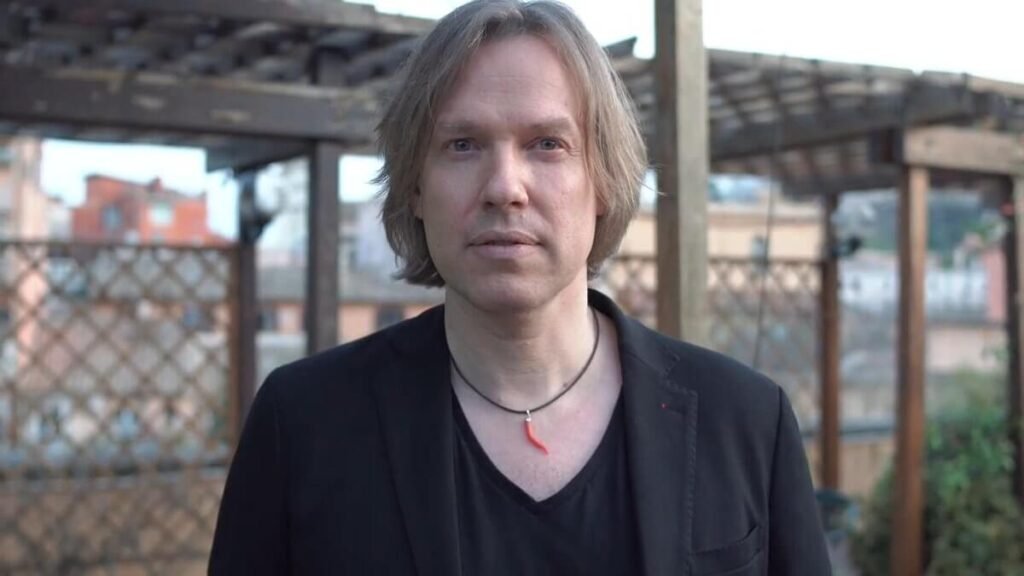
Žarko Paić: How to determine your position in contemporary philosophy and especially in the context of German theoretical thought. Do you have your predecessors in some orientation like post-phenomenology or similar? Steve Fuller stresses that you have „the makings of becoming Peter Sloterdijk’s evolutionary successor.” Wolfgang Welsch highlights that you count “as one of the worldwide leading experts on trans- and posthumanism.” Gianni Vattimo enthusiastically points out that your explorations „of the philosophical meanings of post-humanism has become a point of reference that contemporary culture cannot ignore.“. I agree with these evaluations, although I would add that reading your texts I notice the tendency to overcome the boundaries not only of philosophical disciplines but also the very status of philosophy today within the so-called humanities. Stefan Lorenz Sorgner: Nietzsche has always been a central figure for my intellectual development. I discovered him after reading Heraclitus at the age of thirteen. I had a book with the fragments of Heraclitus’ in which all of them were commented on with excerpts from Nietzsche, Plato, Spinoza, as well as Goethe. I have always felt at home in the writings of Heraclitus, and this made me turn to Nietzsche’s texts, too. By the age of 20, I had read all of Nietzsche’s major writings, some of them several times. Nietzsche still represents a central reference point for me. Whenever there are challenging intellectual issues, I turn to his reflections and engage with them, as they have enabled me to wake up from a great amount of widely shared intellectual slumbers. During my undergraduate studies, I was at King’s College from the University of London, which made me deal with a great variety of reflections from analytical philosophers. Thus, I learned to appreciate the intellectual consistency of applied ethical reflections by utilitarian thinkers such as Peter Singer, even though I do not affirm a utilitarian approach myself. As a result of this engagement, I have eventually also become familiar with transhumanism. Transhumanism is closely connected to the various debates in the realms of Anglo-American analytical applied ethics. However, I think that transhumanist issues can best be dealt with by also considering a wider philosophical understanding of cultural issues, which is more closely connected to the continental philosophical tradition. My doctoral supervisors were Wolfgang Welsch as well as Gianni Vattimo, who belong to the postmodern philosophical tradition, and who represent an outgrowth of the German philosophical tradition. It is this philosophical tradition to which I feel most strongly connected, as it includes the openness to wider cultural challenges. This supports your observation that the issues I deal with transcend the narrow boundaries of Academic philosophy, and can rather be seen as an engagement with the humanities while being critical of the dualistic prejudices on which the humanities have rested for a long period. Žarko Paić: The key setting of transhumanism, according to Nick Bostrom, is precisely “uploading our consciousness into virtual reality” which will create the possibilities of interconnecting the human brain and computer simulation of events. Can we then still talk about the body as a condition of human thinking if the brain has already become virtually encoded in a network of events? Stefan Lorenz Sorgner: I disagree with the judgement that mind-uploading is a key element of transhumanism. If this was the case, then the founder of transhumanism, Julian Huxley, who coined the term in 1951, would not be a transhumanist. The entire discussion concerning the relevance of mind-uploading can be compared to the discussion on the size of angels during the middle ages. During the middle-ages, Christianity was culturally dominant. People believed in angels. Hence, it made sense to reflect upon the issue of how many angels fit onto the tip of a needle’s pin. Nowadays, we live in scientific times. Hence, the discussion has come about on whether we can digitize our personalities. So far, we have no living digital entity. A living entity seems to be a prerequisite for conscious, self-conscious and feeling digital entities to come about. I do not see a plausible reason how this should occur during the next decades. Technological singularity is not near. We do not have to be afraid of AI’s putting us into a zoo. Mind-uploading is not an issue of pressing cultural relevance. There is some value in being engaged with it intellectually, as it enables us to think about who we are as embodied living beings. However, if we take it seriously as a pressing cultural issue, it stops us from dealing with the philosophical questions which are actually relevant, namely the question concerning the meaning of digital data, and whether privacy can be given up while we can uphold the relevance of the norm of negative freedom. Please let us talk about the relevance of privacy rather than about mind-uploading, which is merely a thought which helps Musk and his friends to get received by journalists, but which has no practical relevance whatsoever. Žarko Paić: You argued in one of your texts that transhumanism goes along with a “secular, materialist, naturalistic“ understanding of the world. (Sorgner 2014: 30). Isn’t that perhaps the limit of this notion in its philosophical possibilities? Stefan Lorenz Sorgner: Most transhumanists are computer scientists, biologists, or entrepreneurs. They do not have the education to develop complex philosophical reflections. A proper philosophy of transhumanism has been missing for a long time. This does not mean that the reflections put forward by transhumanists so far are without intellectual merit. This is not the case. Most transhumanists are highly intelligent, innovative, and active thinkers. I am merely stressing that this does not make their reflections proper philosophical one’s. Realizing the relevance as well as the limitations of traditional transhumanist reflections, I have approached the various angles of transhumanism as a philosopher. My monograph „On Transhumanism“ (Penn State University Press 2020) can be seen as a primer to philosophical transhumanism. „We have always been cyborgs“ (Bristol University Press 2022) „is both a comprehensive introduction to transhumanist thought and a clear-sighted … Continue reading An interview with Stefan Lorenz Sorgner, one of the worldwide leading experts in the fields of trans- and posthumanism
