In his famous essay “Karl Jaspers: The Citizen of the World?” Hannah Arendt deeply questions the philosophical concept of her former mentor and close friend, Karl Jaspers
Visual semiotics of fashion culminates in the idea that contemporary clothing has moved from “applied art” to “creative body design,” fueled by what he terms posthuman fetishism.
The most important Romantic thinker besides Novalis, the philosopher and writer Friedrich Schlegel, says the following about this in his “Paris- Cologne
Celan is not a “poet of poetry” like Hölderlin, but of the end of poetry as the art of representing the world itself at its end. The poet does not sing about a world
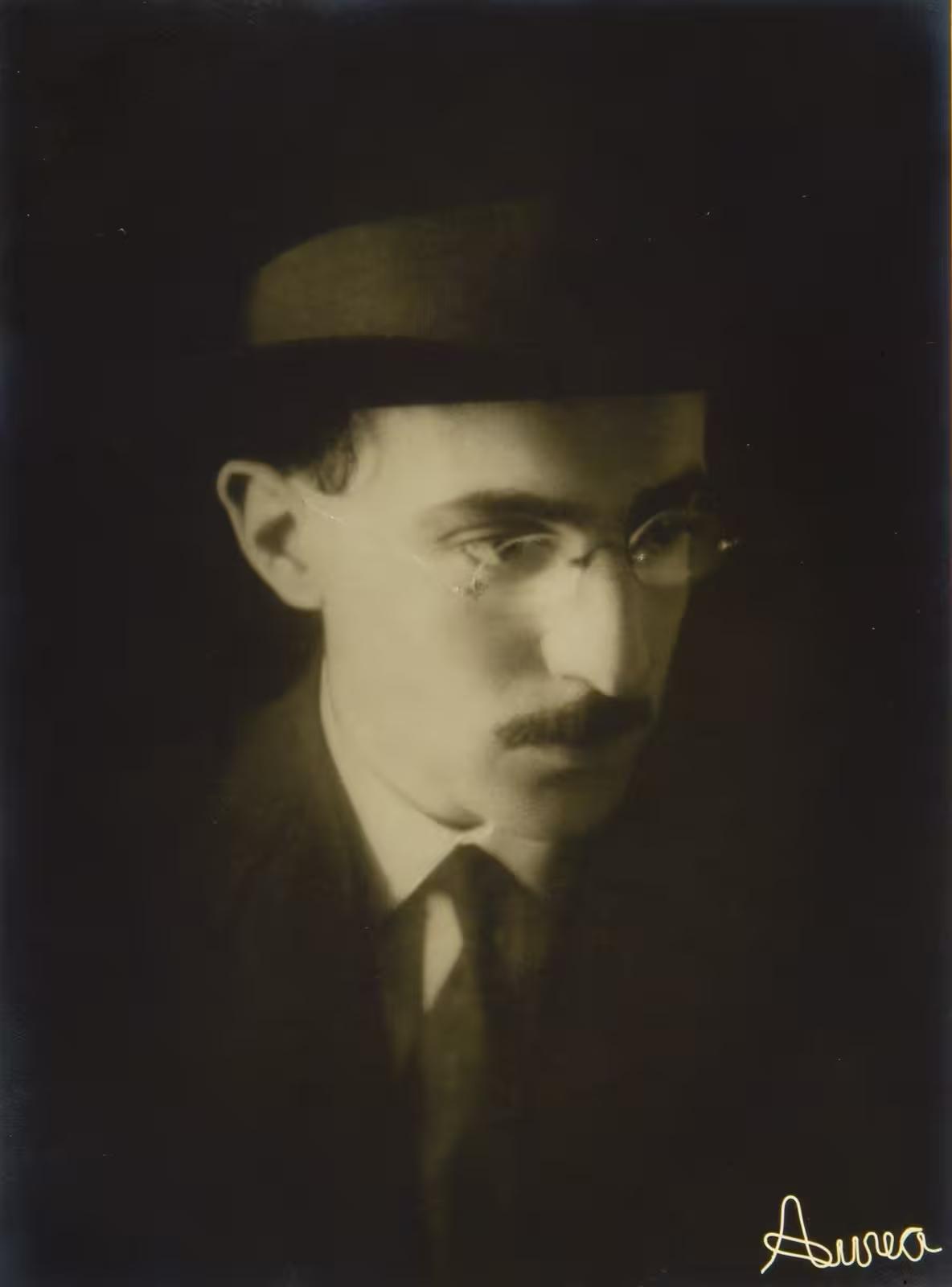
To Ribbons painted with a fountain pen, glasses, and a scent from the book Eros and Psyche Abstract The author analyzes writing as the thinking of the Portuguese poet Fernando Pessoa, one of the most significant artists of the 20th century. However, his influence is only now gaining the deserved world reception not only in the fields of literary theory and poetry, but also in contemporary philosophy. Since the fundamental problem of his work is represented in the multiplication of persons he created as authentic participants in thinking and writing, it appears that access to his works requires, first, an insight into the ontological-metaphysical questions regarding Being, beings, and the essence of Human, because a person cannot be reduced to the matrix of subjectivity. Instead, Pessoa demands a different approach, immediately addressing the aspiration to traverse his heteronyms (Campos, Caeiro, Reis) and recognizing that writing must be understood as absolute freedom in constructing new identities. In accordance with Heidegger’s and Wittgenstein’s thoughts regarding the questions of language, and in the search for a newer analysis of Pessoa’s works in the philosophical writings of Alain Badiou and Judith Balso, the author tries to follow his own way of interpreting Pessoa as a thinker-artist whose voice shows the authentic simulacrum of the world, in which contingency represents the necessity of freedom. The chaos of imagination becomes creative order without beginning or ending. Keywords: metaphysics, madness, Pessoa, heteronimy, plural literary space, chaos of imagination Introduction Approaching the thought directly in the work of Fernando Pessoa does not mean grasping the whole. Without the paradoxes and aporias of the discursive adventure, we will not get anywhere. It should be reconciled in advance that this impossibility of access to his work is simultaneously an open area of overlap between the styles and forms of the writer’s drama of singularity. There is no a priori given personality, some supreme transcendental “I” with which we can reliably start in what follows ꟷ the dissolution and unraveling of the secret of Pessoa’s thought, in which philosophy and art overlap and separate on the same path. If we are deprived of what Judith Balso calls in the title of her inspiring book a “metaphysical courier” (Balso 2006) to penetrate the labyrinth of his writing, then what is left for us? Perhaps the instructions for entering that labyrinth can be found in a fragment of Bernardo Soares’ Book of Disquiet (Livro do Desassossego por Bernardo Soares). Here, in probably the most lucid way, the fundamental problem of the relationship between thinking and writing has been shown from the spirit of metaphysical understanding of things in general. “Metaphysics has always seemed to be an extended form of latent madness. If we knew the truth, we would see it; everything else is the system and environment. If we think about it, it is enough for us not to understand the universe; wanting to understand it means being less than human, because being human means knowing that the universe is incomprehensible.” (Pessoa 2001: 89) Pessoa often uses the word metaphysics as an adjective for various phenomena. The same applies to the word mystery. Namely, metaphysics denotes obsession and illusion in an aesthetic sense. However, it is also about the way of thinking of man, which is given to him out of the necessity of his ambiguous existence as a being who feels, suffers, and experiences anxious moments in the face of the drama of existence. If metaphysics is madness, then this diagnosis should be something completely different from the science of psychoanalysis. For Freud, the central maxim is that where It was, shall I be (Wo es war soll Ich werden). This Enlightenment “rationalism” by other means ꟷ the discovery of the unconscious as a language ꟷ starts from the idea that the self is “that” which rules and governs our archipelago of desires. Admittedly, it no longer does this from the center of the mind, but from the displaced area of the living body. However, metaphysics cannot be overcome by reversing it. It goes down from head to toe. Pessoa, therefore, does not understand madness as a disease of the mind or thought. There is only one different opinion, and that from difference constitutes identity as a river of dreams and the contingency of multiplied “I”. Their origin lies beyond any replication of a proto-original (arché). According to this, Pesso’s undertaking is linked to the revelation of the non-existence of the first cause and the last purpose (télos) of the event. If so, then metaphysics cannot be just madness. It also denotes a necessary obsession with giving Human a substitute consolation: that God might exist and that the world might make sense. For Pessoa, metaphors and figures in literature, as paradigms of art, because language becomes the condition for the possibility of the worldliness of the world, are the same thing that Nietzsche attributes to the conceptual language of philosophy: that it is a substitute for the real appearance of things. Art should be thus played out in double coding. It becomes simultaneously “avant-garde decadence” and “decadent avant-garde”. In the case of Pessoa, this will have far-reaching consequences for the understanding of “his” poetic thought or logic based on the model of aporia and paradox. What, for classical metaphysics, is the unity of place and time, a kind of Aristotle’s fundamental law of the aesthetic determination of the world expressed in Poeticsas the coincidence of the substance of things and the order of meaning in the environment of the harmony of the world, will be completely reversed and denied. Instead of an either-or logic in Pessoa, everything becomes simultaneously positive and negative, possible and real, in the sign of logic, either-or. This is why we must keep in mind two metaphysics and, accordingly, two types of “metaphysical madness”: (1) Aristotelian with the fundamental principles inherited by modern philosophy and science under the name of the principle of sufficient reason (principium rationis) and further developed in the thinking of Descartes, Kant, and
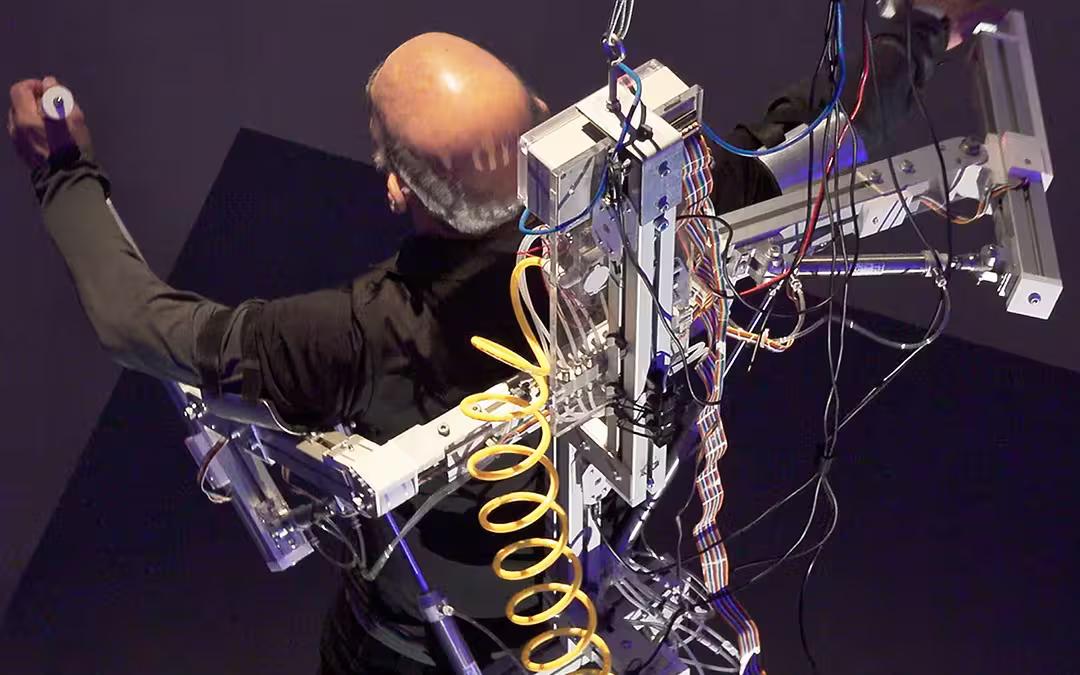
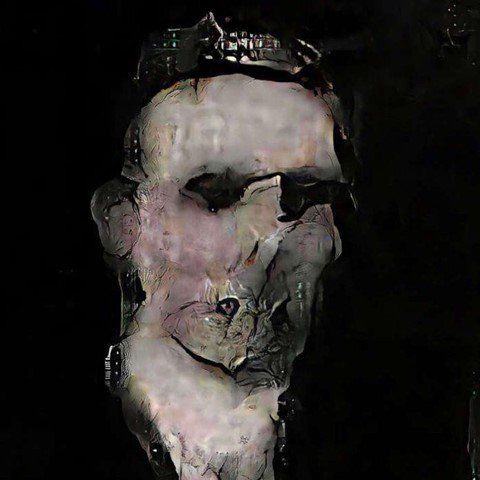
In his latest work, “The Luminous Self-Portrait of DM,” a light-and- sound installation that challenges the very notion of video installation, the artist
In 1942, Vladimir Jankélévitch wrote a book entitled Nocturne, dedicated to the issues of rapture and reverie, dreaming and flickering, those feelings that
Bruno Schulz, or about the enchantment of reality To Delimir Rešicki Abstract Without the mythicization of literature in its multitude of discursive forms, the world would remain painted in the false brilliance of reality. The mundaneness of the world derives from “cases” as “events”. Everything that Heidegger and Wittgenstein express about language in their greatest reaches of 20th-century philosophical thought, but in the footsteps of Nietzsche and the distinctive version of the neo-gnostic secret of creation, bears the pathos of Bruno Schulz’s literary alchemy. Schulz’s “canonization” as a world-class author of experimental prose happened in parallel to the establishment of Jorge Luis Borges as the master-mandarin of postmodernist literature. Despite the undeniable differences, the end of the 20th century brought awareness to the aestheticization of life itself in these literary figures. Schulz’s solution appropriates neo-baroque figures such as allegory, treatises, and pseudo-fiction. When we have this in mind, it becomes clear why Schulz chooses a peculiar strategy of bewitching and disillusioning “reality” through irony, grotesquerie, and obscenity. Key words: inexpressibility, Schulz, postmodernist literature, allegory, irony, obscenity 1. Writing as an experiment in life: Words Who writes, and what is writing? Whoever writes constantly asks questions about the meaning of writing. From this, it is obvious that writing cannot be understood without a relationship in which language and speech require what medieval theology called, albeit negatively, tertium non datur. Writing separates itself from speaking and language as a condition for the possibility of one’s writing by defying the temporality of speaking. In the material trace of a scratch on papyrus or pictorial information in a digital machine, there is a desire to interrupt “here” and “now”. Immortalization in a text like the Book makes writing a divine trace of the “eternal now” (nunc stans). This is why Derrida raised writing to the level of the problem of thinking in the era of the end of metaphysics. (Jacques Derrida, De la grammatologie, Minuit, Paris, 1967) In writing that precedes speech as shadows preceded the light of the seen, the question of who writes goes beyond investigating what is written about. Who and what belongs to the relationship between “subject” and “thing”? Because someone and something are not separate entities. When someone thinks and speaks about something, what is believed determines the one who thinks by the very essence of thinking as such. The speaker is always separated from the one discussed when the difference between “subject” and “thing” is established. However, when the “thing” itself cannot be fully expressed because it is precisely what makes it possible to distinguish between who and what is being said, writing that leaves a mark immortalized in the text becomes an experiment of life itself. It makes the experience of stopping speech at the zero point of telling. If language speaks, as the late Heidegger claims, writing derives from the difference between telling, showing, and expressing in the material trace of presence. Telling represents a collected opening of the worldliness of the world. Words are the light of Being. Without them, nothing is meaningful in the chain of events from the beginning to the end of all things. By showing, however, being is revealed in the presence-absence of Being. Time does not show its period shadows. It is a collection point for scattered cargo. All sorts of historical dramas unfold in that gathering place. Finally, expression refers to the connection between speech and writing. Whoever thinks that the former precedes the latter or vice versa is right. How is it possible that the truth belongs to both, and not to one or the other? The reason lies simply in the fact that truth appears only from the perspective of seeing. This is not a fall into the abyss of cognitive relativism. By expressing something with words, it is exposed from its hiddenness. Because words are not credible enough to “describe” the image of what we see, and suppose we see nothing but shadows on cave walls, as in Plato’s allegory about the world of ideas and phenomena. In that case, this becomes proof that human thought relies on reflection, through which it reaches the knowledge of the absolute. Without reflection and a semblance of reality, there is no royal road to the truth of that reality itself. Writing, therefore, is written not because the language says what must be written down. On the contrary, the relationship between writing and speaking seems asymmetrical and non-reciprocal. In writing, it is about an event without known outcomes in advance. This might be true even when a writer, like a genetic engineer, has a clear plan for what will ultimately result from his “work”. Language expresses Being by talking about it. On the contrary, writing starts from the assumption that what will happen with the text falls into pure contingency. There is no guarantee that the writing will result in a finished work of a historical game on the verge of collapse. Remember Mallarmé’s idea of the Book as an ideal text of a divine event, almost like the “necessity” of nothingness. The incomparable kingdom of the game flows from it. However, it’s unclear why that game is always new and why the rules don’t change. It should be the privilege of “great writers” to intuitively know this even before the words flowed like a dark river from an (un)known source. One who belonged to the exalted sect of scribes could almost demiurge free words from the compulsion of belonging to the so-called reality by enchanting his literature by weaving the world as a mystical image. In the fragment “Mythization of reality” from 1936, Bruno Schulz talks about the fallacies of realism in philosophy and literature. They are even more dangerous if they cling to the semblance of dogmatism of the scientific age, which greedily searches for the truth starting from the subject’s position of the construction of everything external. And although realism has not been given any special attention in cognitive theory since Kant, it
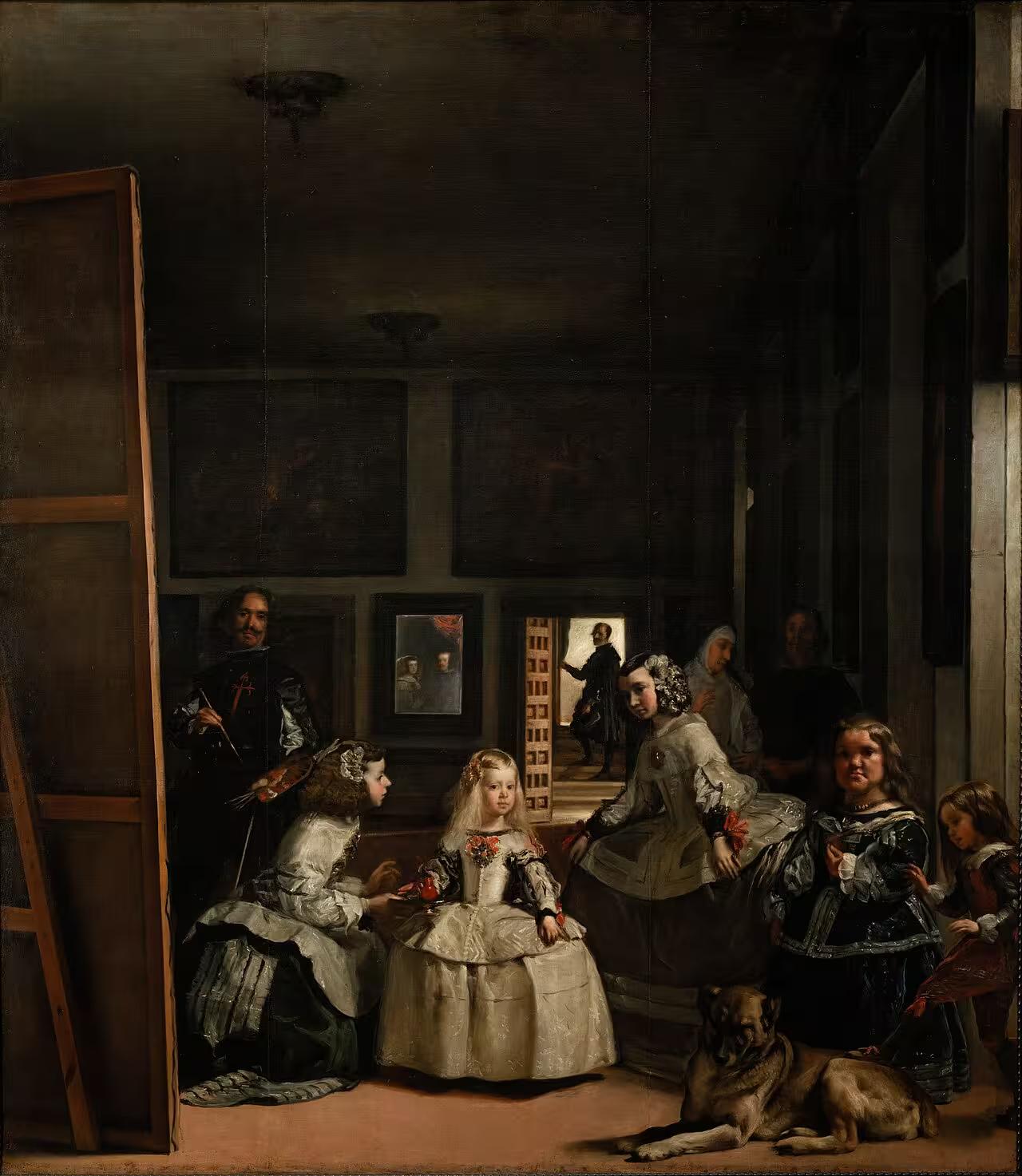
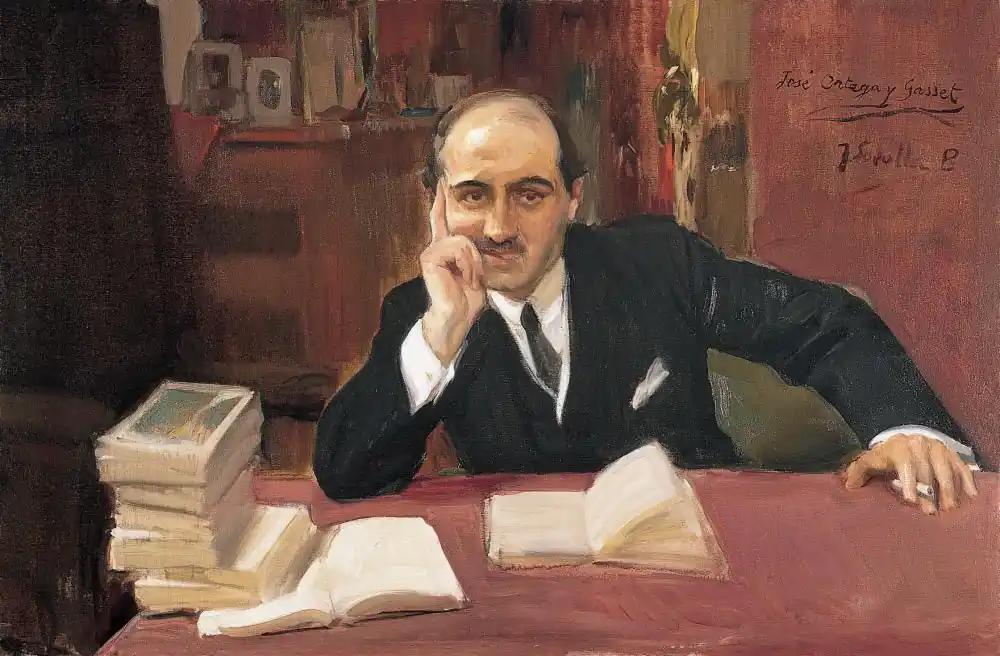
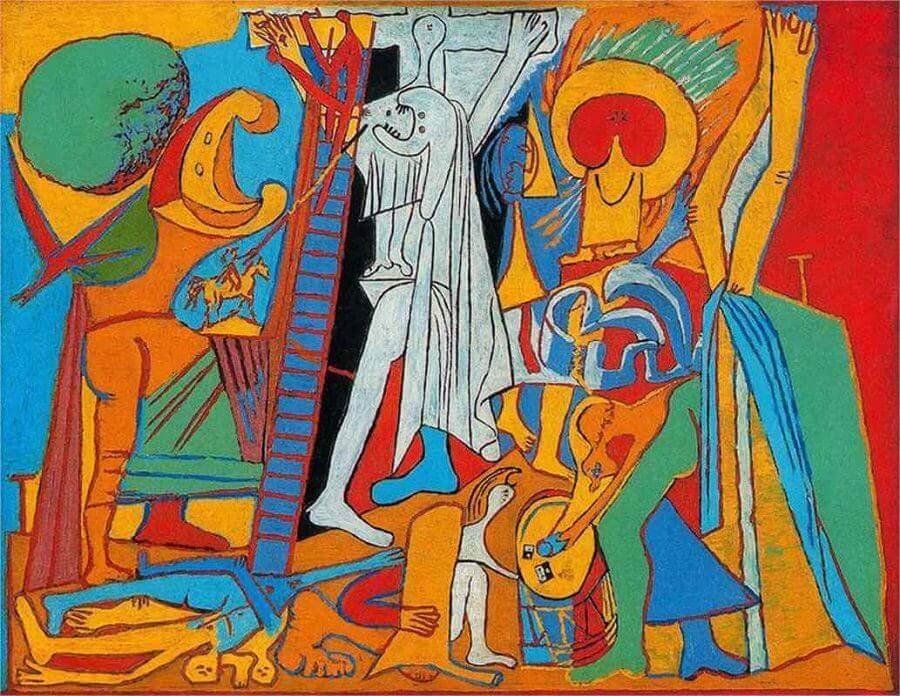
Velázquez and the End of the Representation Abstract If we wanted to describe what characterizes the history of painting from the Baroque to the implosion of colors and the loss of perspective in modern art, perhaps we should perform a necessary operation: reduce the image to thought in conceptual matrices. Thus, we would obtain two mutually opposed and, paradoxically, related attempts to talk about the world from the essence of painting in general. Both are formally linked to Spanish painting. The first is the path established by El Greco through the mystical field of divine sublimity, as in Christ’s sacrifice and bodily suffering on the cross. In contrast, the second path aims to create the illusion of pictorial representation within the pure rationality of the so-called referential painting of the aristocratic era in European history, with Diego Velázquez as the leading representative. Two paradigms of the image seem to correspond to paradigms of thought: one that invokes and depicts the unpresentable in the image of the mystery of Christ with the aspiration that the phenomenal world takes on the metaphysical dimension of the rule of the Platonic idea in the world, and the other that shows that only through the mental construction of the world can the highest degree of enlightenment be reached in the image as a perfect aesthetic illusion. The author attempts to arrive at a thesis on the rational mysticism of painting through Ortega y Gasset’s analysis of Velázquez’s painting Las Meninas, which represents the greatest achievement of the concept of representation in the art and aesthetics of the classical era, but also its end in the autopoietic painting of the late avant-garde in the 20th century. Key words: Rational mysticism, Velázquez, representation, painting, rebirth of the image, sublimity 1. If we wanted to describe what characterizes the history of painting from the Baroque to the implosion of colors and the loss of perspective in modern art, perhaps we should perform a necessary operation: reduce the image to thought in conceptual matrices. Thus, we would obtain two mutually opposed and, paradoxically, related attempts to tell about the world from the essence of painting in general. Both are formally linked to Spanish painting. The first represents the path established by El Greco through the mystical field of divine sublimity, as in Christ’s sacrifice and bodily suffering on the cross. In contrast, the second path aims to create the illusion of pictorial representation within the pure rationality of the so-called referential painting of the aristocratic era in European history, with Diego Velázquez as the leading representative. Two paradigms of the image seem to correspond to paradigms of thought: one that invokes and depicts the unpresentable in the image of the mystery of Christ with the aspiration that the phenomenal world takes on the metaphysical dimension of the rule of the Platonic idea in the world, and the other that shows that only through the mental construction of the world can the highest degree of enlightenment be reached in the image as a perfect aesthetic illusion. Metaphorically speaking, El Greco would be Plato here, and Velázquez would be Aristotle, given the essence of the matter in question. Of course, Platonism is no mysticism, just as Aristotelianism is no rationalism. Our conceptual grasp of reality is often a necessary intellectual appropriation that begins with the abstraction and reduction of reality’s complex structure. However, one thing is undeniable. In European painting from the Baroque to modernity, we encounter an obvious opposition between God in the image and man as the subject of rational anthropo-technology. This metaphysical-antimetaphysically, “The War of the Worlds” happens only in the internal “logic” of the art of painting as what is happening: a historical secularization and profanation of the world. However, the question is why, for this depiction of the conflict between the otherworldly and the here-and-now, idea and reality, mysticism and rationality in the downward trajectory of the metaphysics of European nihilism, as Heidegger would say when dealing with Nietzsche, (Martin Heidegger, Nietzsche: Seminare 1937 und 1944, GA, vol. 87, V. Klostermann, Frankfurt am Main, 2004, p. 45), we decided to take painting as a medium of thought, and not literature? The greatest Spanish philosopher of the 20th century, José Ortega y Gasset, offers us an explanation in his essay ” The Rebirth of the Image,” in which he also says this: “Even Plato emphasized the muteness of the painter. The entire magic of painting is summed up in this duality: the desire for expression and the determination to remain silent. To paint means to decide on muteness firmly, but a muteness that does not mean deprivation or lack. The painter decides on muteness precisely because he wants to express what speech, by itself, can never say. ” (José Ortega y Gasset, “The Rebirth of the Image,” in: The Dehumanization of Art and Other Essays, Litteris, 2007, p. 89. Translated from the Spanish by Dunja Frankol) Literature, therefore, as well as philosophy, due to its focus on language and speech, seems unable to fully reach that pictorial phantasmagoria with which only the conflict between mysticism and rationality always appears as a conflicting dialogue of the sacred and the mundane. Why is this duality so immersed in the network of all our intellectual efforts in approaching immediacy without any substitute means of conceptualization? The simplest answer would be because both the supersensible and the sensible belong to the same indistinguishable origin of the very thing of thought and Being. The beginning of metaphysics in the Greeks, with Plato, establishes this duality, starting from the mystery of logos as speech that the idea uses to introduce the divine into the apparent splendor of intra-worldly beings. However, language can never encompass the mundaneness of the world itself, just as wisdom must use all intellectual means, from paradox to aporia, to establish, through language, a confidential relationship between the meaning of Being and its appearance in beings, and the essence of the Human. In other words, language fails only insofar
So why the Baroque and its dark secrets at all? We can approach the answer to this question by bypassing the question itself. Uwe Steiner points out that when
Bernhard Waldenfels and the Other as a Problem of Ontology Abstract In the article, the author attempts to analytically show how, in contemporary philosophical debate, we encounter the problem of the relationship between human consciousness and the technosphere, which synthesizes the scientific construction of a new interobjectivity with the concepts of the body and the Other. Therefore, new figures, rather than traditional ontological-anthropological concepts such as homo kybernetes (Paić) and homo respondens (Waldenfels), necessarily find themselves in a kind of bipolarity in their determinations and actions in the real world. If, for Waldenfels,” intentionality is transformed into responsiveness”, then the path of phenomenology in the new conditions of action of globally networked societies must be designated as a “post-phenomenological path”. It is already evident from this that the answer to the stranger issue does not only hide the communicative potential of human existence in a historical-epochal sense. Considering a new ontological status of communication with the Other is simultaneously a necessity: abandoning the concept of intersubjectivity in favor of networked relations in the constitution of the body and the Other as existential structures of freedom. Keywords: homo kybernetes, homo respondens, technosphere, intersubjectivity, Other, stranger Introduction After Heidegger, Merleau-Ponty, and Lévinas introduced into contemporary philosophy the “spirit of reversal” of all metaphysical categories, abandoning its original starting points in the problematization of the relationship between Being, beings, and the essence of Human, phenomenology was left without a signifier ─ Husserl’s program of returning to the natural attitude. The question of consciousness and self-consciousness, which was so crucial to the entire philosophy of the modern age, was redirected to the conditions for the possibility of thinking about that which is not only a part of human existence but also the primary meeting point of thought and the matrix of Western metaphysics. Heidegger rightly called it the onto-theological framework of history. The reason is that thinking begins with the question of Being and the first cause or origin as the source of all beings (arché). In constructing the artificial mind and life, suppose phenomenology lacks the object of its focus, such as the forms of human consciousness. In that case, the only remaining area of its “resurrection” can be discerned in the analysis of the body and the Other. By analogy, since the concept of the subjectivity of mind marked the metaphysics of the modern age, the return to the body in the post-metaphysical thought of the 20th century should not be understood as a return to materialism and physicalism, much less to some dark psychologism. In contemporary philosophy, the body represents an enigma, as consciousness does, but on entirely different foundations from those established by the metaphysics of mind. However, Husserl’s critique of the Cartesian legacy in contemporary thought genuinely developed the concept of the Other. It did not radically break through the framework of subjectivity and self-consciousness; it did not wholly leave the environment of egology and anthropology. The first approach is found mainly in Merleau-Ponty’s existential phenomenology. In contrast, the second approach is shown to be derived from Lévinas’ most important book, Totalité et Infini (Lévinas: Totalité et Infini: essai sur l’extériorite). There are multiple overlaps. For French thinkers, the body and the Other simultaneously mark the path into the labyrinth of feelings and the ethical call for freedom and justice in the community. In the contemporary situation, however, the new approaches can be concisely defined as the phenomenological analysis of the body, with Hermann Schmitz as its primary representative, and the phenomenological analysis of the Other, with Waldenfels as its primary representative. (Schmitz: System der Philosophie III.) 2. Der Gefühlsraum) In the lecture “Homo respondensʺ he showed the reach of different definitions of Human throughout the history of metaphysics (homo sapiens, homo erectus, homo faber, homo ludens, etc.). All these definitions start from what has always had the feature or transcendental condition of human existence in history, or has been historically attributed to him, such as something that determines the structure of action, such as work, for example, or play. Responsiveness or the possibility and necessity of answering questions that are posed to him as challenges or as mysterious events that must be solved, as if they give the Human some transcendental “essence” which is reduced to what in cybernetic theory belongs to the concept of substitution of everything from the traditional ontology of causality. How do we reach communication if not by mediating the source or cause of the emergence of intersubjectivity in dialogue and discourse with the body of the Other, whether it is physical, directly given, or only indicated using the image of a contingent and singular body? The reflections on this problem in Bernhard Waldenfels’ thinking are highly stimulating because they introduce into consideration, post-phenomenologically, a new way in which the Other, so to speak, is inter-subjectified through the experience of our changed view and narration not about him as the Other, but about what enables the coexistence of the Self and the Other in a community that is constantly changing and losing the characteristics of ontological permanence. What challenges me to question the possibility of any further phenomenological and post-phenomenological analysis of the Other stems from the impossibility of its ontological determination in modernity, already determined by the rule of the technosphere. Questions are no longer answered only by us as humans but also by them as posthuman bodies of artificial intelligence. As Bernhard Waldenfels clearly shows, responsiveness cannot be what is reduced in one way or another to the environment of humans and non-humans in the sense of living ꟷ Human and animal. (Waldenfels: “Homo respondens”, 6-16.) Hence, it is foreign or alien, that uncanny Other as Stranger, no longer in the sense of that powerful title of Albert Camus’s novel, or that actor in Plato’s Sophist who questioned the universality of the ethical-political horizon of the recognition of the Other in Athenian democracy. Can homo respondens still be an appropriate name for the issue of the body and the Other “here”
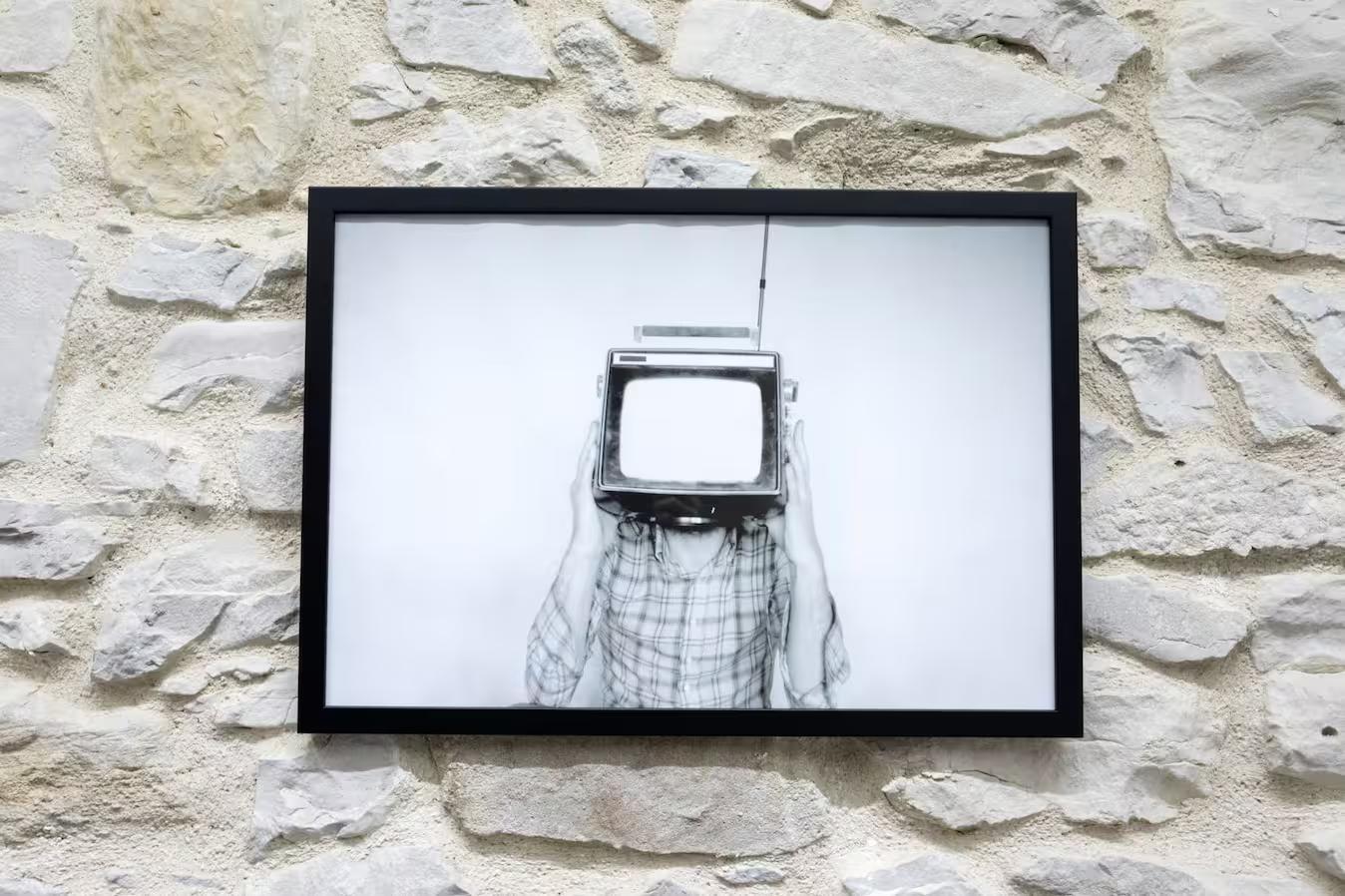
The transition from content analysis to form analysis in media theory corresponds to the transition from text analysis to the analysis of the language of communication or
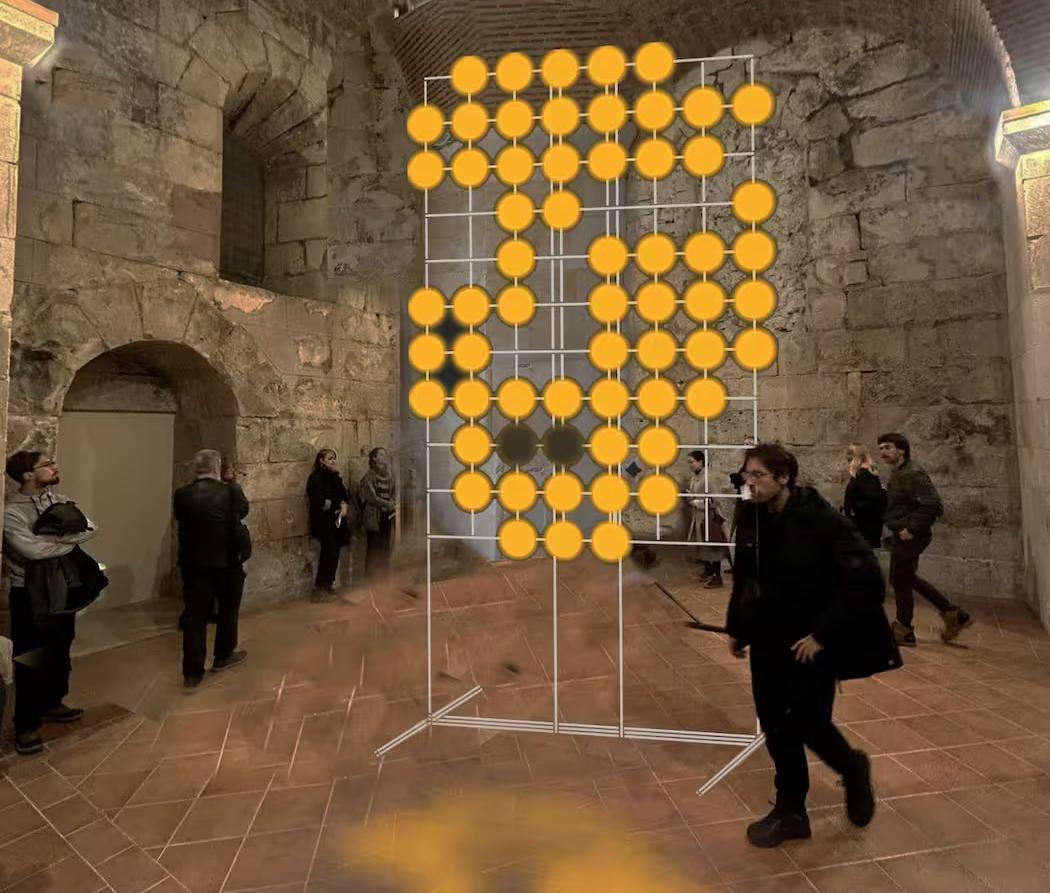
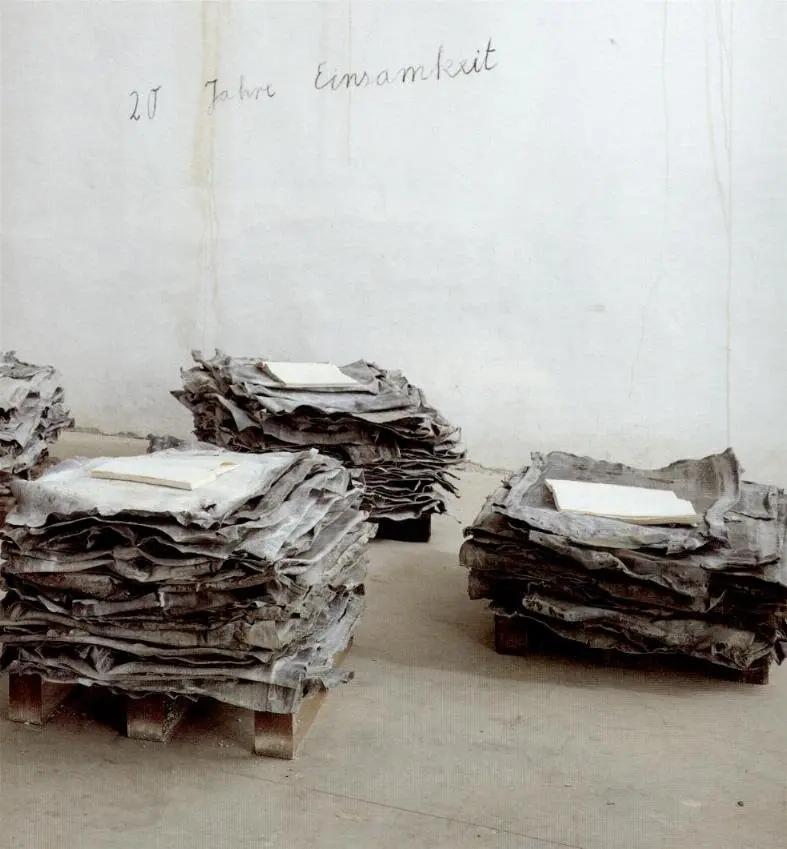
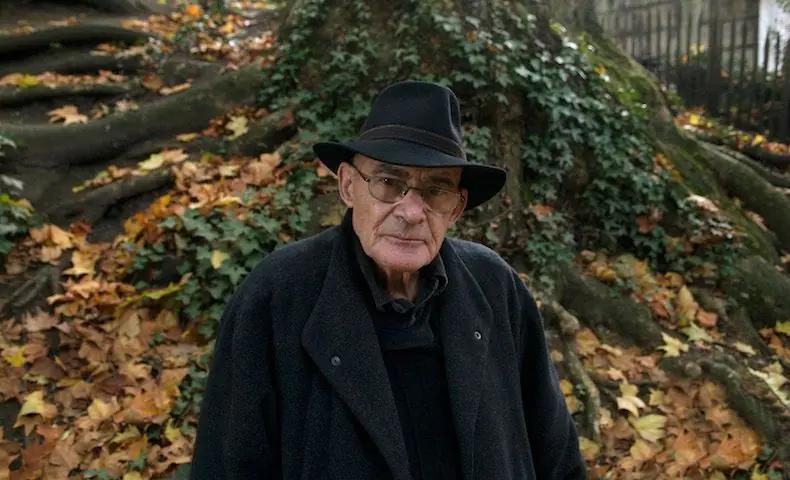
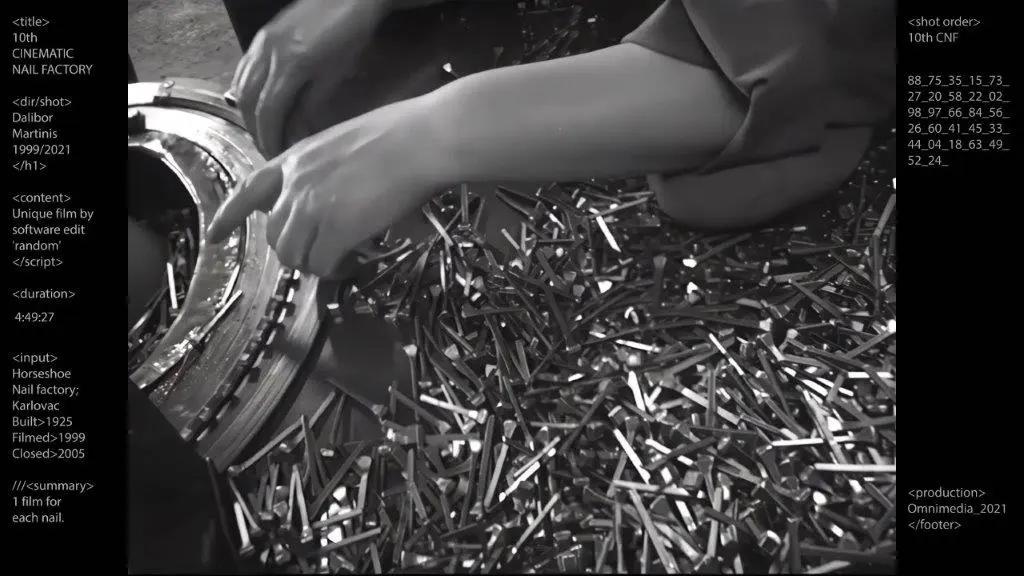
Dead Sea of Forgetfulness Reflections on “Exhibition of Forgotten Works by D.M.” Split, 22 August 2025 AI is a technosphere synthesizing reason and intuition as the highest level of artificial memory in the form of the dispositif of life itself. When dementia or Alzheimer’s sets in and erodes the memory that enables one to find logical-historical bearing in space-time, a fundamental problem emerges for modern philosophy, science, culture, and the meaningful life of the individual as the subject of events. Thus arises, mythopoetically speaking, a dead sea of forgetfulness. In its implosion of information, AI defines why Alzheimer’s is a central issue of our time: “Alzheimer’s disease is a philosophical issue because it cuts to the heart of questions about identity, personhood, the connection between mind and body, and the ethics of caring for individuals with cognitive decline. It challenges traditional notions of what it means to be a person, explores the philosophical implications of memory loss, and forces society to confront complex ethical dilemmas regarding care, rights, and the definition of a ‘good death’.” Only two “diseases” are more than diseases, because they affect the psycho-physiology of human sensibility that underpins the traditional metaphysical concepts of thought and feeling, spirit and soul. They are also uncanny (Unheimlich) fractures of the brain, without which the world as the horizon of meaning cannot exist. One is schizophrenia, and the other is Alzheimer’s. The first refers to the loss of self or “I” as a stable subject that perceives and experiences objects in space-time, and can manifest as 75 heteronyms in Pessoa’s poetry, or Norman Bates, evil incarnate obsessed with mother in Hitchcock’s Psycho. Indeed, Deleuze and Guattari’s crucial works, Anti-Oedipus and A Thousand Plateaus, which examine the rise of the control society in the era of neoliberal info-cognitive capitalism, are jointly subtitled Capitalism and Schizophrenia. The second involves the gradual “disconnecting” from the world as a network of human and nonhuman relations, reducing the individual to the level of a single-celled organism or a mere plant in vegetative agony. Schizo-and-Alz states of what belongs to the concept of consciousness are ambiguous phenomena of modernity, marking the final clash between biological evolution and technological singularity, as AI cannot be “mad” and “forgetful” unless it becomes entirely human bysome other means. To be-as-Other and to be-as-a-plant withering in the process of desubjectivization and desubstantialization means no longer being the “self” that functions in the world of, paradoxically, capitalism as a schizo-and-Alz state of dizzy “infinite speed” of what remains of this world. Transmedia artist Dalibor Martinis, in his quest and experimental analysis of whether it is still possible to open a space-time passage beyond the boundaries of the work and the event through conceptual-visual contemplation of the limits of contemporary art, directs his focus toward what remains the paramount problem of contemporary philosophy and art in general: the problem that Heidegger, engaging with Plato’s allegory of the cave and the world’s appearance as shadow or simulation, called the forgetting of being (Vergessenheit des Seins), while defining truth as unconcealment or openness in accordance with the ancient Greek word aletheia. Time “temporalizes” itself in the flow of the ecstases – the dimensions of temporality that form the triad of past, present, and future. When the “age of forgetfulness” arrives, the human beings, as those who unconceal the truth of the world in the self-showing of phenomena, lose orientation, for they no longer know when an event occurred, if it occurred at all, or what in fact occurred, because they cannot differentiate between the object and its shadow. Forgetting is linked to the concept of recollection which belongs to the innate articulation of language; not to memory, which, as Freud notes, belongs to the superego – the rule of state and society, nature and culture, craft, technology, and technosphere over the fragile knowledge of the individual subject. We forget simply because we are human, and our cognitive ability to recognize signs and traces of the real world is limited by our biology and lifespan. Memory is thus a step forward in the objectification of consciousness, functioning as a dispositif of a highly developed culture that archives its recollections in databases containing infinite information. What is DM trying to show with this “exhibition”? The “author”, undergoing a creative loss of recollection of events that belong to his “forgotten works” claims that he seeks to affirm an authorially documented condition, while wondering what remains of what we have forgotten. At this point, we must pause and ask: are objects as things or artifacts the same in their non-forgetting, as a kind of Kantian thing-in-itself (Ding-an-sich)? What remains of the world – as a work of both nature and human creativity – is not self-evident without the author. Even when we see, in a virtual museum of sorts, iconic objects linked to artists and philosophers – like Joyce’s glasses and hat, Picasso’s brushes, Wittgenstein’s neurotic signature, or Deleuze’s crumpled shirt – we sense that their “bearers” linger as ghosts above the dead sea of forgetfulness, guarding them from the final fall into nothingness. In his “exhibitions,” DM ties his own experience of remembering the forgetting of an object or event with the idea that the so-called works on display emerge from the realization that recollection precedes forgetting, not the other way around. Negation may be the end of the world, but not its beginning. The “author” frames this as an act of juxtaposition that inscribes into the space-time of contemporary art something almost “fateful” and “inevitable”: the threshold at which humanity marks the “end of history”, and the arrival of a posthuman reign of artificial memory as the archive of this interlude, in which “forgotten works” once again become “works of forgetfulness,” not as lost lettersrecovered from the dead sea of forgetfulness, but as the return of what can never truly be lost. What astrophysics calls “information at the event horizon,” we shall call the creative energy of life beyond the boundaries of selfhood, the “I,” the subject. DM says: “Some time ago, I began writing down the dates when
The problem with the disappearance of absolute sovereignty from Bodin to Schmitt, as Derrida sees it in the act of his late (ethical-political) deconstruction, is that there is no longer a sufficient reason for any effectiveness of representing the Other. Reasons are reducible to this or that form of violence. Everything must be dismantled and disassembled. What remains of sovereignty becomes the contingency and singularity of the space between power and freedom. In this space, Derrida begins with the view of the Other and unconditional hospitality as a deconstruction of previous metaphysical politics of hospitality. The Other must be emancipated from the perspective of the subject’s metaphysics and its inherent violence. In the discourse of politics of friendship lies the ground for democracy to come as a final soteriological solution for other headings of history. Keywords: politics of friendship, upcoming community, Derrida, deconstruction of sovereignty, violence, Other 1. Deconstruction of Sovereignty What Lévinas has taken from Heidegger and endeavored to “overcome” by ethically thinking as a starting point for the critique of metaphysics as an ontology, Derrida continued in an articulated and even more radical sense. In the analysis of ethics of hospitality and guest policy concerning Lévinas settings we often encountered Derrida’s critical interpretation of central concepts of post-metaphysical condition ‒ foreigners, refugees, and asylum seekers in the discourse of receiving the Other as a guest in “my” home and the emergence of a new one perspective for the subjectivity of the subject. One of the constant motives we encounter from the early works of Derrida is the corpus of the modern theory of state and law, until the 1990s which marked books like Spectres of Marx, The Politics of Friendship, and The Beast and the Sovereign. The notion of sovereignty refers to the logic of the metaphysical establishment of the rule of the subject in philosophy and the humanities. The main intention of Jean Bodin in political thinking ‒ justification of the rule of monarchies based on the absolute power of the kingdom as a source of popular sovereignty ‒ was also the task of Descartes in the ontological-philosophical sense. The question of the two bodies of divine and popular sovereignty (theology and politics) had its metaphysical origin in the Cartesian duality of mental and bodily substance (res cogitans and res extensa). The opinion of the subject in the statement cogito ergo sum establishes the power of the supremacy of the mind over the body so that the separation between them becomes a matter of the functioning of the whole building of metaphysical concepts such as “infinity”, “being”, “substance”, “idea”. That gap represents far-reaching consequences for the European formation of political identity from culture as such. Sovereignty denotes the autonomy of the mind and the heteronomy of the body. So, it is logical to assume that Derrida must reckon with the legacy of this metaphysics of rationality and occasionalism from Malebranche to Rousseau. The main reason is that the subject of self-establishment denotes the power of the modern age when the rule of the mind appears as enlightening systematic madness of absolutism. In contemporary French philosophy, the critique of the Enlightenment was most radically carried out by Michel Foucault. (Foucault 1984, 2-50, Paić 2013, 181-211) It is interesting that from there one can even genealogically reconstruct history before and after the French Revolution as an event of radical cut with linear history. From Descartes to Hegel the creation of the absolute subject becomes a matter of thinking process which tries to achieve a peak of modern metaphysics. Sovereignty does not mean freedom by the act of constituting the external world of objects (nature in the sense of natura naturans and natura naturata) starting from the act of foundation of mindful substance. It rules the body even after its disappearance. How is that possible? Logos in the tradition of Greek-Jewish onto-theology is always inscribed in the body by transcending it, and not the other way around. In the gap or rift between God and man (mind and body), the emergence of modern anthropology was already determined in Kant by the necessity to find a consensus between the fundamental world of the Law (noumenon) and the empirical world of facts (phenomenon). Derrida’s deconstruction of the metaphysics of subjectivity aimed to establish just that place “in-between “, that empty meeting place between the two. The moment when the act creates the new thought and action that arises with modern sovereignty is already recognized from its structural or ontological violence. That is why in the brilliant analysis of Lévinas’ ethics of the Other in the essay “Violence and Metaphysics” included in the collection of essays entitled Writing and Difference (L’ecriture et difference) from 1967 Derrida could say that what belongs to the structure of thinking subject we might claim as “totalitarianism of the same“. (Derrida 1978, 91) The concepts of cogito, subjectivity, sovereignty, a nation-state, and modern Europe as the cosmopolitan order of mind Derrida tried to deconstruct. Suppose we want to clarify the controversy that is so abused in contemporary discourse not only in the social sciences and humanities. In that case, it is worth first recalling what Derrida himself self-ironically said about it in the book Positions. At one point he noted that he was dealing with the translation of the key concept of destruction from Heidegger’s Being and Time (Sein und Zeit) in French. It is well-known that Heidegger’s intention before turning in 1930 focused on the “destruction of traditional ontology“, and Derrida had insurmountable difficulties in his translation. What this term refers to in German cannot be the same as in French, where it has the explicit meaning of destruction and annihilation. So, he opted for what would be just like destruction, but what would be more appropriate to Heidegger’s thinking. When, therefore, he chose the word deconstruction despite destruction, the whole horizon of new meanings appeared to him, and thus the possibility of an internal “critique” of Heidegger. We think from language, and language denotes a riddle of the trace of that event, which has the possibility of changing the essence of Being. The rest belongs to the history of the post-metaphysics of Otherness (alterity) because the Other and difference direct the history of thought. In addition, deconstruction means disassembly and dismantling with the intention of permanent rebuilding. (Derrida 1982) When the age of modern sovereignty of the people loses its power, the subject of the representation of the Other in all existing systems of thought and reality disappears, from philosophy, science, art, culture,
Let’s start by clearly delineating the space of discussion. Yes, it’s a matter of spacing – a phenomenon to be elaborated in more detail later –, a matter of topos, topography etc. Any discussion on reality necessarily opens up a question of being-in-the-world, of Being as such, its manifestation as happening, as situatedness. But what exactly is happening here, what is being situated? Poetry in its original sense is related to the openness of Being as the event of freedom. The descent into the spacing of writing manifests itself in the form of a disclosive, illuminative (written) record (os alethes). What situates this record also maintains it, reveals it, exposes it in the openness of this coming-to-be emerging at the horizon of the event. Language itself is in perpetual flux, and poetry is language as such, language overflowing the utmost recesses of Being and permanently running up against its own limits where it breaks into silence (and vice versa). To remain silent is to be. Poetry, the act of writing about poetry and neoliberal paradigm intersect in the process of spacing, in the openness of the event. No creative thinking about revolution can dispense with the situatedness of the event conceived as an intersection of covertness/truth (aletheia) of Being. The revolutionary turn taking place in the world nihilistically dominated by neoliberal paradigm can be realized only through the situatedness of Being, for otherwise it is not a genuine turn/descent, but merely a reproduction, a recycling of nihilism/destruction/death. Poetry in its original sense – poesis as the act/realization of the openness/truth* of Being in its emergence/persistence as a historical truth of the Western world – is thus a manifestation in the present of what is yet to come, of the utopian Being of post-revolutionary world characterized by the turn/descent into being of nihilism. It is the being-in-the-world of our children. The only real revolution, i.e. a revolution conceived as a utopia of an already realized future (in the Husserlian sense of protention), discloses itself as a creative openness of experimental poetry, as an openness of Being in the sense of an “alternative” to nihilist neocapitalist practices and their destructive/exploitative approaches to life as such. The German philosopher Martin Heidegger once wrote: “Language is the house of Being”. Allow me to bypass certain phases of my thinking, and state clearly: it is not that Being is hidden inside of a house, i.e. that one needs merely to open up the house and bring out what is hidden within. Far from it – the treasure chest is empty, there is nothing inside. Transcendentality consists of the presence of the non-present/non-existent/imaginary. Being is the treasure chest itself: language as the trace (Derrida); poiesis as spacing, as opening, as revealing; verbalization as naming (nennen) and therefore as Being as such, as the event beyond things, beyond the reality of this “now”, the clearing of worldhood basking in the truth of disclosure as the existential abyss of freedom. I borrowed an idea and turned it upside down. It would be easier to draw out an argument on experimental poetry in light of neoliberal paradigm, but that is not what I’m after. Quite the contrary, what I’m pursuing is the idea that it is possible to understand neoliberal paradigm only against the background of what is being exposed (la poésie ne se impose pas, elle s’ expose, as Paul Celan once said /cf. Sloterdijk 1992: 5) by means of experimental poetry in the process of global neoliberalization, in light of what a well-known ideologist of neoliberalism called the end of history. The same phenomenon could be referred to as a suppression or elimination of history as historical thinking. A careful reflection on post-historical destiny of experimental poetry might shed some light on my own embeddedness in one of the ghettos constructed by the neoliberal newspeak and by the eradication of human beings perceived as human societies within the context of a discursive/cybernetic machinery of global, profit-oriented economy and social, political, economical, financial, military etc. relations it establishes, enforces and develops. The nature of these relations is reflected in the Greek word stasis denoting conflict, crisis, instability, and struggle in both living social communities as well as in ourselves. It is also reflected in the Greek word kinesis referring to (according to Thucydides) “a general state of uncertainty, danger and uprootedness” (Kalan 1983: 10). Some might find this an exaggeration, but the term crisis, which has gained a widespread popularity among neoliberal ideologists, points precisely in this direction. In this particular context, of course, the term crisis has to be understood as an ideologeme, a symptom of a certain strategy, whose main goal is to functionalize the machinery of profit accumulation based on existential interests and needs of people. It is a stasis between “profit and people” (Chomsky 1999), human society and all other forms of life, including the planet as a whole. The main attempt of our discussion on the meaning and role of experimental poetry, on its suppression as a stratagem concocted and spread by the neoliberal profit machinery, is to show the following: in the realm of poetry, language transcends its designated role as a means of communication for mediating specific, strictly limited messages, and thereby sets itself outside of the neoliberal, cybernetic machinery of information control and management (Heidegger 1999: 137); as such, it becomes a medium in which what Greeks called henargeia (lat. evidentia) takes place – “henargeia, which has the same root as argentum (silver), means that which in itself and of itself radiates and brings itself to life” (ibid.). It is important to realize that what we’re dealing here is a perpetual, on-going being-in-the-world. There is no need for silver to take on the role of an element symbolizing market value; it is not something that has to step out of language conceived as a cybernetic means of communication, as it is already outside of it, already in front of it – it speaks and discloses something else and is
1. The Sublime, similar to Unheimlichkeit Beauty and decadence can be used to intercommunicate somewhere where the two different things become the same, but simultaneously, they are entirely opposed. Victor Hugo created the figure of Quasimodo in the novel The Hunchback of Notre Dame as a paradigmatic figure of the new era. The figure is no longer a solitary hero who, with the skill of the warrior of the Crusader wars with the Saracens, somewhere far away on the shores of Acre, begins an extended return to the homeland and his beloved, who, of course, is waiting with tears and unmarred virginity. Romanticism represents a great heritage of European art for displaying and presenting a religious and homogenous world in which Christianity conflicts with Islam, particularly in its western boundaries in Spain, turning it into a concept of beauty and the sublime, starting with the irony of the tragic subject. Nowhere does it feel so plastic as in poetry that invokes the metaphor of horror and lust for realising what has so generously disappeared in praising the technical era of machines. Quasimodo is not the opposite of the idea of beauty, some monster with the heart of an angel, cheerful and determined to preserve the beauty of Esmeralda forever from the outside world in his kingdom of appearance, in the environment of pure art as an ecstasy of the spiritual life. What Quasimodo symbolises is not any aesthetic of the ugly where decadence leads to the discovery of the damned body in the decay and the livelihood of the life force. He is an anti-hero of romanticism, and with that contemporary art, a sign of negativity and rebellion entered into the strangeness of the idea of the sublime. The aesthetic counterpoint to the religious perception of beauty must be constructed in conflict with nature as a purpose (telos), just as the monstrousness of superhumanity necessarily arises without a concept, purpose and final goal. Those scary and angry beings, which deny the possibility of peaceful contemplation, come from the cracks of the very thing from the new era that established the area of the pure aesthetic experience. What is left if the omnipresence of the sublime has not come to the term? It is impossible to define it except through its lack of a term. Despite this, anything that has a sublime feature is derived from the essence of unpredictable, emergent and contingent events (Mersch 2010, 68 96) In his poetic travel report of Greece entitled Augenblicke in Griechenland, the Austrian writer Hugo von Hofmannsthal wrote the most beautiful description of his experience. The poet describes his feelings in front of the statues of five women covered with long outfits. In the philosophical tradition of Burke, Kant, Mendelssohn, Hegel, and Nietzsche, the sublime (das Erhabene) is first perceived as an addition or even a contradiction to the central concept of aesthetics as beauty. The difference is that beauty could be determined by what is sensitively present in appearance as an idea. This tradition goes from Plato to Hegel. Therefore, the sublime is understood by termination or cut concerning the appearance of the concept of beauty. Having recaptured the empty place of beauty, the sublime does not change the subject of our knowledge in an aesthetic sense. What should be changing refers to the whole body-soul relationship between humans and the world. With the sublime emerges a rare moment (Augenblick) of ascension over appearance and reality. An analogy to this might be apparent in the ethical sense of humility to the divine in language and image. The spiritual experience of divinity goes beyond the aesthetic and the moral shock of encountering the thing itself. So, that experience must have something monstrous, terrible and horrible inherent. Without this condition of the possibility of the relationship between art and nature, it seems impossible to establish anything aesthetical per se. When we try to look at the representation of the religious art of different worlds, we see that all that von Hofmannsthal wrote in the poetic language of description is nothing other than what the ancient Greeks, then the Christian art of the Middle Ages, the Renaissance and the Spanish Baroque, sought to count on the superhuman. Therefore, nothing subjective or objective exists in our inner world or outside it. From the sublime comes the uncanny experience of the infinite and nothing more, precisely as von Hofmannsthal wrote: At that point, something happened to me: the unseen horror did not come up from the outside; it was like a lightning strike. The eyes of a statue were staring at me, and their faces reflected a smile I had never seen before [ ]. In these bodies, I answered with the certainty of the moonlighter, lies the mystery of the infinite. (von Hofmannsthal 2001, 120) The mystery of the infinite refers primarily to the uncanny event. However, the new era and the Aesthetica of Alexander Gottlieb Baumgarten date from 1735 until 1750, when he created this concept built on the idea of beauty as philosophical knowledge objects of nature and art, something in that establishment was already almost on the verge of feasibility. It is well-known that in the 18th century, the rationalist worldview ruled all aspects of life. Nature was no longer seen as it was by Aristotle. Isaac Newton physically adjusted nature by laying down mathematical laws of motion. The clock, therefore, is naturally suited to the mechanical motion model as an infinite line. In that sense, increasing and accelerating time played a crucial role. The linear time of the machine has ordered the space of mechanically-understood nature. Therefore, the human body is represented as a frame of reference. Infinity is derived from natural sciences, just like Baumgarten and Kant’s idea of beauty, which emerged from the concept of the purposefulness of nature. The law of causality creates, of course, the origin of the plan of the divine. Hence, it might be evident that beauty conceptualised in Kant’s aesthetics, for
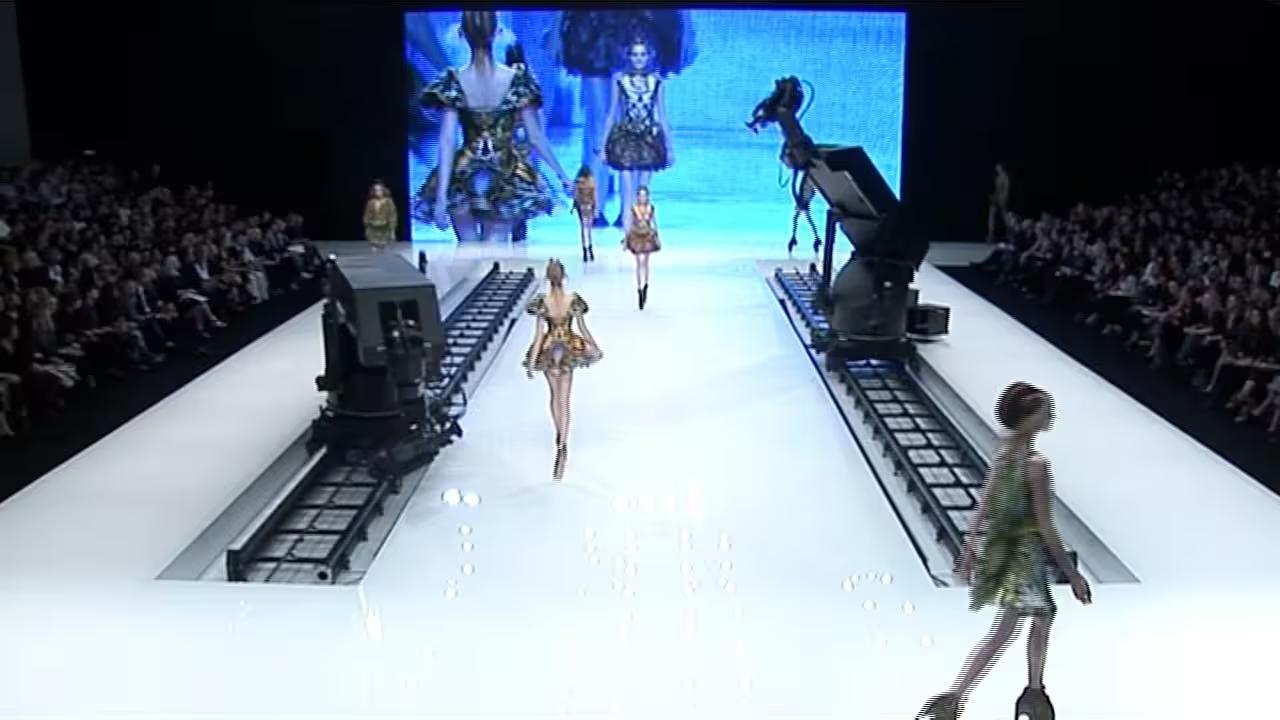
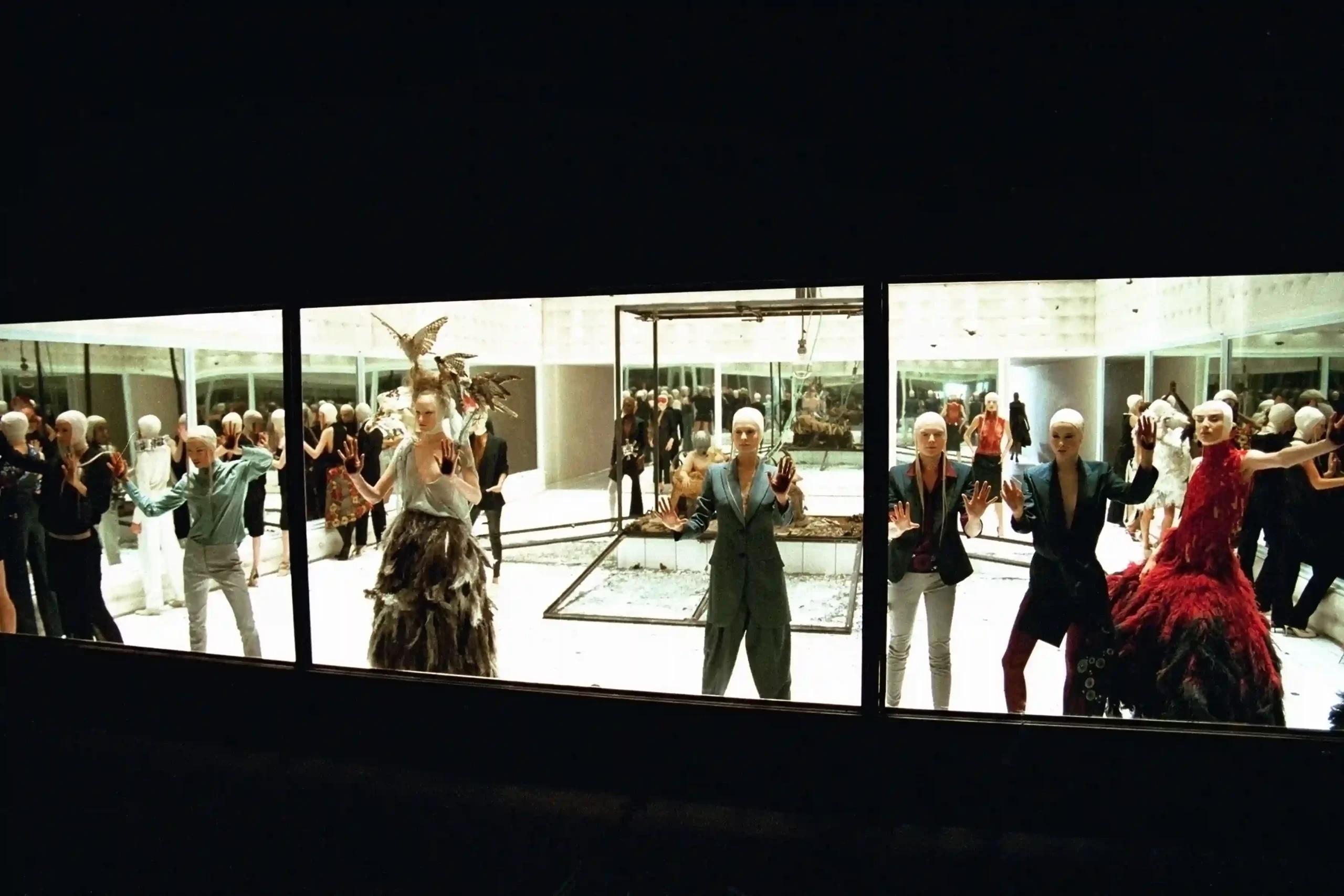
In the age of new technologies, the question arises whether new media can bring something new to contemporary fashion? The work of Turkish – British designer Hussein Chalayan
The subject I want to address is today’s relationship between aesthetics and ethics. Both disciplines deal with courses of action, even if different ones, and reflect on such behaviours. Ethics has delved deep into the criteria and principles according to which we qualify our choices as “good” and, as such, we choose to adopt. Aesthetics has focussed on discussing what makes us consider a human creation as beautiful. It is precisely such centrality of human action that is questioned in today’s scenario, in both disciplines. Nowadays, human action takes place in technological environments: in other words, environments where human beings are not the only ones who act, with some level of independence, but where devices provided with “Artificial Intelligence” act too. Therefore, the disciplines – aesthetics and ethics – that reflect precisely on such behaviours need to be deeply rethought and also need to change the very ways they can relate to each other. The present paper will try to discuss this topic. Keywords: Aesthetics, Ethics, Beautiful, Good, Technology, Technological environments, Artificial Intelligence. 1. Aesthetics and ethics The subject I want to address is today’s relationship between aesthetics and ethics. As we know very well, they are two disciplines that have an important history: a longer one that of ethics, which dates back to Aristotle’s quests (Aristotle, 2009), and a more recent one that of aesthetics, which as “the theory of beauty” was initiated by Baumgarten in the 18th century (Baumgarten, 2007). Both disciplines, though, deal with courses of action, even if different ones, and reflect on such behaviours. Ethics has delved deep into the criteria and principles according to which we qualify our choices as “good” and, as such, we choose to adopt. Aesthetics has focussed on discussing what makes us consider a human creation as beautiful. It is precisely such centrality of human action that is questioned in today’s scenario, in both disciplines. The disappearance of such centrality implies the need to dramatically change their setup. Nowadays, human action takes place in technological environments: in other words, environments where human beings are not the only ones who act, with some level of independence, but where devices provided with “Artificial Intelligence” act too, if not most of all (High-Level Expert Group on Artificial Intelligence, 2019). Such a new scenario has major consequences: it affects the forms of our actions and provides new developments to what we can mean as “beautiful” or “good” behaviour. Therefore, the disciplines – aesthetics and ethics – that reflect precisely on such behaviours need to be deeply rethought and also need to change the very ways they can relate to each other. It should also be said that, usually, in the past, their connection was not investigated as it should have been. Quite the opposite: a 20th-century Italian philosopher, Benedetto Croce, theorised a clear-cut separation between aesthetics and ethics, regarded as “distinct” dimensions (Croce, 2017). And, even today, a lack of interest in the connection between such two disciplines, and the connection between the “beautiful” and the “good”, is equally widespread among scholars. When one thinks they should be investigated, that is mainly done in one of two ways. Either the relation between specific forms of judgement – the judgement about the ethical “value” and the judgement about the aesthetic “value” of an experience or a phenomenon – is questioned, or arguments are formulated about the good or bad consequences, that a work of art can have on the social or individual sphere. In the former case, there is the risk of this subject turning into a matter of how to share opinions inter-subjectively: as no opinion can be objective at first. In the latter case, one very often ends up falling back into moralistic statements. In both cases, however, the matter of the relation between the “beautiful” and the good”, between ethics and aesthetics, is dealt with by adding the opinion of a subject in between the opinion of a human being. Such an approach is typical of modern thought. This is not what happened in ancient times, instead. This is not how the relation between goodness and beauty was viewed in Homer’s Greece. Back then, goodness and beauty were very closely connected. Let’s briefly touch on such a context. We might say that the entire Iliad is an expression of the synergic relation between goodness and beauty. The many Achilleses, Agamemnons or Hector himselfare the epitomes of kalokagathia: where “beauty” and “goodness” are notions that have a specific meaning, which we have to understand again. Homer sings their union and conveys it in the forms and in the styles of his time[2]. How did such a connection come to be expressed? It had to be fully visible. In other words, it alluded to a publicly acknowledged virtue that appeared to other humans, in equally public and outward forms (as shown for instance by Jaeger, 1986). It would have made no sense for Homer to regard and sing Achilles as a hidden hero of his generation or merely mention the beauty and goodness of his soul. It was with Plato, or better, with Alcibiades in the Symposium, that the concurrence between inward virtue and outward beauty was put under strain, in the figure of Socrates (Plato, 2009, 215 a-b). But, once again, even in Plato’s age, what eventually came to the fore as a paradigm of beauty was order, harmony, the concurrence of the elements of a body and a person, of a character and a community, of a people and the world it lives in. Such balance, such concurrence, between the inward and the outward, and between the part and the whole, were substantiated not only by Attic architecture and statuary but also by the very idea of a satisfactory action, as formulated by Aristotle in the first book of his Nicomachean Ethics (Aristotle, 2009). 2. A few underlying questions All things considered, then, what is suggested by the authors I mentioned is an idea of “goodness” and “beauty”, as
The author deals with the consideration of what he calls the post-metaphysical complex of the technosphere, for which the ontogenetic framework of classical metaphysics from Aristotle to Hegel is no longer valid. Instead, the question of the essence of man posits his transcendence in the emergence of Homo kybernetes, with which he removes the posthuman condition. To explain how the permeation of human and non-human appears in all areas of contemporary life as a connection and relationship of information, feedback, control and communication, it seems necessary to open the issue of the cyborgization of life itself. At the same time, the analysis of transhumanism in the opinion of Stefan Lorenz Sorgner proves to be stimulating for understanding what the digital age of the technosphere presupposes, and that is the question of the possibilities of freedom beyond its metaphysical framework as it was considered in the speculative thinking by Schelling. Instead of freedom as absolute, the time has come to establish the possibility of thinking about freedom as an experiment of thought and action beyond human reduction and its associated anthropologies that have lost their credibility in an encounter with the complexity of Homo kybernetes. Keywords: Homo kybernetes, metaphysics, information, technosphere, onto-genesis, posthuman condition 1. Metaphysics and Technosphere Without thoughtful reflection on the challenge of the relationship between technology and (post)humanity, it seems impossible to persist in the relationship between technoscience and humanities that would not become non-contemporary in one way or another. Although the prefix post is in parentheses, and humanity is without it, it seems obvious that today there is still something that does not reduce human prerogatives and achievements to the logic of technological singularity. As if this play between what comes after the human and what is here and now human-too-human, to use Nietzsche’s famous statement, points to the necessary difference between what constitutes the essence of posthumanism and humanity at all, which becomes the highest reach of technosphere rule in managing societies and culture with the help of artificial intelligence. But what if this small difference no longer exists or if it is suspended and neutralized? What, furthermore, if a man has never been able to separate from technology in historical development, i.e. what if we have never been humane, as Donna Haraway claims, or what if we have always been cyborgs, as Stefan Lorenz Sorgner puts it? (Haraway 1990, Sorgner 2022) While, namely, there is a relationship between the human and the non-human, the metaphysical structure of thought is at work, even if Being is replaced with the concept of information, and beings with a multitude of pure contingencies. A relationship denotes always a possibility of a union at a distance. Synthesis, therefore, presupposes a real state of analytical separation, for example, of different substances in some hybrid assemblies such as contemporary technoscience with biogenetics, biocybernetics and biosemiotics. When we talk about the relationship between the human and the non-human, we must start from the assumption that the former is always the model for understanding the latter. Man in so-called human nature or its essence cannot be understood within metaphysics in any other way than essentialist. This means that his position within Being and his being are always given to him spiritually and biologically, i.e. vertically, following Aristotle’s famous definition of animal rationale. Furthermore, the relationship between the two, starting from the human primacy, is therefore not only horizontally reduced to biologism, from which psychologism and anthropology follow, which Heidegger in Being and Time (Sein und Zeit) tried to eliminate within the framework of the systematic “destruction of traditional ontology”. (Heidegger 2018) The reason should be seen in the fact that he considered that by doing so “man” or being there (Dasein) completely fails in his thinking and thereby reduces to exactly what he wanted to critically overcome, namely Aristotle’s definition of animal rationale. Biologicism denotes the reduction of man to naturalism, thatis, to the so-called biological factors of the whole of his own; psychologism becomes a reduction to the so-called unconscious articulation of language, which reduces man to a pre-and-post-rational living being, while anthropology means the reduction of man to the subjectivity of the subject by which all other beings appear at a lower level of cosmic-biological evolution and thus make him the master of nature as a whole. Heidegger’s critique of the reduction of the meaning of Being to the so-called life processes in their inclusive vitality affects the triad of biology-psychology-anthropology because they think a man insufficiently and inauthentically according to this conceptual-categorical “rationalization” of language. Any reduction of the human in man to the non-human necessarily fragments his integrity and irreducibility as a being among beings. However, every reduction cannot be the same as the annulment of human authentic existence in the openness of freedom. To reach the purity of the human essence, phenomenologically speaking, it is necessary to understand that such an essence comes from the dark core of the non-human, which was already known by pre-Socratic thinkers when they spoke about the relationship between demons and humanity. We should remember that Socrates was also constantly followed and urged to freely express his thoughts in public by his demon. So, we shall see that the question of the relationship between humans and non-humans cannot be simply resolved by a vulgar distinction between the biological and the post-biological when it comes to the relationship between humans and post(humanity). It is not difficult to understand that the problem of this relationship is that both relata in the relationship are derived from the difference against the life force of what comes from the concept of nature (physis), which is life (bios). The human in the metaphysical sense is always rising above the limits of biologically understood life as mere survival at the animal level. Therefore, it seems self-evident that from this every form of animalism will be considered as a loss of the so-called human dignity. This term has its origin in connection with the ethical-aesthetic doctrines of the Renaissance notion
The arguments that follow are situated within a larger project entitled “Critique of Algorithmic Rationality.” That project, drawing deliberately from Immanuel Kant
The paper analyzes the performative-conceptual turn in contemporary art, starting from the idea of two bodies and two worlds – life and artificial or aesthetic – in the media-created reality.
Long live the new flesh! David Cronenberg, Videodrome 1. Beyond a fashion? “Elle est contemporaine de tout le monde” In a world without the metaphysical foundation of beauty and reign of the sublime, the categories of contingency and chaos have long since lost the meaning of modern aesthetic values. Instead, technically-scientifically shaped forms of life take on the task of decorating the surrounding world. The process of aestheticization covers all areas of life. However, in that gap between the worlds—one that strives to preserve by collecting objects and traces of the past and another of integral reality that, like a soap bubble, bursts in the air—there is going to be something disturbing and, at first glance, uncannily spirited. This event signified the experience of German literary romanticism and psychoanalytic-philosophical insights from E.T.A. Hoffmann to Sigmund Freud and Martin Heidegger. We should here call to mind the uncanny experience of the world (Unheimlichkeit). The fantasy of an unusual object of the universe, which is at the same time close and strange like a puppet or a cyborg in a virtual space, as assumed in the movie The Matrix, belongs to one of the iconographic foundations of fetishism in modern culture. To even think of the loss of beauty and the transition to the world of decoration as a world of fashion, it might be necessary to find out what is going on in the world and in time that is disturbing and uncanny as conditions of the possibility of the reign of the fetishism of objects. Is it a unique and universal world and a unique and universal time? The answer to this question seems to be an insight into the disputes between the postmodern deconstruction of truth and the new cognitive realism. It seems just like a dispute between those who deny the universal truth of reality and its existence outside of the context and situation and those who depart from the idea of transcending the long conditionality of our knowledge of the world. If it is about a unique world of things, what can the identity of contemporary art and fashion be? If, however, a multitude of worlds and different perceptions and experiences of time proves the primacy of that “ontology of things,” then the question of the essence of contemporary art and fashion and the question about the status of the contemporary metamorphosed body as a visual matrix of the machine and the cyborg has to be found in the new concept of life. What if it is about the other world and the disappearance of time? If, therefore, a homogeneous area and heterogeneous bodies lie in it, and its deployment of immigration-emigration constitutes an entirely new situation at the end of history, how is it possible to access that hiatus, namely, one in multiplicity? This could be the exact situation of all things, just as nomadism, loss of homeland, and transgression have been successfully represented in the installations and critical reflections concerning the fashion of the designer Hussein Chalayan (Evans 2005, 8–15; Quinn 2005, 46–51; Steele 2001). In his aesthetics, Immanuel Kant assumed that ideas of beauty as disinterested spectators belong to the field of court taste. Such a judgment cannot be objectively legalized. The reason is that it should be not a category of mind, irrespective of whether they are antinomically defined, such as, for example, the case of the idea of God. However, the idea of beauty may have a general scope that should take the place of aesthetic judgment. So, it is always culturally determined or customarily arbitrary. This assumption has undergone a new interpretation in the semiology or semiotics of Saussure and Barthes. For them, the signifier is a cultural order, not the natural condition of communication. Is not that something that we can add to contemporary fashion? It cannot be otherwise thought of as an essential cultural and decentralized order of meaning—as an apparatus and whether it is an enabler[1] —at the time of the transition of social relations to the network of visual communications. If there exists a universal language of fashion (la langue), then the multitude of speeches of fashion (la parole) might be equivalent to a multitude of cultural orders. We should note, in advance, that the ideal speech situation in the postmodern context encompasses the assemblage of ready-made and designed fashion objects. The multitude is reflected in one. Instead of the autonomy of the discourse of fashion, the apparatus of fashion still has to be in the operation of the heteronomy of fashion. This could be the attitude of Gilles Lipovetsky in his famous book The Empire of Fashion: Dressing Modern Democracy. The concept of open fashion determines our fluid and very complex age. Fashionable clothing is less and less a means for social distancing, more and more an instrument for individual and aesthetic distinction, an instrument of seduction, youthfulness, and emblematic modernity. Ever since it began, fashion has blended conformity with individualism. For all its openness, contemporary fashion still has not escaped that basic structure. But there is a difference: individualism has become by and large less competitive, less concerned with what others think, and less exhibitionist. (Lipovetsky 2002, 127) Contemporary fashion, thus, stems from an uncanny blurry aesthetic and a transgressive encounter. In all manner of manifestations of transgression, the transition to the norms limits the fields of autonomy. The peak of transgression is represented by the taboo of eroticism. Although the notion of transgression was developed by Michel Foucault in his analysis of the will, knowledge, and biopolitics of the modern age (Foucault 1977, 29–52), it was undoubtedly Georges Bataille who gave this concept the power of reflection for the upcoming era. Transgression is, namely, directed towards eroticism, exile, taboo, sacrifice, violence, divinity, sacred, ritual, craving, and exclusion. While Foucault describes transgression as a boundless boundary and the emptiness of excess after the death of God and the establishment of new frontiers towards infinity, Bataille, in the victim’s economy determined by crossing the
Observing the works of art selected for the exhibition East of Eden by the participating artists from their existing artistic production with the intention of providing the theme with a consistent visual and spatial identity, the first thing we will ask ourselves is what are the reasons for gathering exactly these works and artists at the exhibition under that name. If we consider the location of the event, East from the exhibition title is self-explanatory: what connects it all is the living and working space of these artists, the city of Osijek. Until recently, on the map of contemporary art events it was considered – if not “empty land” – then certainly a marginal environment in comparison to Zagreb, and in relation to which the art scenes in Rijeka or Split were also marginally positioned. With the founding of the Osijek Academy of Arts and Culture in 2004, things began to change radically in Eastern Croatia as far as contemporary art is concerned. The work of the Department of Visual and Media Arts at the same Academy has become not only an ever more present and visible but also an unavoidable factor within both Osijek and Croatian art today. This is largely due to the initiatives and activities of the participants in the exhibition East of Eden, most of whom have either been active at the same Academy since its establishment or soon afterwards became lecturers there, whereas some former students became teaching staff there in the meantime as well. The changes and increased attention to events in contemporary art in Osijek are witnessed also by this exhibition, whose actors, but also many other artists and theorists unrepresented in the exhibition together with the Academy as a starting point for the new events have made Osijek art scene during the last decade recognizable beyond the borders of our country. Such an achievement in such a short period may perhaps be called a miracle rather than a sin, but sin is not only a crime, but also has to do with the strange, with disobedience, something unusual that goes beyond the predictable or an existing, given state. In support of the skandalon, the fact that it is indeed a “criminal form” here we speak in a creative, most positive sense, namely artists and artistic production that gave the label marginally in this area a whole new meaning – the meaning of advantage, independent artistic expression with emphasis on the awareness of place and time as a framework for an activity whose reputation, in its essence, rests more on sin and disrespect, rule breaking than on virtue, which is more rebellion than acceptance of the circumstances. Dissatisfaction and disobedience to the given, both the current geo-political and socio-cultural conditions, here, however, were not primarily expressed bitterly or aggressively, nor were they accompanied by any revolutionary manifestos, theses or frequent anarchic speeches, but the shifts and changes took place in discipline of conceptions and disciplinary concepts of work, with an awareness of the effects of that work on one’s own as well as on the identity of the urban environment. The activities of public joint performances of most of the participants in the exhibition East of Eden within the POPUP group established in 2012 can also be described as such. At that time, activities in alternative, mostly emptied and abandoned spaces of Osijek, among other things, pointed to the acute demographic and social problems of this environment, which however did not go at the expense of creativity based on research processes that primarily answer the question of art “here and now”. If this characterization to some extent evokes lettristic and situationist analyzes of society and urban everyday life, i.e. Debord’s definition of the term psychogeography presented in 1955: “study of precise laws and specific effects of the geographical environment, consciously organized or not, on the emotions and behavior of individuals”, then this can be applied to Osijek artists in a quite altered meaning: their desire for change was not reflected in the desire for “complete dissolution of boundaries between art and life”, as stated in the continuation of situationalist demands but in the pursuit of articulation of separate boundaries of art within these domains. Likewise, according to the basic principles of the situationist theory of psychogeography, Osijek actors emphasize differences rather than overlaps: thus the term derive by no means implies “rapid passages through different environments” in the manner of flaneur; and from the method of détournement – even if the premise of “ludic-constructive behaviour”[1] is retained, it is with the broader meaninings of this term – as “diversion, distortion, subversion” – with Osijek artists present in the aspects of socially conscious positions of art/artists towards society whereas also extremely non-narrative, controlled, ideologically and analytically based creativity is oriented primarily to the discourse of art itself. Speaking about the plans for this exhibition, which, like many other activities was postponed due to the pandemic last year, on the occasion of the opening of the Knifer Gallery in an interview artist Vladimir Frelih, the first gallery manager and one of the participants and initiators of the exhibition East of Eden, said that exactly these seven artists “in a way represent” and form a certain “cross-section, yet by no means a closed list of artists of the contemporary Osijek scene”, i.e. that the exhibition brings together those artists who point to the “Osijek artistic moment related to the issue of the”new image”, and which is according to him an attempt to “provoke the question of identity and different properties of Osijek artistic manuscripts.”[2] Hence what could these “Osijek manuscripts” stand for, that “script” which, in the meantime, out of isolation, from the position of marginal and secondary “remark”, predominantly articulates the specifics of the potential of the scene in Knifer’s hometown? This question is especially important if for each of the artists represented at the exhibition East of Eden, we can first of all state that the works shown – neither the individual ones nor the oeuvres
Modernism radically breaks its ties with the linear mimetic-representational way of presenting the image of the divine found in myth and religion as the idea of beauty and sublimity. Modern art removes the substance of humanity from its works with a new aesthetic that distorts reality and creates unreality. From a sociological point of view, works of art that create a new style are misunderstood by the masses who traditionally see art as an extract of life. Modern art no longer places the content of sensory experience in the center of their works and rejects the burden imposed on it by tradition. In order to be able to understand modern art and its objects, who create a new autonomous language and the new spirit of time, we must change the way we look at it. The process of dehumanization of art serves as a prelude to a posthuman state that will radically establish new types of art through new technologies, such as bio-art and crypto art, through which they will affirm a new aesthetic. There is no doubt that with the new paradigm shift we are facing the most radical philosophical, ethical and cultural changes. Keywords: modernism, art, human, aesthetics, dehumanization, tradition, radical, posthuman 1. Introduction The art of the new age is no longer based on myth and religion, but replaces them with aesthetic that can only be understood through political construction of events and as a scientific-technical design of a world in which there is now a rebellion against the old values and in which new aesthetic rules are being established. Art periods go through a process of approval by the public before they are popularly accepted. The unpopularity of modern art shows that it does not follow this tradition. From a sociological point of view, modern art divides the audience into two types, the individuals who understand it and the masses who don’t. Different principles and views on art separate these two groups. As known, characteristic of the aesthetic experience of an artwork is that some may like it, while others don’t, but in the case of modern art this division takes place on a higher level, because it’s not that the majority of the audience doesn’t like a particular work of art, it’s that they don’t understand it. The masses, accustomed to dominating everything, feel threatened by the modern art, which they see as the art of the privileged. The masses like a work of art if it manages to draw them into thinking about their own humanity. That happens when human destinies are placed in front of them through which they can connect their own feelings and experiences. Modern artists remove this substance of humanity and destroy the bridges that link the real and artistic worlds resulting in a new autonomous image in which the masses are lost and left without any way of connecting. In optics, if our visual capabilities are not sufficient, we cannot see the object or we see it in a fallacious way. In order to be able to understand modern art and its objects, we have to change the way we look at it. If we make an effort to understand the modern art and its concepts, they will, very quickly, seem more clear, coherent and rational. The new tendencies are radical and extravagant in their representations and can change the traditional artistic path. It’s necessary to approach the new images with a completely open mind and to come up with a completely new tools which can be used to describe the images of the new aesthetic life. Modernism changed the traditional artistic path and opened the way for a new, more radical and more monstrous, aesthetics of posthumanism, transhumanism and metahumanism, which are led by new technological directions and approaches. 2. Ortega y Gasset and the dehumanization of art Until modernism, art was constrained to the service of the divine in myth and religion. Since it has been freed, art stepped out of the world of beings and gods into its own world. The liberation experienced by modern art was effective in all its aspects, from the autonomy of the work, the freedom of form and expression, the democratization of social conditions, to the revolutionary cultural assumptions of one’s own relationship with the world.[1] Modern art manifests itself through rebellion against the existing social order, the liberal-democratic “boredom” of early capitalism, but also as the justification of its scientific and technical innovations. The individual is the essence of modern society, his function is to be at the service of the capitalist order as an ornament of formal freedom of choice, therefore it is necessary that modern art is perceived as a rebellion against the order of old values and as the establishment of new aesthetic rules. Since the art of the new age no longer has its foundations in myth and religion, it replaces them with an aesthetic that can only be understood as a political construction of events and as a scientific and technical design of the world. Thus, the problem that Ortega y Gasset faces here is not the social problem of the status of art, although that is his starting point.[2] The uniqueness that each art era has, no matter that it manifests itself in different ways, is truly astonishing and mysterious. Within an era, the same characteristics can be found in different artistic media, so without even being aware of it, musicians try to express through music the same aesthetic values as painters in painting, or writers in literature. Every artistic period must go through a process of re-examination before it is generally accepted by the public, as was the case with the Romantic period. The acceptance of the public and rapid popularity of the Romantic period is very different from the acceptance of the modern art. Unpopularity of the modern art shows how it does not follow the traditional path. Romanticism managed to win the masses over to its side, while modern
The thesis I argue in my text through three separate planes of discussion is that mimesis (μίμησις) cannot for Nancy be reduced to mere imitation of an already always existing reality. Instead, what is at issue is a creative principle of the openness of the world as meaning starting from the possibility of imitating something that can only be presented-represented in the equation between the logos, the figure and the image. Mimesis thus presents-represents an existential event of novelty in the world. If it is impossible to ask about an event in the traditional metaphysical terms of what it is (quiddittas), but only how it occurs (quoddittas), we cannot rely on the language of the openness of the meaning of the world without previously elucidating on the mediality of the media in Nancy’s thought. This simultaneously means that the logos and the image are connected neither via language nor the representation of something as something (being as the singular plurality). An event occurs authentically precisely in this “elevation of the body” (levée du corps). And this is neither the truth of the “resurrection” nor the mystery of “transcendence”. In Nancy’s narrative, it becomes abundantly clear that the body (corpus) assumes the position of the unthinkable in traditional philosophical thought. The logos of the body is, thus, in its representation as a figure-image in what is open and therefore beyond the opposition between the “self” and the “outside”. In orderto think this “crack” between philosophy and art (logos and mimesis) it is necessary to make a decisive break with the “oblivion of the body” symptomatic of the entire history of Western philosophy. Keywords: Nancy, mimesis, art, body, image, event, ontology “La mimesis n’est pas la copie, ni l’imitation reproductrice.Elle re-produit au sens où elle produit à nouveau, c’est-à-direà neuf, la forme, c’est-à-dire l’idée ou la vérité de la chose”.(Jean-Luc Nancy, Le plaisir au dessin, 2009.) Introduction Speaking about the “meaning” of what renders us speechless in the close encounter between philosophy and art already presupposes an important differentiation. This is not, however, a differentiation according to rank originating in the primal uncanny (arché) from which the historicity of existence, being, and essence of man is interpreted. Differentiation produces difference like thinking produces meaning. But only when a language has established the equation that Jean-Luc Nancy, already on the opening pages of Noli me tangere: Essay on the Elevation of the Body terms a “parabolic truth”. Drawing attention to portrayals of Jesus Christ in art history and the symbolic course of Western history something suddenly occurs as an unforeseen event. In Christ’s body, the difference between the “logos, the figure and the image” is cancelled out.[i] If philosophy and art produce meaning in the narration and depiction of the world as a horizon of meaning, then this identification, which Nancy holds to be a problem of ontological determination without rank and hierarchy between the “logos, the figure and the image”, can be viewed as a non-identification. Therefore, the statement itself is further problematized. How can we see as the same and identical that which according to the original determination is different and therefore points towards the primacy of philosophy over art? Logos cannot become a figure oran image unless its “essence” is previously deconstructed. However, even when we see in the figure as the image that which is “logically” perfectly performed like in a piece of conceptual art, for example by Joseph Kosuth, it remains unclear how and under what circumstances thinking can become a figure-image. This act must indubitably have in it something beyond logic in the formal sense of the word. Moreover, there must be a medium, mediating experience of merging thinking and feeling so we can truly attest to differences dissolving before and almost mystical similitude. That medium is the body. It enables the equation of what seems metaphysically different. Logos and figure as the image can only in relation to the body become a feasible relation. It can even be demonstrated that this mediation, this mediality in the touch between philosophy and art without the former ruling over the latter as has been the case throughout the history of metaphysics until Heidegger, is the focal point of the crystallization of thinking the openness of meaning. In the touch of what is separate different thinking takes place. Thinking the body outside Western metaphysics is to touch the untouchable. Is not untouchability, however, what denies the possibility of touch even when it seems that sensuality is, like the immateriality of the virtual world, beyond any imaginable tactility? The question of touch directly affects us with the surplus of synesthetic sensuality. Touch cannot be understood from the spatiality of matter, things and objects in motion as necessary merging, colliding, intertwining, pervading, synthesis of action between matter and energy. Only beings touch. In their desire for intimacy and confidentiality, they compensate for the inherent lack of independent existence. What moves them surpasses the experience of corporeality in the sense of physical mobility (flesh and nerves). The question of the “exalted body” which no longer possesses the signifiers of bare corporeality for Nancy in his essay Noli me tangere as well as in his book Corpus refers to the mystery of the double helix of existence. On the one hand, it is about disembodiment after the death of a being, and on the other, about approaching what is a “relict” of metaphysics in the theological understanding of transcendence as a path towards suprasensuality. Whoever thinks “of” the body in the existential openness of the meaning of the world must pass into a state of freedom from thinking “about” the body. In the aesthetic experience of the sublime, we come to the threshold of Plato’s form (eidos), Kant’s schematism and Lyotard’s presentable un-presentability of the thing itself. Nancy’s essay on the “exaltation of the body” should furthermore not be considered a mere variation on the problem Christianity has according to the relationship between man and the divine, life and death, crucifixion and
The most significant notion of Benjamin's thinking in the path of a particular refinement of style surely represents the concept of of aura. From this notion, the
The phrase cinematic factory in the title connotes the history of cinema. On the one hand, it refers to the first film screening held in Paris in 1895 – Workers
In an interview given to Günter Gaus, released on 28 October 1964 in West Germany under the title Zur Person, Hannah Arendt – the smoke curling off the tip of her cigarette – says that she wants to “look at politics with an eye unclouded with the philosophy”. There is a tension between (wo)man as a thinking being and (wo)man as an acting being that seems to be of particular importance when applied to Arendt’s intellectual voyage from the “enclosed garden” of philosophy to the public sphere of political theory. In this essay, my major focus is on the tension produced by the dynamics of opposing[1] in developing philosophical argumentation in the course of philosophy-doing. The feeling of that complex tension becomes existentially important for Arendt. When I say “existentially” I mean two different, yet connected things. First, I refer to the importance of the “need to understand” for Arendt, as exemplified in the sentence in the interview where she remembers how after having discovered Kant in her parents’ house library – she has just one alternative: either to study philosophy, or to jump in the river. Propelled by the need to understand philosophy, the fourteen-year-old child Hannah has become a compulsive reader, constructing herself as an existential subject whose very existence first presented itself as a riddle and a task to solve, then – in the formative university years, under the influence of Jaspers – the same subject constructed itself as a problem, enabling existential philosophy to become the basis for Arendt’s theory of action. As Bruno Latour said in Politics of Nature, “Scientists argue among themselves about things that they cause to speak, and they add their own debates to those of the politicians. If this addition has rarely been visible, it is because it has taken place—and still takes place—elsewhere, inside the laboratory, behind closed doors, before the researchers intervene as experts in the public debate by reading in one voice the unanimous text of a resolution on the state of the art” (Latour 2004, 63-64). What is the nature of that uncanny “we” that exists across Latourian networks that are simultaneously real, like nature, narrated like discourse, and collective, like society? (See Latour 1997, 6-7). Is it possible for an “I” to get re-created across contemporary networks? If the answer is yes, then at what stake? How should an individual “I” perform nowadays, and what makes its performance valuable? Is there a daimonian code to the social language that makes the voice of an “I” sound like a “valid personality” to another “I”? Is there a special type of spectating necessary for an Arendtian “space of appearance” (Arendt 1998 [1958],199) to be brought to existence in the contemporary world? Has the nature of witnessing the reality of the public sphere changed since Arendt’s times, and how much equality and distinction is contained in the “plurality” of individuals who judge the value of the public sphere while participating in it? Here I propose differentiating phenomenological participation in the mutually co-created actor-spectator “space of appearance” as the internal, individual space of ethical re-creation of the subject (Arendt’s internal polis that goes wherever a person goes), from historically actualized performances in the public sphere. The performative virtuosity of freedom inherited from the ancient Greek type of democracy, is seen in Arendt as a performance of public disclosing of shared values. Let me use a metaphor from the practice of performing arts: if there is some improvisation on agora, it is structured. Arendt’s concept of plurality is a dramaturgically (and narratologically) constrained freedom. The virtuosity of freedom is a performance of shared narratives and dramaturgical scripts. Even if Arendt notices some kind of thinking-doing related to the unstructured risk of historical participation in the public sphere, it does not seem important to her. Performing philosophy in the public sphere becomes politically relevant for Arendt only in connection to Jaspers’ “boundary situations” (Jaspers 1973) which are then re-thought as existentially heightened moments in the shared collective narrative. Rehabilitating politics among thinkers is important for Arendt but it does not imply overcoming the old tension between thinking and doing. Arendt insists on showing how the act of thinking in “dark times” changes the very essence of philosophy by establishing a new possibility of balancing the otherwise opposing tendencies of belonging to and withdrawing from. Again, unstructured thinking-doing is politically relevant only in connection to the ”boundary situation” that has disrupted the warp and the weft of a shared narrative texture of what Arendt perceives as the community constituted by memory. The most drastic example of it is the challenge of philosophizing as thinking-doing in the times of the Holocaust. There is a dramaturgical potential in Plato’s philosophical thinking where the re-creation of Socrates’ persona always remains in an intrinsically motivating relationship with the most intimate process of Plato’s discovery of his own philosophical Who. I see this Platonian Who – invented from the tension between living in the polis and dwelling in the “neighborhood of those things that are forever” – as an important component in the development of Arendt’s concept of Who versus What. When confronted with Plato’s ambiguities – one could not escape noticing that there is something that remains unresolved by his dialectics. I would – though tentatively – define that ambiguity as a surplus of artistic value in Plato’s art of the experimental. Aristotelian technê of peirastics (from peirastikê = experimental) includes the process of wandering – because, in order to get clear of difficulties, one should first engage in the free play of thought that implies the solution of the previous difficulties, as stated in Metaphysics (see Aristotle, 1991 Book III (B) 995a24-995b4). The nature of the art of the experimental, however, is different from Plato and in Aristotle. Aristotle’s thinker-wanderer has to experience getting lost before eventually finding the well-directed path. Aristotelian aporia tends to be resolved by tracing the path out of difficulty, while Plato’s aporia frequently gives the impression of staying in the
This paper is a general assessment of the reasons for, and proceeding of, Russia’s invasion of Ukraine. I argue that the political order established by Vladimir Putin at the beginning of his tenure is now crumbling due to his very desire to preserve and expand it. Among the issues discussed are the ideological background of Putin’s conception of power, Germany’s attitude towards Putin, the Russian struggle for recognition by the international community, and the problem of moral symmetry between Russia and US military interventions. In conclusion, I argue against the interpretation of the Russia-Ukraine war as a proxy war of two imperialisms and suggest the present form of imperialism is now on the wane. Putin’s order The unfortunate period of Boris Yeltsin’s presidency is known among the Russians as smuta, or despair. Some of that time I have spent in the company of young people from the post-Soviet bloc. The Soviet habit of heavy vodka drinking had not yet been then superseded in Central Europe by the liberal wine-sipping. In the alcohol-induced frankness, one of the Russians bitterly said: „На что мена такая великая родина, когда в нее порядка нет?” („Why should I need such a great homeland, if there is no order in it?”) In this straightforward way, he pointed out two main, closely related Russia’s problems: its size, and its endemic disorder. Soon after, Vladimir Putin found a solution to these problems, establishing the order much longed for by Russians. Though at the top of the political hierarchy this order turned out to be a system of organized crime, it brought some relief to all. After more than two decades of despotic rule, Putin decided to expand the Ruskij mir he founded. As a result, the Russian order has just begun to disintegrate and, together with it, the global order as well. The Invasion In a public lecture on his geopolitical ideas, delivered to a worldwide audience shortly before the invasion of Ukraine, Putin reiterated his long-held position. He used a twisted interpretation of history to claim that Ukrainian territory is an integral part of Russia. He questioned the statehood and cultural distinctiveness of Ukraine and denied its sovereignty. It was a historical mistake to grant Ukraine the status of a separate Soviet republic within the Soviet Union. He dismissed the 1994 Budapest Memorandum, signed by Leonid Kuchma, Boris Yeltsin, Bill Clinton, and John Major, which guaranteed Ukraine the „respect for the independence and sovereignty of the existing borders” and its security in exchange for the renunciation of nuclear weapons located on its territory during the Soviet era. He accused the West of breaking the promise given to Mikhail Gorbachev that NATO would not expand east of the East German border and would not deploy in the Central European countries the weapons that might endanger Russia’s security. He interpreted the subsequent political evolution of Ukraine as dictated by the leaders of the West bent on undermining Russia’s security by bringing NATO closer to its borders. According to Putin, Russia cannot trust Western countries because they have broken numerous pledges given to Russia after 1989. The ring of independent former Soviet republics surrounding Russia in Europe and Central Asia, which politically gravitate towards the West, is seen by him as a noose tightening around Russia’s neck. In the face of this betrayal, and out of concern for the country’s security, Putin wants to reclaim the areas lost by Russia: Ukraine and the Baltic states, as well as the sphere of its former influence. The first step towards these goals is to change the government of Ukraine, America’s errand boy. During the decades of his reign, Putin disciplined Chechnya, Nagorno-Karabakh, and Georgia. He began disciplining Ukraine in 2014, by annexing Crimea and supporting the Russian separatists in Donetsk and Luhansk. The time has come to take over the rest of Ukraine. His goal is to de-Nazify and demilitarize Ukraine and protect the 12 million Russians living in Donbas from Ukrainian Nazism. By Ukrainian Nazism Putin means the party Right Sector which originally evolved from a movement of supporters of the Metalist Kharkiv football club. Its militant extreme-right and neo-Nazi members, many with a criminal record, adopted as their own the Nazi symbol of Wolfsangel. The Ukrainian government granted them the status of a National Guard unit which was transformed in 2014 into the Azov Battalion, now the Regiment. Azov uses a crest that dangerously resembles the crest of the Nazi 2nd SS Panzer Division Das Reich. Azov took part in military action for the first time in Mariupol, recapturing the city from the Russian army during the annexation of Crimea in 2014, and fought against separatists. Russia accuses Azov of violent repressions against the Russian-speaking population in the present Donetsk quasi-republic. In the most chilling part of his speech, Putin threatened that any country wishing to prevent him from implementing his plans in Ukraine would have to take into account the consequences that no one had seen in history. The Russian mir The ideological foundation of Putin’s geopolitical vision is the nationalist philosophy of Ivan Aleksandrovich Ilyin, now the most widely read Russian philosopher. His ideas won the sympathy of such Russian figures as Alexander Solzhenitsyn, the Kremlin court philosopher Alexander Dugin, and the popular film director Nikita Mikhalkov, who proposed to bring Ilyin’s remnants from Switzerland. Since 2005, twenty-three volumes of Ilyin’s writings are being published in Russia. Ilyin was born in Moscow in 1883 to an aristocratic German-Russian family. Influenced by Pavel Novgorodtsev, a law professor at Imperial Moscow State University, he rejected his youthful anarchism, turned to law studies and right-wing ideas, and against scientific socialism. He was among 160 intellectuals expelled from revolutionary Russia by the Bolsheviks in 1922 on the famous „philosophers’ ship” which sailed from St. Petersburg to German Stettin. He spent ten years in exile in Germany, where he wrote anti-Bolshevik essays for the magazine „Kolokol”, and then moved to Switzerland, where he died in 1954. Like many of the „white”
No “revolution” is “revolutionary” enough. Martin Heidegger, Die Geschichte des Seyns 1. Mephisto’s problem: So, what if there is nothing left behind? One of the most lucid analyses of the essence of a contemporary world in which the governance of capital becomes the assemblage of the power of technoscience, transnational corporations, and crisis management policies is the monumental study by Luc Boltanski and Eve Chiapello titled The New Spirit of Capitalism. The main assumption seems extremely provocative. In spite of late capitalism being a neoliberal doctrine and the practice of the radical privatization of public/common goods in the world from the end of the 1970s to today, one can speak of a reaction to the defeat of the idea of the student rebellion in 1968 (Boltanski and Chiapello 2005). How are we to comprehend this almost emblematic assumption of left-wing theory? For this, we have at least two explanations. One is that capitalism cannot work without periodical crisis. Stability, otherwise, arises from the danger of the system’s collapse. So, the balance of the structural elements of its existence, such as the supply economy, political changes in the bipolar system of liberal democracy and, most importantly, innovation in the field of science and technology, seems to be constantly violated. Therefore, the governance crisis in all situations from political revolutions to the wars of conquest for new markets in the 20th century and today shows the continuation of the power struggle by other means. The classic era of industrial capitalism belongs to modernity. Its ruling idea encompasses unconditional progress. But the late capitalism assembled by IT corporations is based, however, on the idea of sustainable development. What is the difference? Can it be visible only in the way social relations function? The paradigm of the linear notion of history in the social sciences and humanities has been replaced since 1968 by models of indetermination and contingency. However, despite the uncertainty in the era of doubt in unlimited economic growth, the facts contradict the heroic pathos of the “Big Defeat”. With the transition from the form of the object/thing in the form of techno-scientific capital to the process of creating a new life (biogenetics and biocybernetics), unconditional progress became a posthuman condition. Its main features include the following: (1) Science now connects once separate spheres of nature and many by exploring the possibilities of creating artificial intelligence and artificial life. In the know-how of the information society, man is reduced to biogenetic code. With it, the experiment is aimed at improving the cognitive-physical capabilities for performing complex work operations. All sciences have now become technoscience. The concept of technology, unlike the technique, is no longer an asset for purposes other than itself as the “essence” of the contemporary era. Technology, hence, refers equally to nature and culture, the production of objects and the way of creation of a subject. The shift from technology to the technosphere means the transition from the analogue to thedigital paradigm of the historical development of thinking and Being. (2) Technology, therefore, combines areas of science and culture, nature and man, information and communication. All technical logic is today digital, and instead of their instrumental power, in the centre arrives a new aesthetic function. But now we are no longer talking about a beautifying of objects. Design, on the contrary, becomes the conception of the new digital world, as the construction becomes the basic notion of complexity, but of the fundamentals of new sciences (cybernetics, informatics, computer intelligence, neuroscience). Artificial intelligence (AI) and artificial life (AL), thanks to the relationship between nanotechnology and the cognitive machines, have become the creators of life from the uncanny power of immateriality. The space of their proximity and their events is virtual, and time is taking place in the immediate instant. We can define that as a condition of forgetting the past, without being aware of the already possible event of interruption with the order of the perpetual updating of the new. (3) Finally, culture simultaneously becomes the life-world and the ideological justification of the performing event of the power of capital and capitalism without alternatives. Within this framework, culture takes the “power” of the irreducible remnant of what is most proximate to the man due to the art and its non-instrumental character of the un-representability of the work. From spectacle to design, from aesthetics to architecture, from high culture to mass culture, identity is constantly emerging. We no longer understand life as a gift and unchangeable destiny. So, to create something new, based on the methods and experimental technoscience and freedom of choice, is more important than a biologically given position as a facticity of Being. When this “holy trinity” of the posthuman condition is translated into the language of communication, then we are immersed deeply into a cognitive model of capitalism. The paradoxes and aporias of historical experience are simply shown in the fact that the 1960s were the years of the highest growth rates in the second half of the 20th century within the capitalism of the West, as well as in the framework of real socialism in Eastern Europe, particularly in the former Yugoslavia. It is by no means a coincidence that this was the time of a pervasive belief in the stability of the new economy, despite regional wars in Indochina and the Middle East and the ongoing political crisis. The welfare state became—due to the Scandinavian model—a desirable image of labour and capital compromise. Structurally speaking, capitalism is expanding through wars of conquest and in the context of the decolonization of the Third World, and it internally intensified its power by political movements for human rights and democracy. The second explanation, however, is that neoliberalism as a new spirit of capitalism should be much broader than the dogma about the privatizing of public/common goods, the disappearance of nation-state sovereignty, and the destruction of civil society institutions. It denotes, in fact, an ideological-political project of establishing a new form of rule and governance. Foucault, in his lectures
Zygmunt Bauman’s books have been read by millions of people in over thirty languages. For this reason alone the biography of this outstanding philosopher and a sociologist deserves attention. An interest in his life is justified not only by the natural need to learn about the twists and turns of his activities as a scholar and popular intellectual. It may contribute to our understanding of how someone who faced extraordinary and overwhelming challenges managed to achieve the status of a global public intellectual. Bauman’s life has already become the subject of three biographical accounts, all written by Polish intellectuals. Izabela Wagner’s Bauman: A Biography, appeared in English (Cambridge 2020). Polish-language biographies was authored by Dariusz Rosiak, (Bauman, Kraków 2019), and by Artur Domosławski (An Outcast: 21 Scenes from Zygmunt Bauman’s Life, Warszawa 2021). All of them may be read as extended commentaries on Bauman’s brusque and (un)apologetic statement: “I couldn’t have another life.” Bauman was born in 1925 in the city of Poznań, Poland, to impoverished Jewish parents. As a teenager, he fled with his family to the Soviet Union to escape the oncoming war. There he excelled in education, conducted in Russian, despite the fact that he attended it erratically in multiple schools in various locations, and then became an officer of the Polish army established on Stalin’s orders. He fought in World War II, was badly wounded in a battle, and, having recuperated, he continued to fight all the way to Berlin. After the war, his military corps was transformed into a special security force in which he served as a propaganda officer. Discharged from the army, he enrolled at the University of Warsaw and soon became an academic. As a trusted comrade, he was sent to the London School of Economics on a scholarship as part of which he conducted research for his book devoted to the British socialist movement. Upon return, he quickly climbed up the academic ladder in Warsaw and became a professor. After the Stalinist atrocities were revealed in 1956, he gradually slid into revisionist positions and became one of the suspect intellectuals in the eyes of the nationalist fraction which gradually won preëminence within the Polish communist party. In 1968 he was expelled from university, and from the country. He took his family to Israel, where he rapidly mastered the Hebrew language and taught briefly at Tel Aviv University. Never a Zionist, he was soon discouraged by Israeli politics and publicly criticized it. In 1972 the Baumans moved to England where Zygmunt chaired the sociology department at Leeds University until his retirement in 1990. As a writer, he flourished especially when released from the academic chores. He wrote predominantly in English, which was his third language. He published nearly sixty books and innumerable papers on a great variety of topics in social theory, moral philosophy, the Holocaust, postmodernism, urbanism, and many others. His Postmodern Ethics (1993) won him the status of a prominent exponent of postmodernism, a label he later discarded. After 1989 he frequently visited his homeland Poland, where he was rediscovered and admired by the young intellectual generation until the extreme-right, xenophobic movements took him to task for his past cooperation with the Polish and Soviet secret services. He passed away at his English home in 2017 at the age of 92. In 2010 Mark Davis established the Bauman Institute at Leeds University, now chaired by Adrian Favell. Undoubtedly, his was an intense and fulfilling life. But it was also riddled with secrets, some of which became subjects of international controversies: his belief in communism, his collaboration with the secret services of Soviet Russia and communist Poland, about which he was interrogated by Aida Edemariam,[1] the unfortunate pistol he allegedly used to carry in a holster in his initial year at the University of Warsaw, accusations of plagiarism and self-plagiarism, along with problematic family issues in various periods of his life, like his declarative and actual renunciation of his father, or his oppressive solicitude towards the people he loved. An autobiographical sketch he wrote for his daughters does little to dispel his secrets. In 1945 Bauman joined the communist ranks. For a number of years, he fervently believed in the egalitarian ideology, and overlooked the oppressive practice of the communist party or rather took it as a necessary stage on the road to communism. This was held against him until his death, and indeed after he passed away, as a sin for which he could not hope to be forgiven. In his voluminous work, Domosławski asks a number of pertinent questions which make the reader realize the problems Bauman had to cope with in his early life. Could nineteen-year-old Zygmunt Bauman have become anyone else in post-war Poland but a communist? Were any other options available to him over the next decade in a country ruled by a regime imposed by Moscow? Obviously, Bauman, a Jew, could not become a member of the nationalist opposition: already in his early childhood, he learned the hard way the true meaning of the anti-Semitism and nationalism ingrained in Poland’s cultural genes. There were no liberal democratic movements at that time for him to join, and, as an urban creature, completely unfamiliar with rural life, he could not seek shelter in the peasants’ movements. The key to an understanding of Bauman’s choices, and the content of his work, is the problem of oppression. Oppression was an integral part of his personal and intellectual life. He was bullied in childhood by non-Jewish peers, flew with his family from the war terror, seized any opportunity to physically survive the exile in the harsh conditions of Stalinist Russia, fought with the Nazi army during World War II, was badly wounded in a battle, and was ill-treated because of his Jewishness in socialist Poland. In a provocative essay entitled “Persecution and the Art of Writing,” Leo Strauss attempted to explain the situation of a writer who, fearing persecution, encodes double meanings in his text: the superficial, understandable to
It is almost unquestionable that throughout history educated classes have always adhered to dictatorial regimes. Plato and his failed ‘mission’ in service of Dionysius I, tyrant of Syracuse, bequeathed us the Seventh Letter . This legendary episode is often taken as a metaphor for all philosophers and artists of the 20th century who were impressed by leaders and politics crossing the boundaries of democratic boredom. Notwithstanding, it is somewhat peculiar that the absolute moral guilt of visiting Syracuse has always been ascribed to the greatest thinker of the 20th century – Martin Heidegger – while the cases of Knut Hamsun and Ezra Pound, although considered amoral, have nevertheless been regarded as completely benign compared to that of the master thinker. It is today most difficult to find literature describing and interpreting political delusions of the great novelist and poet. On the other hand, Heidegger’s marveling at Adolf Hitler’s ‘hands,’ in the words of Jaspers, who accused Heidegger of allegiance to Nazism, still serves as an inspiration. One could say that dealing with Heidegger’s short adherence to Nazism during his vice-chancellorship in Freiburg in 1933/34 represents a certain universal (moral) examination of conscience for the entire western culture. In the spirit of Hegel’s maxims, philosophy is in this way unintentionally placed above all sciences and human skills. This happens regardless of the fact that the end of the 20th century was definitely marked by Warhol’s maxim about the artist (the philosopher included), who is but one of many in the business of the world. In spite of the studies written by Bourdie, Pöggeler, Farias, Safransky, it seems that the Heidegger case remains open. Nevertheless, this does not mean that boredom has gained supremacy and that historical revisionism will dilute this episode as unnecessary for the understanding of Martin Heidegger’s thought world and political views. However, it has lately been easy to notice that most studies are trying to grasp the meaning of Heidegger’s political engagement beyond the vulgar accusation that he was nothing more than a regular Nazi. Two books written by philosophers of the younger generation – Miguel de Beistegui ‘s Heidegger & political Dystopias (Routledge, London-New York 1998) and Julian Young ‘s Heidegger, philosophy, Nazism (Cambridge University Press, 1997), stand out as most provocative studies. These books should be critically discussed if we wish to find the answer to the central question raised in this paper: is it possible to talk about Heidegger’s understanding of politics and political engagement as such, from the perspective of Heidegger’s idea of the western metaphysics and its particular turn? Moreover, can Heidegger’s thinking still be preserved as a life-saving chant in the overall nihilism of virtual civilization? Miguel de Beistegui is a professor of philosophy at the University of Warwick. His study on Heidegger and political engagement written from the point of view of understanding political as such, belongs to the tradition of new German historiography, since it is trying to consider the notion of political in relation to politics, in accordance with the famous book by Christian Meier , Die Entstebung der politischen bei den Griechen . The rigidity of execution and the faithful following of the idea of political and politics in Heidegger make this work stand together with pieces written by Löwith, Bourdie and Pöggeler. Beistegui is trying to understand Heidegger’s political engagement in service of Nazism, by pondering upon his idea of politics in general. The real question is whether this is possible in the first place, since Heidegger left only a few fragments written on politics and society (useless to the philosophy of politics), found in Sein und Zeit and in some of his lectures on great metaphysicians of the West. Therefore, Beistegui is trying to correlate Heidegger’s destruction of traditional ontology with the issues of border-lines between peace and politics in the speech of Heidegger himself. Three methodological approaches have taken root since the beginning of analyzing the Heidegger case. They are, of course, cognitively relevant, as well. The first approach claims that Heidegger’s political engagement during Nazi regime was the result of his philosophy. The second says that it is all only about moral and civil allegiance, as a form of human and political opportunism. The third approach believes that Heidegger failed and went astray into politics, of which he soon grew tired. There is also a fourth approach, which today seems least credible, saying that Heidegger gave some sort of esoteric criticism of Nazism. It could be said that Miguel de Beistegui’s is the first approach. However, he rejects Farias’s accusation that the thinker of the turn of metaphysics was but a small, provincial Nazi. In the foreword to his book, Beistegui explicitly states that he wishes to lay out the following thesis obtained from Heidegger’s radical criticism of metaphysics and modern times in general: we have before us a philosophical answer to the question about the sense of political engagement. In this respect, the entire interpretation is more inspired by the works of authors who focused on Heidegger’s understanding of community and politics, than those interpreters who ideologically rejected him as an eminent Nazi thinker. Beistegui presents Heidegger’s reception in the United States in detail, in view of his political engagement that was in the liberal democratic tradition always confronted with more benevolent attitudes of the English or Italians, or even the French, gathered around Heidegger’s friend Jean Beaufret and great surrealist poet and anti-fascist Rene Char. Miguel de Beistegui openly admits that his main problem with articulating Heidegger’s attitude towards the Nazi politics is an attempt to clarify and phenomenologically understand the notion of here-being ( Dasein ) in the part on historicity in Sein und Zeit . Nevertheless, he rejects Adorno’s serious accusation that Heidegger’s thinking is therefore basically “fascist in its innermost components.” Since there is no explicit political philosophy in Heidegger, it is obvious that we must first see why the modern man’s experience of being without home creates conditions for a different notion of politics, beyond enlightening tradition
Most transhumanists are computer scientists, biologists, or entrepreneurs. They do not have the education to develop complex philosophical reflections.
If we should ask what remains of Husserl’s phenomenology and its study of intentional consciousness, the answer would probably be as follows – a body and Other.
Although we can find non-figurative representations throughout human history, it was only in modern times that abstract pictures came to the center of theoretical
At the beginning of one chapter in his capital work Arcades Project Walter Benjamin under the letter K in the section on dreams talks about the Copernican turn of historical perception which consists in the following: in space-time time of sleep (Zeitraum) individual consciousness turns more and more to introspection and reflection, while the collective world increasingly sinks into a deep sleep, noting that each historical epoch turns to dreams in its own way. Previously, the point of interest was “what has passed” and the cognitive apparatus focused on it, while today there is a dialectical turn: the “flash of awakened consciousness” has led to politics taking precedence over history; the information we receive from the world has yet to be translated into memory. Historical-collective consciousness has the character of still-unconscious knowledge, and it is precisely this structure of awakening from the collective dream. More precisely, Benjamin does not want to tell us that society can perceive itself only through a collective oneiric imaginary, but that socio-political changes can be understood only in that brief flash of the moment, in the awakening in which e.g. we understand fashion, architecture, painting, photography, film or advertising as the interior consequences of dreamy visions. In the continuation of this chapter, he makes an interesting statement: “the task of childhood is to create a new world within the symbolic space” because children are able to do what adults cannot: to re-recognize the new, or see the unknown in the new (way). Only with such an opinion does a different understanding of the origin of the “world” come from the projection of the aesthetic power of the phantasmagoria of things themselves as objects. The aim of this text is to show the extent to which Benjamin’s reflection on the deep connection between art, politics and technology is a kind of guide and reflective model of understanding how the relationship between traditional art categories and many emerging sciences and technologies is established in the digital age. The theoretical path paved by Benjamin is crucial in understanding techno-culture, which opens up the possibility of constructing new worlds of imagination. There is no doubt that today in the age of techno-scientific construction of the world – according to the legendary and inaugural Heidegger’s statement that the essence of technology is nothing technical, because it governs the whole set of technical thinking that understands being as the object of objects – with cybernetics it is decisive for understanding today. What this is really about is the techno-scientific construction of “artificial life” from the spirit of biogenetics. In this context, why is Benjamin’s thought indispensable for the analysis of the logic of the information age with the associated digital aesthetics? It is primarily twofold: it is a question of modernity and the connection between art and technology in the modern age. As Žarko Paić convincingly argues in his book The Angel of History and the Messiah of Event, for Benjamin’s technique is not a mere consequence of the economic progress of capitalism resulting from industrial production. “What is uncanny in this turn of power to shape the ‘new world’ is that technique (téchne) is born from the essence of art (poiesis). On the other hand, aesthetics arose from the essence of technique. Its emergence in the new age corresponds to the transformation of the world from the openness of Being to the construction of the subject.” Thus, with aesthetics comes the age of the absolute technical construction of life. Only when this is kept in mind, it becomes clear why Benjamin in the above, short but significant passage, speaks of childhood as a paradigm of creating a new world based on repetition, that is, when in the new one sees something unknown. This is important because the foundations of opinions today are laid as calculations, which has become an analytical plan for governing the world in which the emergence of the “new” (emergencies). This quantitative, calculating character of thought has nothing in common with Benjamin’s conception of the new / modernity, nor with the new as synonymous with unconditional break with tradition as in Badiou’s theology of events, nor with Hanna Arendt’s epochal attempt to open the space of the new age with political anthropology. In order to surpass modernity with its cult of the “new”, philosophy must understand this “new” in a “new” way. If for Badiou this means that philosophy in its epochal “novelty” must open the possibility to the coming as an opinion that must not be reduced to philosophy of science, political philosophy and philosophical aesthetics, for Benjamin the matter is different: it is basically a question of modernity, as Paić summarizes precisely in the already mentioned book. Now we are coming to the problem of contemporary art: in an epochal attempt to describe the relationship between classical and modern Parisian art in a thousand pages in the Arcades Project, dealing with the decadence of 19th century Paris, the capital of European modernity at the height of its glory, Benjamin thus also detects a reversal in the essence of modernity as substantial to the understanding of contemporary art. Modernity does not arise from the aesthetic or political autonomy of what belongs to the notion of a work of artistic production, but arises from the dialectic of history where art has become inextricably linked to the absolute technical construction of life. Today, man treats everything that is, both the world and himself and his creations, only through technology. Science is not the research and cognition of something that exists as its object independently of it, but it is, in the strictest sense of the word, the production of being as an object. One of the main reasons why Benjamin’s theses are increasingly associated with modern technology as an assembly or dispositive, as Foucault’s terminology puts it, in relation to information technology that creates digital culture is that he is among the first thinkers in the last century who clearly opened up the problem of the relationship
1. The arriving – art as the vibration of chaos If we remove the tone of the vatic dimension of speech and the tone of the apocalyptic in speech about what is to come in the arriving, it would seem that contemporary art immersed only in the dark shadows of the present would lose any kind of sense of his own sovereign right to the destruction of everything in existence, including itself. Did not the watershed thinkers and artist of the modern period demand that it be overcome and superseded in the immanent transcendence of the world, from Nietzsche to Artaud, from Duchamp to Debord? What is left to us of their un-realised programme without an insight into the future on the far side of the mere fulfilment of the present with a greater intensity of the power of the engineering and scientific code and the forces of the control mechanisms of the social reproduction of life? Were art just a representation, a history and social intervention in the current state of the world, then its imaginary power would be reduced to a mere aesthetic sign with, it is true, critical social resources of revolt against the perversion of the world and its dominant symbolic forms. But there are moments in which something that corresponds to the fatal embrace of the current and its immanent criticism will flare up. Perhaps the time has finally matured for us to free ourselves of the temptation of cutting art down to a profane commentary on philosophical and scientific interpretations of the world and to being used to further social change and awareness of some change of the actual world. All these are superficial and external definitions of that with which contemporary art confronts us, retaining still the primordial understanding of creating something new-in-the-world. The arriving is that possibly imaginable and thinkable in language-script-images of the radical perspective of events. Elementary powers in the chaotic dance of human and inhuman life join the threads of a woven net. In it the infinite can be seen in the finite, eternity in the truly temporal, and images of the unrepresentable in the conceptual purity of the world as event. Art streams through worlds of iconically different epochs, leaving a trace of presence of that one and singular event of time in its epochal boundaries.These powers flare and burn out in language, language and visual codes of art, philosophy and science. Deleuze defines these three great forms of thinking as elementary powers of joint play in the understanding of the primary state of chaos. From its magma and ash derives every possible creation of worlds.The relation of finitude and infinitude, the domiciliary and the de-territorialised, nature and the cosmos, man and the inhuman takes place through three forms of relation to chaos in general. The thinking of art is opened via sensation and the construction of monuments, material traces of the work. And so architecture is the primary art of the relation of the finite and the infinite, earth and cosmos. The thinking of science operates with functions and constructions, the thinking of philosophy with conceptual language. But all three forms are immediately creative operations of production of the event of the new. Art, however, appears, unlike science and philosophy, as that elementary power of the creation of the new closest to the primary state of chaos in the creation of the work of art. The whole of the temporality of the work of art is shown in the mode of the possibility of the event of the arriving. Time builds and dissolves, as one of the Heraclitean fragments says about the play of a child with pebbles without any other purpose except the act of creative play. Art and philosophy and science relate towards the oceanic chaos by not passing in their symbolic games the set borders of feeling, function/construction and conceptual language. Contemporary art can then be defined only negatively. It is a frenzied search for the lost space of reconciliation (space), deterritorialisation and (the time of) singularisation. The time of its indeterminacy is irreducible to philosophy and science. but at the same time, it is the Promethean dream of the rule of the image that joins conceptual script-language with the functions and constructions of the world. And there remains its irreducible remainder on the far side of every image as perspective of event. This remainder is not just in the sensation of the oscillation of chaos. At issue is a whole experience that the work of art opens with its entry into the world and its exit from the material structure of the work itself. Deleuze called the issue of the subject of the artistic world in the event of the openness the existing/being of the world singularity. In it the movement of finitude and infinitude appear through the subject-artist. But this does not happen by the artist being the centre, rather the surrogate, of the event The subject of contemporary art in the arriving time of the fulfilled emptiness of works, artefacts, performative actions, interventions and provocations (provoking experience and the interactive communication of the participants of the event) is singularity without the modern subject as actor of the work of art. The artist is nothing but the link between singularity and deterritorialisation. So, the art is the arriving elementary power of the contemporary age. The conceptual language constructs the world as a network of functions with sensation and experience of the world this side of transcendence. Everything is here and there. Everything has its place in the chaos of the universal creative game only when the world is placed into the horizon of the engineering and scientific game with objects in the space of the social, political and cultural network of events. For the event to have its own perspective, clearly it has to produce a double effect. It has to be put in some relationship with the history of the mediality of perspective as illusion with which the
I present the concepts of love in the Western history (twin souls, platonism, catholicism, courtly, romantic, psychoanalytic love) and argue that the aforementioned concepts are unrealistic and disatisatifying because they measure the success of a partnership by restoring some previously lost, divine or primordial wholeness. My concept of love thus offers realistic expectations of the partnership that aims at a happy and peaceful relation which does not allow violence, abuse and inequality. Key words: Western concepts of love, Majerhold’s love concept. Given that I have written in depth about the dominant Western concepts of love I can say that previous notions or concepts in the Western culture are ‘negative’ – notions of love that makes a person either never satisfied and fulfilled or demands a tragic dimension that causes someone to die, sacrafice for the others or experience a great misfortune. Western love works on the principle of ‘lack’, and ‘lack’ is defined in various philosophical, spiritual and religious history in various ways, either lack of a premordial or pre-embodied state of the divine soul (Plato, 1960), a reunion of the lost twin soul (Aristophanes in Plato, 1960: 80), a purification of the human body, nature and the restoration of the divine spark (Orphism)[1], as a returning and recovering connection with God (St. Paul, 1984), an everlasting desire for unattainable Dame (Villiam IX. Duke of Aquitaine in Novak, 2003: 11), restoring unity of a male and female complementarity (Rousseau, 1959; 1978), a restoration of the original family (Freud, 1995) and a confluent love (Giddens, 1992). Personally, I am not for any regression to some original state (divine or familial), point zero state, ‘death’ or nirvana. And in light of the concepts mentioned, we can say that we have came a long way from chanting about finding a lost twin (Aristophanes in Plato, 1960); from chanting about wild and impossible passionate and ecstatic love (Villiam IX. Duke of Aquitaine in Novak, 2003); from chanting about tender, ethereal, sweet romantic love of male and female (Rousseau, 1978); chanting about mother as the source of all love (Freud, 1995) or chanting about love as motivation of Christian self-sacrifice for the others (Paul, 1984) to chanting about plastic sexuality and last but not least to chanting about unbridled sexual pleasures of swinging, BDSM and other diverse tastes (Soble, 2001) to finally reveal new, different concepts of love. In my opinion, people just like to meet, socialize, communicate and unite, not because of biological function (evolutionary biology, endocrinology or medicine) and not because we have to get rid of the ‘dungeon’ of our incarnation, according to which we are not important as individuals here and now (Orphism, Platonism, Catholicism) and also not because we used to be perfect, divine, complete, eternal and in control (Orphism, Platonism, Catholicism, Psychoanalysis). When and how we could be supposed that since we know only our earthly mundane existence? Our goal is also not to present man as a somekind ‘perfect machine’ that has ‘software’ and ‘hardware’ in it and behaves predictably in accordance with the hardware. If we look at this view, man tends to be a solid, stable, self-contained eternal, complete whole (a kind of jigsaw puzzle made up of parts or as a clockwork made up of gears). But at the same time, it also means that we are not the only and unique (specimen) of our species and therefore nothing special, much less a ‘crown of creation’, because we are not significantly different from others. We are just a piece of some biological species that can be interchangeable and combinatorial. Or if I express myself about our nonuniqueness with the example of Socrates and Alcibiades from Plato’s Symposium (Plato, 1960). Alcibiades, a renowned soldier, statesman and a beautiful man who could have any man, fell in love with Socrates precisely because he believed that Socrates had a distinguished feature and skill no one else had – he knew how to conjure up every situation in words, a fact or thought (probable or unbelievable, real or fictitious) so that you had a ‘feeling’ as if an ‘imagined’ thought or situation appeared before you’ as completely tangible and visible. Alcibiades discovered in Socrates the extraordinary convincing power of words and spirit, which he did not find in anyone else and which, according to him, made him the most attractive and desirable of all men. But we can say that for Alcibiades this remarkable rhetorical and ‘sophistic’ feature of Socrates was so appealing because Alcibiades was a politician and one of the most important abilities of a politician is precisely the ability to persuade convincingly, to disply the power of verbal sovereignty and persuasion. In this one finds a sensible explanation as to why Alcibiades fell so much in love with Socrates and considered him unique, (better than all the others) as he surpassed all other philosophical, rhetorical and sophistic rivals. After all, Alcibiades revealed this motive by offering a bargain that if Socrates taught him these ‘agalmas’ of his (hidden priceless valuables of verbal persuasion), he would offer him pleasure between the sheets. The human uniqueness called agalma by Lacan is thus revealed by surpassing: (s)he is unique as long as (s)he is better at something from all the others and that is something I desire and/or need (Lacan, 1996). But Socrates himself objects to this notion of uniqueness when he tells Alcibiades that he should take again a good look if he may not be mistaken – what Alcibiades is supposed to see in him is a reflection of his desires and beliefs, this is not how Socrates sees and understands himself (Platon, 1960). Socrates also thinks that Alcibiades is not in love with him at all, but with someone else, Agathon (ibid.) and thus gives us a notion of love as desire driven by the other who responds to our desire (Lacan, 1996). Therefore for the case of agalma or uniqueness of someone as a criterion for choosing someone over someone else, we can say that
While the birds were talking, I thought I heard, though behind them, or deep in their shadow, another voice, perhaps human, perhaps, artificial, which seemed
Europe stands at a precarious moment and today is facing huge economical, political and social crisis. Although the idea of Europe has been widely discussed for centuries, nowadays we are dealing with its urgent questioning, asking questions about the aim of this project beyond all historical, cultural and political borders. The main idea of this text is to bring back into discussion the idea of Europe in terms of its philosophical concepts, in the period of devastating economic crisis and the deficit of political, about the future of European Union as supra-national economical project, as well as about possibilities of forming new political identity and making a radical turn in order to renovate this project in the age of global post-democracy and media plutocracy. I would argue that one of the main problems is that the ideal of Europe as universal political community and creation of universal cultural values is still utopian ideal, and the main problem is non-existence of Europe as universal political community (politically united peoples of Europe). In other words, Europe today is post-imperial space of end of history and peoples without power. There is urgent need for structural change of paradigm of social construction of reality. Contemporary global capitalism is based on techno-science, new media and neoliberal economy; politics has become domain of managerial elites and culture reduced to celebrity culture; mass media are events without message, turned into the visual semiotics of emptiness. To address those issues, I will focus on works and ideas of two thinkers of Europe, who didn’t always agree on these topics, but are nevertheless very important critics and indispensable thinkers of European project. They are Jacques Derrida and Jürgen Habermas. Before I begin my analysis, I would like to propose three main arguments: 1) The possibility and faith in realization of European project is basically question of possibility of action within framework of liberal democracy, which is basically project of unfinished modernity. The fundament of Europe is the Enlightenment’s notion of freedom, reason and tolerance. Therefore, the question what is Europe? is not “one among the other questions”, as Derrida would say, because this is the question of sustainability of ideas that determine universality of the notion of the world, which means that the future of “project Europe” is the global question about meaning of politics in general. Therefore, as far as Habermas is concerned, there will be no change of politics before building up institutional legal-political preconditions for different type of action. 2) We must separate notion and idea of Europe from European Union. Before mentioned crisis of Europe as universal ideal is quite different from economic crisis of European Union – the point is not only about making a radical shift in political space, but to change the politics of neoliberal capitalism which in case of EU has taken form as main generator of production of structural crisis, where politicians in EU have become managers, and EU does not serve interest of European citizens and nation-states alike, but follows brutal interest of transnational corporations. 3) There is a need to change “identity without power” to “power identity”. I argue that one of the main advantages of USA over Europe is that America is successful because it is the rule of “political power without cultural identity”, and in Europe we have “cultural identity without political power”. Those are the cornerstones of my presentation, and the main point is that Europe is not geographically defined space inhabited with peoples who do or don’t consider themselves Europeans, but primarily universal political community, founded on spiritual values based on historical process of building Kantian “Perpetual Peace”. Let me first begin with Derrida’s notion of Europe. As Derrida wrote in the beginning of The Other Headings: Reflections on Today’s Europe, the question of Europe is not merely one question among others: it is a question that will always be of current interest. The question of Europe is “at once a chance and a danger”, drawing its urgency and actuality from the threat that what we call Europe is the problem that we “no longer know very well what or who goes by this name”. That said, for Derrida, Europe has always been in crisis. What is imminent today in Europe is not only that Europe may be about to realize the promise of its “concept”, but the very existence of Europe as a conception which is “at once a chance and a menace”. Taking up Husserl’s definition of Europe as an idea, Derrida inquires both into the eidetic unity of Europe and how Europe itself is born from the idea of philosophy. Although Husserl explain the crisis that the teleological idea of Europe undergoes in modernity as a result of sciences’ naive desire for formal objectivism, Derrida wrote that there is no teleological reason for this crisis, and that itself cannot reveal anything originally to us. The idea of Europe is therefore intrinsically related to the idea of philosophy as an infinite task, which is why Derrida is not only “European thinker”, but “thinker of Europe”. What follows from such a position is therefore neither Eurocentrism nor Anti-Eurocentrism, but critical interrogation of European identity as the spiritual unity of Europe. Let us remind ourselves that the idea of Europe was born from the ancient idea and birth of philosophy, and later enriched with the multiplicity of sources and identities that intersect in European heritage. The other conception of Europe, “new figure” can understand itself as having its origins outside itself. Therefore, Europe is this openness, or freedom in regards to all dichotomous counter positions (the Other). This is a universality of Europe, not as a territory or nation-state. The name “Europe” imposes itself as a conception and as a task of universality. As a consequence, Europe as the figure of the “passage” neither presupposes prior identity to be overcome, nor a new one to be achieved. Rather, it is openness to otherness, transformation and permanent transition, and this is precisely why it
This paper problematizes the subversive icon of pregnancy and offers a linear overview of its various iterations in juxtaposition to the culture of fear, starting with Vlasta Delimar, whose installation Pregnancy (Trudnoća, 1987), inscribes her in the feminist and women’s art history of the Yugoslav/Croatian context as the first domestic artist who employed photo-documentation, or photo-performance, to document her own pregnancy. She performed her pregnancy in the manner of a goddess, sexualizing it by means of the Baubo pose. Next, the paper addresses the interpretations of the subversion achieved by the pregnant belly in Sanja Iveković’s work Lady Rosa of Luxembourg (2001). The sequence is further contextualized by the distressing confessional of Martina Križanić, a younger generation artist, who visualized the subversive representation of motherhood (Changing Booths, installation, 2017) from her own perspective and without fear, in the first local exhibition about pregnancy Woman – Pregnant Woman – Mother: Green Spheres and Necropolitics (Žena – trudnica – majka: zelene sfere i nekropolitike, Vladimir Bužančić Gallery, Zagreb 2017, curated by Anita Zlomislić). Keywords: pregnancy, Croatian contemporary visual practice, Vlasta Delimar, Sanja Iveković, Martina Križanić, subversion of fear Birth, hymen, martyr… sacrifice James Joyce This text was written in retrospect, as a post festum of sorts, to the exhibition Woman – Pregnant Woman – Mother: Green Spheres and Necropolitics (2017),3 held as part of the annual program of the Vladimir Bužančić Gallery in Zagreb entitled “Body and Mind”. This was the first local exhibition dedicated to the subject-matter of pregnancy and featured works by the following female artists: Milijana Babić, Ines Matijević Cakić, Tajči Čekada, Vlasta Delimar, Nives Kavurić-Kurtović, Martina Križanić, Ivana Popović, Lena Šimić, Ana Uzelac, Vlasta Žanić, Xena L. Županić, as well as male artist Vladimir Dodig Trokut, along with the collaboration between Darko Schneider and Branka Prša. The key unifying feature of the works at the exhibition was fear:4 thus, Vlasta Delimar states that she had “a horrible fear of this ‘motherhood’ because [she] had never been too interested in children”, Ana Uzelac recounts the trauma of labor, Vlasta Žanić relates her experience of bringing up children… That is, in her performances, Vlasta Žanić also reexamines the stereotypical female roles of woman and mother, responsible for providing her family with emotional and physical nourishment. In her sculptural performance, Cherries (Maraške, 2002), the cherry cake is a symbol of comfort and family protection, while the art- ist’s body becomes the locus of the symbolic inscription of the traces of wounding. By covering her body in dough and impressing cherries into it, the artist expresses the totality of the burden pertaining to this role, as well as the burden of suppressing and sacrificing one’s own personality within the family unit, which is regarded as obligatory (cf. Žanić in Marjanić 2014: 644). Whereas in the exhibition catalogue I provided a description of each female and the invited male artist with regard to the subject-matter of the exhibition, here I interpret the subversive image of pregnancy in a temporal continuum – from Vlasta Delimar, whose installation Pregnancy (Trudnoća, 1987) inscribed her in the Yugoslav/Croatian feminist and women’s art history as the first female local artist to employ photo-documentation, or photo-performance, to document her own pregnancy; she performed her pregnancy in the manner of a goddess, sexualizing it through the Baubo pose (cf. Devereux 1990). The linear overview 7 continues with the interpretations of the subversion by means of a pregnant belly, in this case, in a political context, achieved by Sanja Iveković’s work-intervention, Lady Rosa of Luxembourg (2001). The outline concludes with a harrowing testimonial of a younger generation artist, Martina Križanić, who participated in the aforementioned exhibition with an exhibit and performance piece representing a subversion of the media image of the ideal (Stepford) mother (Changing Booths/Kabine za presvlačenje, installation, 2017). Consequently, performance art was the logical choice, however, the notions, terms, techniques and materials pertaining to sculpture remain present in the process of the conceptualization, as well as realization of my work (Žanić in Šimunović 2016: 265–266). I employ the term linear overview to signify the chronology of the socio-political circumstances and developments that can be ascertained from the artistic features of works analyzed in the paper – namely, Vlasta Delimar’s 1987 work Pregnancy, created in the period of late Socialism, just before the dissolution of Yugoslavia and the imminent disaster of war, Sanja Iveković’s 2001 work Lady Rosa of Luxembourg, contextualizing the period of post-Socialism and the capitalist transition in the local sphere, and neoliberal capitalism, given the location where the intervention was presented (the 1998 Manifesta 2: European Biennial for Contemporary Art, Luxembourg), and Martina Križanić’s 2017 work Changing Booths, which belongs to the period of realized capitalism or corporatocracy. All three artistic works, which I have taken as representative of the abovementioned socio-political periods, demonstrate the superiority of the androcentric matrix, addressed in the closing segment of the paper, in which I underline that the 2018 debate in Croatia about the ratification of the Istanbul Convention con- firmed the fact that Croatian society continues to stigmatize women. The physicality of pregnancy: the expectant condition, liminality, in-betweenness Both pregnant women, by means of experience and cultural anthropology, through theory, equally attest that no experience is more physically embodied than pregnancy. During pregnancy, this body thinks more intensely, feels more sensitively and has more pronounced psychophysical reactions to the unknown – the body acts as a protective barrier, shielding the infant that is soon to come into the world (in Borgudan, http; Young 1995). In folklore and informal imaginations, being pregnant is termed expectant,8 which defines the particular patterns of behavior during pregnancy and implies the ritual status of the pregnant woman.9 Sociologist Meredith Nash (2012: 29) uses the term in-between to refer to a pregnant woman’s body in order to loosen the meaning of the liminal status (cf. van Gennep 1960; Turner 1966).10 Nash explains that she does not use the term “liminality” or the term “rite of passage”, because neither did her narrators, that is, the conversations
There were many such people who deep inside wished to be free and authentic but believed it was not yet totally and completely possible, or who believed it was simply necessary
One thing that this discussion will attempt is to show the path towards the technosphere as a new discourse in the aesthetics of the age of digital currents. In this way various concepts of science, technology, and art are linked with a view to revising the notions of art, aesthetics, and the spectator. Certainly, the artistic usage of new the technologies and the specific current forms in which science and art are interlocked lead to diverse formulations of questions – of practical and formal, as well as conceptual and philosophical natures – to which only future developments will deliver answer. The technosphere as new “Aesthetics of the Digital” addresses several of these principle questions. Beyond the metaphysical place of modal categories all forms of life become completely virtual: possibility, reality and necessity. The primacy of virtuality characterizes the ontology of the digital age. However, this condition arises from an epochal constellation of relationships among things in the order of thought. But the structure of the living object is setting a “hidden agenda” in an ultimate purpose of historical development. Instead of “a plan of transcendence”, into the contemporary philosophy of science Gilles Deleuze introduced the “plan of immanence” concept with its leading terms of nonlinearity, difference and desiring machines (Deleuze, 1994). Those new concepts are determined by the technosphere. From it derives the power of the digital illusion of reality itself as a construction process of virtual reality. Within the technosphere other virtual worlds have also been created beyond the classical metaphysics of reality and illusion. The fundamental problem is no more the cognitive-theoretical meaning of being in the constellation of the techno-scientific world. Actually, it is only important to know how to understand the emergence of event and from which perspective to consider all the changes concerning the prospects of “life” as the alliance of technosphere and biosphere in the forthcoming production of artificial life and artificial intelligence. This aesthetics was born in the very heart of modern technology just as art itself originally emerged from a folding complexity of poiesis and techne (Paić, 2014). It is obvious, however, that technique belongs to the peculiarities of human activity within nature. Culture should appear fundamentally changed compared to the previous understanding of the world itself. “Experience” of the world as a matter of entity and its powers of imagination corresponds to art’s “illusion“. On the other hand, the disappearance of truth in favor of aesthetic works of art finally leads to the technosphere. Art beyond “art” is addicted to the media-art event that represents the “essence” within the technical development of the world. Martin Heidegger with philosophical concept of Gestell as the essence of technology gave a brilliant description of the metaphysical articulation of power. Directly derived from the essence of modern technology, it could be understood as something uncanny beyond the human interfaces. Hence, Heidegger articulated five basic conceptual elements. All of them were included in historical movements from modernism to the information age. With a reframing of the close connection of aesthetics, technology and power a whole new constellation of relationships between human and inhuman worlds emerged. These elements are essential in providing a new assemblage: (1) dynamics refers to the realization of power; (2) totality affected the rules of power to anything outside that environment and these effects lost their innocence and cannot be considered as “real”; (3) imperiality derived from the nature of domination and is able to cancel out any possibility of exceptions and cases in their own environment; (4) rationality implied that the human mind as computer recognizes the character of opinions in the withdrawn part of the power of execution; (5) a planetary orientation that indicates in what circumstances power is no longer just “total” and focused on one country and one nation-state, but its limits are determined within the inhabited globe, like the atmosphere and the stratosphere, which means that the planet as a whole and its related images can be won in a “breakthrough” and thus neutralize any possible planetary opponents (Heidegger, 1997:16-25). Let us see how to describe the essentials of our world today. The contemporary global capitalist economy is based on the digital immateriality of work and the related social connections. Certainly, from this perspective there is only one step to the abolition of binary oppositions: work and freedom, working time and leisure. Controlling the freedom of humans as biopower does not come from outside where we can detect a strong transcendent power owned by human characteristics and governing the enforcement of discipline and their punishment for non-performance of “plan” and “construction”. It seems that posthuman immanence controls the emergence of the whole system from within. Boris Groys, art theorist, ironically recalls a famous slogan from the early Soviet system of production when totally organized life was under surveillance by Party and State and had an extremely deep impact on the pressure derivinig from physical labor: “Comrades, sleep faster!” (Groys, 2009). The difference between what Heidegger called the technique of the outcome of the new period of visibility and transitions in the upcoming world and technosphere, however, appears as the difference between two forms of aesthetic “experience” and “illusion.” Two forms of aesthetic “experience” and “illusion” provide two important ways in which the understanding of the digital world, human, language and art is revealed. These are also two forms of visual communication: analog and digital. The former is based on a mimetic-representational image paradigm and the latter on a cybernetic code of information. When the sign replaces reality, and refers only to other visual signs, interaction in the communication process indicates that the technosphere take place within the matrix of social relations of late capitalism. That’s the reason why we should start talking about an epistemic cultural turn: semiosphere occurs as mediasphere. In his provocative essay The Aesthetics of Disappearance, Paul Virilio wrote about accelerated changes in our techno-aesthetic environment. There are no more changes, but only speed and acceleration of transformation processes.[1] The meanings of the digital age are contextually determined and decoded within situation. Putting this proposition in aesthetic terms is
Against voluntary slavery was Étienne de La Boétie. It is supposed that he was sixteen years old boy/man when he wrote this little discourse. He died when he was thirty-three. The question arises if he passed away so early, although it seems he died from plague, because he was forced to the slavery of the established life? For the reason that he could not stand his own choice to the conventionality? That he did not dare to act according to his youth attitude? Is not the critique of Michel de Montagne’s relation towards his friend’s work La Servitude Volontaire, result of one‘s own contemporary lack of courage to confront oneself with not having audacity and will not to support the tyranny either in public or in private life? Or, just petit bourgeois. This amazingly liberating and youthfully free, insightful text of almost digested stile, which with an openness overcomes always politically cautious, although celebrated psychoanalysts of the second and the third millennium, is unpleasantly reflecting from the past one’s own present-day conformity, of avoiding confrontation of oneself with the consent to agree to one’s own slavery… What is the nature of this misfortune? What vice is it, or, rather, what degradation? To see an endless multitude of people not merely obeying, but driven to servility? Not ruled, but tyrannized over? These wretches have no wealth, no kin, nor wife nor children, not even life itself that they can call their own. They suffer plundering, wantonness, cruelty, not from an army, not from a barbarian horde, on account of whom they must shed their blood and sacrifice their lives, but from a single man; not from a Hercules nor from a Samson, but from a single little man. Trying to comprehend the reason for that La Boétie encourages disobedience: Resolve to serve no more, and you are at once freed. I do not ask that you place hands upon the tyrant to topple him over, but simply that you support him no longer; then you will behold him, like a great Colossus whose pedestal has been pulled away, fall of his own weight and break in pieces. Persistence of will to serve, voluntary slavery, so that it seems that even love for freedom is not natural any more, leads him to conclusion that the first reason for voluntary freedom is habit. Nevertheless, it is clear enough that the powerful influence of custom is in no respect more compelling than in this, namely, habituation to subjection… It is amazing, not only this unbelievable synchronicity of La Boétie’s perception of mind-numb- ing conformity in 16th century with the contemporary one, which has advanced with the help of misuse of media into the powerful means of political manipulation, but that in spite of this insights it is not often that one rebels against it. In the ruling life emptiness it is not even noticed as slavery, or thought as important: At the very beginning of his translation in 1942, Harry Kurz writes: »This call to freedom ringing down the corridors of four centuries is sounded again here for the sake of peoples in all totalitarian countries today who dare not freely declare their thought. Plays, farces, spectacles, gladiators, strange beasts, medals, pictures, and other such opiates, these were for ancient peoples the bait toward slavery, the price of their liberty, the instruments of tyranny. By these practices and enticements the ancient dictators so successfully lulled their subjects under the yoke, that the stupefied peoples, fascinated by the pastimes and vain pleasures flashed before their eyes, learned subservience as naively, but not so creditably, as little children learn to read by looking at bright picture books. Roman tyrants invented a further refinement. They often provided the city wards with feasts to cajole the rabble, always more readily tempted by the pleasure of eating than by anything else. The most intelligent and understanding amongst them would not have quit his soup bowl to recover the liberty of the Republic of Plato. Tyrants would distribute largess, a bushel of wheat, a gallon of wine, and a sesterce: and then everybody would shamelessly cry, »Long live the King!« The fools did not realize that they were merely recovering a portion of their own property, and that their ruler could not have given them what they were receiving without having first taken it from them. It is not historical secret that philosophers have often supported tyrants, and some of them even the famous Fürer. Even the professional connoisseurs of man’s soul have not believed in realization of his perverted fantasy. With the misuse of their knowledge, even today, the justify delusions of their own petit bourgeois interpretations and their arrogant self-confidence. … It is not the troops on horseback, it is not the companies afoot, it is not arms that defend the tyrant. This does not seem credible on first thought, but it is nevertheless true that there are only four or five who maintain the dictator, four or five who keep the country in bondage to him. Five or six have always had access to his ear, and have either gone to him of their own accord, or else have been summoned by him, to be accomplices in his cruelties, companions in his pleasures, panders to his lusts, and sharers in his plunders. These six manage their chief so successfully that he comes to be held accountable not only for his own misdeeds but even for theirs. The six have six hundred who profit under them, and with the six hundred they do what they have accomplished with their tyrant. … Thus the despot subdues his subjects, some of them by means of others, and thus is he protected by those from whom, if they were decent men, he would have to guard himself; just as, in order to split wood, one has to use a wedge of the wood itself. The embrace of power, and dependence on it, as a part of an exchange for family
In contemporary social and political theory in the last twenty years, there are two currents that are of crucial importance in rethinking modern economic-political and cultural global constellation: neoliberalism and socialism. Although it seems that after the fall of Berlin wall we have witnessed glorious victory of neoliberal doctrine, the events in last two decades have shown at what extension such a victory was temporary, brittle and deceptive. If the left and Marxist social theory have traditionally been placed into the wider cultural framework of modernity, then neoliberalism and so-called Third Way as its contemporary ideological disguise are denominator of postmodern tendencies. The main idea of my essay is to give brief critical overview on some recent philosophical and political theories that deal with contemporary constellation of leftist and neoliberal forces, i.e. to give appropriate interpretational framework to the dialectics of capitalist modernity. After concise elaboration of economic-political and social-intellectual parameters of recent social theory, I will try to provide summary of main currents into certain doctrine and critically evaluate its relevance in the scope of respective social constellation. Both neoliberalism and new left in the previous decade have invested their creative energy into the utopian thought, which means that a huge variety of radical thinkers get into the business of imagining real utopias, the fact by itself interesting enough and invigorating for constructive and critical debate, even more if we have in mind that, historically speaking, leftists and socialism have hold the monopoly over utopian ideas. In the same manner, there is emergence of surprisingly new theological turn that left had made in the recent years, turn denoted by numerous leftist thinkers as a result of radically new conceptualizing of terms of universality and solidarity (I will address that issue later on), which does not only mean that rightists have lost monopoly on Bible, as suggested by one author, but also that a major change took place in regards to restructuring discursive field of leftist theory whereby the new thinking of collective emancipation had emerged. This is only one of several examples of big structural changes in the field of social theory, and to appropriately analyze them it is necessary to begin with the simple premise of this text, a premise upon which there is a need for building fundaments for contemporary analysis of phenomena such as neoliberalism and socialism. This assertion is very simple: today both capitalism and leftist ideas are in deep crisis. However, the major difference, as Russian social scientist Boris Kagarlitsky argues, is that the crisis of the Left is moral and ideological, not economic and predominantly social as it is the case with neoliberalism or its political cover of Third Way that used to legitimize its means. Against hegemony of neoliberal concept he wrote trilogy New Realism, New Barbarism, The Twilight of Globalization and The Return of Radicalism, trying to develop discussion on the reasons of demise of leftist politics that primarily went wrong, as shown in the last part of his trilogy, in institutional and organizational meaning of the term. His attitude is clear: contrary to some Western interpretations, wild transitional capitalism and underdeveloped postcommunist democracy in Eastern Europe and Third World have shown that there is a strong need for universal new left thought as only relevant and pertinent alternative to what he named “new barbarism” arguing for alternative socialism or barbarism, because there is no third way. If we take a look upon historical situation, leftist ideas and socialism have dominated in the 60’s and 70’s in Europe and around the globe, intellectually hegemonized all major centers and articulated idea of collective emancipation, from socialdemocratic Sweden and France in 70’s to Tokyo and Far East. And then, suddenly, this leftist tide withdraws, as scenically depicts Göran Therborn in his book From Marxism to Post-Marxism, leaving the space for the arrival of devastating neoliberal tsunami. Socialist and leftist structures fall apart, and Marxist ideas have drowned in the global deluge. That was a time for triumph of liberal capitalism which tried to show itself as moral “capitalism with the human face”, and the fall of Berlin wall became a “new play of liberalism” with totalitarian disposition of the world as a horizon of enacting biopolitical power that all natural sciences turns into biosciences, humanity into barbarism and political economy into microphysics of power of imperial forces. However, if we look upon this argumentation from another perspective, it is obvious that the victory of neoliberalism was actually shattered: some authors claim this is the end of neoliberal utopia that died twice: first, at 9/11 when terrorist attack ruined very fundaments of democracy and developed countries of the world led to the abyss of biopolitical surveillance and psychosocial fear and mistrust, and second time in year 2008 with the beginning of deep economic crisis on the global scale, whereat it was proven that even the hardcore neoliberal democracies such as USA have to impose socialist solutions such as redistribution of wealth in order to mitigate the crisis (basically, loss of money of big private companies was restored and refunded from national budget, as it was the case in communist countries, with a major difference that private capital was saved thanks to taxpayers, i.e. common citizens). As Michael Hardt convincingly argues in his text Collective ownership in communism where he questions relations between Marxism and biopolitics, the rule of capital has been put on a trial. Hardt criticize Keynesian system where he sets out difference between private (capitalism) and public (socialism) ownership, arguing for some kind of communist collective ownership, clearly from contemporary perspective instead of referring to historical Marxism from the previous century. Two basic principles in this text are to bring back the concept of communism its original meaning and to critically question biopolitical, non-material production based on hegemonic position, which are the point easily related to the ideas he developed (together with Negri) in crucial political writings in the last decade, books Empire and Multitude. Hardt asserts that
Why does it seem so self-intelligible that the major watershed world historical events are crucial for the periodisation of art? Is this not just a proof of the
In order to discuss the problem of ethico-political disenfranchisement I will analyze some recent contributions and topics that stood out as cornerstones in debate on
You hardly know yourself. This person with whom you spend every night and day. This person who can surprise you more than anyone in so many unexpected ways. With actions you have never thought were possible. The feeling is pleasant. And frightening. However, you are not reluctant to think that you know more about the others than they know about themselves. Although, sometimes you do accept that you do not know yourself so well. You believe to be able to righteously and critically evaluate their work. Or thought. As if you are in the middle of this incredible tectonic process of creation, as its very word. Even before it flew out. Hurting someone. Or appraising. Showing its power, because of which its creator often had to justify himself. What is the best way to approach the work of your teacher? His or her life choices? The moments when they abandon you with their actions. Or statements. Or, when you abandon them. And, how do they approach themselves? Is it with an autobiography in a form of self-defence?[1] How to be able to critically juggle with conclusions on the one who inspired you? The one whose work you used for the sake of your career. Without whom nobody would probably ever hear about you in the first place. Because, that is the point. To take their place. At least by means of a critique. To finally find your own position. And viewpoint. About the one you probably no longer understand.[2] At which point does the common language disappear? At which point this understanding seizes to be? Is it when you, like the couple in Godard’s film Adieu au langage (2015), no longer speak the same language? When does this happen? And like the double meaning of the title, it is not merely an adieu but only a greeting, as Godard points out the case of Vaud, the French-speaking part of Switzerland. However, this goodbye is also a farewell to the former manner of expression. To approach the other one. With a constant motto: the absence of message. The teacher is here so that one day, if you happen to chose so, you can become one.[3] They exist to open doors to you.[4] As if that is not their intention. As if they do it by mistake.[5] Successors sometimes shut them with their own narrow-mindedness. Gilles Deleuze reminds us that on one occasion Félix Guattari suggested at a psychoanalytical congress that analysands should be paid as well as analysts… there’s the analyst’s work of listening and shifting, but the analysand’s unconscious is at work too. … He establishes similarities with Godard’s statement: why not pay the people who watch television, instead of making them pay, because they are engaged in real work…?[6] Many find that Adieu au langage is Godard’s most exciting film after King Lear from 1987.[7] Abracadabra Mao Zedong Che Guevara, an incantation from his King Lear, with the connotation of magical words which historically also have healing power, imposes a question of how to analyse a language of magic? Having in mind that psychologically it does not surpass the subconscious, it also offers a possibility to remain outside of the codes already established. Rejection of all linguistic conventions as well as those that belong to film. A possible way out in the choice that the magical power of words also becomes a healing power. According to anti-psychiatry, this word has lost this power due to excessive use.[8] Isn’t this abstruseness of meaning or acknowledgement of incomprehension the most important lesson? Yet, everyone knows who was the first teacher of this. Godard’s language, which is always a step forward to the subsequent, offers the healing clarification by means of magical abracadabra. Godard’s King Lear was made in 1987, a year after the accident in Chernobyl. Norman Mailer, who was the author of the script, starts his story with a contract dated on 16 April 1986. A few days before the disaster. Critics like to highlight the contract signed on a napkin by Jean-Luc Godard and Menahhem Golan, the former director of Cannon Films, as well as the alleged Godard’s statement that he had never read the eponymous Shakespeare’s play. This is contradictory to the spectator’s focus on Godard’s exciting and witty wordplays and playful linguistic intertwinement of both works.[9] His exquisite linguistic practice; not the langue, but the language. Shakespeare’s King Lear ends with Cordelia in his arms. The sequel can be found in Godard’s film, and intricately interlaced themes that preoccupy him. Following the power, after the disaster, instead of language.[10] The other part of the film’s title points out to that, i.e. Fear and Loathing. A descendant, William Shakespeare Jr. the Fifth (Peter Sellars), tries to renew the play in the preserved part of the world in Nyon, Switzerland.[11] In Denmark he has re-discovered to be or not to be, and France is the next country that calls him.[12] In the search for his ancestor’s lost words, everything but culture has regenerated after the disaster, he is inspired by Shakespearian and Learian dialogue between Don Lear, the mobster, and his daughter Cordelia (Burgess Meredith & Molly Ringwald) sitting at the table nearby.[13] Stanley Cavell points out that in case of Godard’s characters (after Breathless) there is no problem of ending or change. They are somewhere else, already in future. Godard establishes this not by altering the psychology of his characters, nor through their responses to their own inability to respond, but by depersonalizing them from the start.[14] With its complexity and multi-layered possibilities of meaning, Shakespeare’s King Lear intrigued Freud’s psychoanalytical curiosity in an essay written in 1913.[15] The elderly king Lear decides to split up the kingdom between his daughters based on their flattery. Two sisters, Goneril and Regan, declare their love in fulsome terms while the third one, Cordelia, finds this repulsive.[16] The father should grasp the bashful and soundless love of his third daughter and award it but he rejects it only to award
Some objects are imageswithout revealing themselves as such, while others are not images at all, and only appear likethem. Design objects for instance have
One of the striking features of much architectural discourse, at least from the perspective of an outsider, is its apparent tendency to prioritize the visual,
The problematics of the body certainly cannot be referred to as an exclusive theme of contemporary visual arts, since they are as old as the idea of sacrificing the body as a physical material in the name ofcompensation of spiritual values, or as a pledge of divine protection. The iconographic figure of crucified Christ is but the most spectacular image-sign of the Christian strategy of bodily-spiritual exchange which, because of its almost pictographic character, is emptied of a real content of physical pain in order tosymbolize transcendent values of spirit i.e. to represent its true, trans-iconic meaning. Along with this thesis, it seems as if excessive naturalism in representing Christ’s physical pain in Mel Gibson’s movie Passion is a result of a director’s conviction that the image of a wounded body in Western culture has lost its primary physical dimension which, for two thousand years already, has been enabling the symbolical exchange of a corporeal component of Christ’s suffering for our redemption. In other words, a return to the realism of physical pain in Gibson’s movie was meant to renew faith in all those reasons Christian doctrine lists to justify Christ’s suffering. Altogether in tune with a basic idea of a legitimate loss of body integrity that is compensated by an insight into higher and superior spiritual values, an entire pleiad of Christian martyrs followed Jesus’ example and apparently registered their iconography as a historical-artistic vanguard of the body mutilations done by contemporary artists. However, in our time, consideration of bodily issues moves away from the original religious impetus, sliding off its linear course, especially so if “a genealogy of pain” i.e. causes of bodily violence in today’s art are established as a basic criterion. The motivations of contemporary “martyrs”, even when clad in common public goals and advocating the needs of gender, social and political interest groups, always became auto-referential in their physical rendering, directed towards the voluntary destruction of the body of the very author/artist/ performer. To that extent, art practices of the 20th and the 21st century primarily problematize the issue of the identity of an individual and his interest group vs. totality of social power. Essentially, however, they mostly deal with legitimizing the self-recognition of an individual’s fight for his own, personal identity. One of the theses which I intend to advocate here is contained in a belief that emancipation of the political body is supported by emancipation of the body in contemporary visual arts. It is not supported, as one could presume, by excessive presence of the body or its transgression and self-destruction, but by paradoxical relinquishing of the image representation of the body. On one hand, this is the aniconic upheaval of the New York School painters Marko Rothko and Jackson Pollock. On the other hand, it is a dialectic of investing in and giving up the power of the spectacular body in the most recent non-events by Vanessa Beecroft. In Duncan Tucker’s movie Transamerica I actually recognize a contemporary paradigm of a body’s role as an individual’s physical support in his identification with himself, outside of any intentional higher social goal which, nonetheless, is not less socially relevant. The body rhetoric in Transamerica evolves on two levels, both of which are equally produced by cultural assimilation of transgressive sexual behaviors and the growing expansion of individual life strategies. Namely, a fact that Bree, a leading character in the movie, is a transsexual whose sex reassignment is about to transform her psychologically untenable status, is presented in a farm of a road movie that is most often used as a genre pattern of an individual’s failure to fit into a dominant cultural model. Therefore, a typical iconography of landscapes and road “infrastructure”, vast horizons, lonely gas stations, and ruined motels with “vacancy” inscriptions contribute to a formative and adaptational live phase of the leading character, before she resumed immersion into a mainstream structure of a large city on an ocean shore. However, a journey that will take Bree from the American East to the West coast is not at all connected with her personal identity issue. She (i.e. he), totally and clearly wishes to reject her male nature, however, the movie’s narration is dedicated to praising a newly established social situation in which transsexuality and change of sexual embodiment are regarded with compassion. Therefore, Bree does not fight with her split self that is, anyway, deeply rooted in her original subjectivity from the very beginning of the movie, but with quite a down-to-earth case of her recently discovered fatherhood, i.e. the traditional problem of family relations, rather than with potentially objectionable sexual extravagancy. The movie relocates its center of gravity from a sexual transgression to a family comedy, presenting Tucker’s thesis that individual freedoms are always preferred against the wishes of the collective, regardless of the degree to which a freethinking individual separates from a prescribed social matrix. Despite the director’s placating softening of a potential social conflict, through the presentation of “gender dysphoria” as a principally uninteresting disorder with an easy surgical solution, one cannot escape the impression that bodily agony is present, all the same. Each change is necessarily preceded by at least insignificantly expressed ambivalence, an unterminated state “before” that is fighting with an “after” state, that has not arisen yet. Becoming the (female) body as opposed to relinquishing the (male) body and an individual’s balance is disturbed by its unacceptable object. A predecessor to the ambivalent body state in Transamerica can be recognized already in a period of “the ambivalent image” from a heroic era of abstraction and theoretical-practical attempt to epistemologically ground a subject of non-objective art During the 1940s and the 1950s, the issues of the object and nothingness in abstraction were considered by the artists who were establishing a new painting cannon. Correspondingly and equally, the abstract subject increasingly referred the critics from hermeneutics of “what does the picture present” to the semiotic analysis of the image-sign in a post-industrial
Nevertheless, what is a connection between stranger, intruder and Nancy’s heart transplantation? Claire Denis’ explanation is worthy of note. In her opinion
(The errors of occidentalism) Ideology is older than the world of modernity. Like religion and metaphysics, it is“innate” to man as a member of a social community. Just as paranoid manifestations in asociety can sometimes have a protective function – because society responds to apotentially genuine threat by activating the defense mechanism of fear, which results in areturn to human solidarity – prejudice is not merely a false consciousness, but rather away in which a society shapes its self-consciousness in relation to the Other. Ideology is,admittedly, a modern invention of struggles based on opposing politics and worldviews,but it also transcends the realm of politics. The entire history of the 20 century can bequalified as an attempt to subdue culture by means of ideology, beginning with socialistutopias and totalitarian fascist movements, all the way to the neo-liberal ideology ofglobalization with its frightful counterpart, religious fundamentalism. The last book ofessays by the German ideological critic Panajotis Kondylis goes one step further than theusual neo-Marxist approach to ideology. [1] According to Kondylis, it is no longer aquestion of the distorted consciousness of a false social being – which, in Marx’s case,provided a strong standpoint for criticizing all things extant through the lens of animaginary utopian future – but of an intertwining of culture and ideology as almostidentical value structures, from which framework every human action is then judgedthrough the moral standards of survival. Only when history is viewed from theperspective of apocalypse does ideology reach its climax. There is in fact not a singleserious ideological power system that desires to implement its “program” in a futureconceived of as a realm of beauty and eternal justice, after having won the formidablebattle against the forces of evil and transforming the world into an idyllic heaven.Ideology is always only a means to other ends. This is why its resemblance to religion, as a surrogate mode of finding one’s way in a world lacking sure strongholds, is only fitting.Edward Said’s critical study Orientalism, published in the 1970s – which showed how theWest used all forms of knowledge and power, throughout the history of colonization, tocreate an ideological image of the so-called Orient, in order to domesticate it and turn itinto its own reflection, all the better to subdue it by other means (science, technology,and culture) – created a fertile ground in postcolonial studies and cultural theory onwhich to base a different critique of ideology than the one canonized in the works ofcritical theory (i.e., by Adorno, Horkheimer, and Habermas). This implies a fundamentaldeconstructing of so-called Eurocentric discourse and thought. Using Said’s theory as herstarting point, Maria Todorova wrote a key book on the Balkan problem, which shedefined as an ideological product of the West’s policy rather than an eternal geographicand cultural twilight zone. The value of ventures such as hers is manifold. They are notmerely an abstract, theoretical penetration into the collective unconscious of history seenas “scream and fury.” Critiques of orientalism and of the vision of the Balkans as an“imaginary map” of all the Western ideological chimeras had the clear political functionof dissipating the myths, prejudice, and appalling political incorrectness. And the last isrecognizable at every step – in the case of the philistine British Prince Philip during hisvisit to the Aborigines, or in Peter Handke’s adoration of Slobodan Milosevic in his role asa noble barbarian genius, who, in his “defense and his last days,” is trying to wash awaythe sins of his own genocidal politics through a critique of the West.Admittedly, Said and his critique of the West’s ideological bugbears have changed criticaltheory’s dominant discourse in social science and the humanities concerning traditionalsocieties of the so-called Third World. It is just as undeniable that his critique ofEurocentrism and Americanism, conceived of as a continuation of the West’s hegemonyat the end of the Cold War era, created a ground for another kind of ideologicalmanipulation – namely, lack of any kind of self-criticism on the East’s part in theintercultural dispute/dialogue, even after such a significant turning point as the terroristattack on the US on September 11, 2001. Freeing oneself from the colonizer does notnecessarily lead to a positive state of freedom from one’s own ideological specters. Justas the blinded ultra-leftist fanatics in 1968 France saw in Mao and Castro icons of the“utopian revolution,” as opposed to totalitarian dictators and tyrants (and this goes justas well for students and their ideological leaders such as Sartre, Althusser, Foucault,Derrida, Baudrillard & co.), thus the idea of the West outgrowing itself as a cradle ofreason and insanity is deeply rooted in the ideological picture of the East, conceived of asa geographical and spiritual locus of purity, virtue, and ingenuity. The last, however, is nolonger just a fiction of the West, attempting to find a way to overcoming its crisis and itsdecadence in mystical India or esoteric Tibet, but a dangerous fiction of the East itself, inits hatred of the West.Having laid their hands on the ready-made concept of Said’s critique of orientalism,authors Avishai Margalit and Ian Buruma published a controversial essay entitled“Occidentalism.” [2] Their notion of occidentalism is simply a set of images and ideasabout the West as they appear in the minds of its foes. The essay takes as its startingpoint the thesis that the present hatred of the West by the East, meaning mainly theThird World countries and leftist and rightist critique of America in Europe, is a result ofa historic fight against the universalism of a new age enlightenment project. It is nolonger merely that anti-modernist anger of the “humiliated and aggrieved” against the materialist culture of capitalism, as presented in justifications of the terrorist fanaticismof Islamic fundamentalists. The hatred against the West, conceived of as a project ofcreating an “alternative” world history beyond capitalist modernization, appeared in theform of a program to overcome the West as far back as 1942, not long after the Japaneseattack on Pearl Harbor, when a group of Japanese philosophers in Kyoto discussed therole of Japan in the world. The ultra-nationalist project of returning to the sources ofauthentic culture meant at the
Politics and the Political This essay explores the political, in particular that which we might call the vanishing of the political. We should first be aware that the terms politics and the political are polysemous and their applications are many. Politics as praxis can be used against the political as a discursive principle or attitude and, vice versa, the political as an ethos or universal category of “being- with” (Nancy) can be opposed to politics. If we take politics to mean the organization of societies and their futures, including institutional systems and the handling of conflicts, the political addresses firstly the human state of being political; our existence as zoon politikon, which has always placed us in a space of “dispute” (Lyotard), dissent or “disagreement” (Rancière). At the same time, the political denotes that discursivity in which the reasons for the structuring orders of the social are experienced as divided and posited in conflict (Aus- einander-setzungen). The political thus also designates the necessity of forming and structuring the social, as well as the dispositif of its legitimacy and rejection, which always accompany it. We are thus dealing in two ways with measures that are as practical as they are theoretical, that equally produce and reflect upon the social. However, it is not the discursive alone which is most important – that discursivity of discourse which builds upon the classic political dichotomization between freedom and the lack thereof, justice and injustice, law and violence, etc. – but rather the practical which establishes and enforces the differences within the social. Nor should we fail to mention that the differences that pervade discourses of the political are on the one hand themselves the effects of practices which in turn can be described as such, just as on the other hand discourses are practices, situated in the space of politics and the political. The problem of talking about the political is therefore that it both has the power to create society to a certain extent – to order it and to quash it – and at the same time denotes reflections on this power, in which it is justified or criticized – and the two terms cannot simply be separated. The intricate situation results thus from the political referring to both a practice of creation and a practice of theory or reflection, which, as a practice, is part of the political in which it intervenes. Every criticism of social conditions or the political systems which they uphold is itself already a political action, participating in the power structure, even and especially when suppressed or prohibited. There is thus no extrapolitical terrain, no apolitical discourse, no conflict about the political which transpires in a special philosophical space outside of that which the term denotes. This by no means should imply that the political nature of these practices is so unavoidable that we are locked into them as in a cage. Politics and the political are rather complementary like the two sides of a mirror, which is not accidentally the cardinal metaphor of reflection; but – like with every mirror – they distort reflection and only make some aspects visible while highlighting selected details that otherwise would have remained hidden. This also means that we must see politics and the political to a certain extent as universal categories. Just as there is no beyond to social systems, there is no beyond to the political – the structure and organizational forms of the social necessitate politics and the political. It is this circumstance that makes the reciprocal clarification and understanding of their relationship so difficult; the question of the politics of discourse and the discursivization of politics, not to mention the politicalness of the question of the political, which always intervenes unreasonably in political relations and dares to criticize them. However, in order to begin somewhere, I choose the polis as the paradigmatic stage on which all these questions play – on the etymological level as well. The polis already includes the symbolic question of the politiké, the politeia, and the problem of thinking about the source of these structures, their arché or foundation and legitimacy. The terms politics and the political thus both deal in equal measure with the body politic and its realization, whether in the form of different political systems and their specific instruments – or media –, such as laws, the public sphere, means of negotiation, relations to the outside world, etc., or in the form of the formulation of general principles which go before, and which, according to Martin Heidegger’s reconstruction of early Greek philosophy, were of course situated in the physis.2 It is also of note that all of these questions are directly connected to ethos, or were and still are touched upon in discussions on ethics – in particular all questions of justice and a just order and, correspondingly, laws such as the ones introduced in the Greek city-states after the overthrow of tyranny in the 6th century BCE. At the same time, these questions are contextually tied to episteme, knowledge and its philosophical justification which is taken on the one hand from an other – namely a natural ontology –, without asking whether this is a transferable category; and on the other hand from the phronesis of practical intelligence meant to guide governance and its tactics. The aim is not to justify the order and specific organizational structures of the polis, but rather to ensure strategies of exchange such as the long-term transmission of tradition and its protection through a way of life. The latter necessitates in particular the temporalization of the varying respective beings and the shaping of their relationship to one another. Differences between desires and order must be balanced and this balance must be preserved or withstood, whereby the former took the form of a kind of spatialization of participation (methexis), which invented the polis as a whole, as a unified organism. This inventory makes the origins of the different terms and their particular perspectives
The article deals with the question of the possibility of a new interpretation of Picasso’s picture entitled Crucifixion, which was created in the context of the art paradigm shift in the 1930s when the master focused his attention on the return to painting as a reference framework of myth and religion. But this return was only a turning point towards a modern understanding of the world and art from other sources. It should be noted that the problem of pictorial turn nowadays has a strong impact on postmodern theology, which encompasses various cultural traditions, and also quite opposite philosophical attitudes. The article shows, thus, the inner relationship and connection between painting art and the search for transgression in the language that was the idea of Bataille. In the first part of this article, the author tries to show the consequences of Bataille’s thinking of transgression; the second part has attempted to articulate the problems of interpretation of Picasso’s canvas Crucifixion, and the concluding remarks is an attempt to review the emphasis on the relationship with pictorial turn and transformations in the notion of contemporary art concerning the body as a sovereign event of the freedom and sacrifice. Keywords: apocalypse, body transgression, Picasso, Bataille, crucifixion, pictorial turn Introduction Can we imagine any other world without a picture? German art historian and theorist of the iconic turn Hans Belting has declared Pablo Picasso as an absolute artist. In this statement, he reveals something truly uncanny. First of all, it is a painter who in his entire works constantly transgresses the boundaries of styles and movements. No doubt, Picasso pushes the boundaries between the concept of classical paintings and those belonging to the modern art. The absolute artist cannot, therefore, be the same as the total artist. Why? The reason can be certain in that whereby the difference emerges from the concept of absolute which cannot be reduced to the synthesis of the separated fields. Anyway, we can argue almost the same in an attempt to understand the avant-garde conception of total artwork in the synthesis of all the senses, media, and form. Picasso in his painting has overturned the whole metaphysical history of the image, and from there changed his attitude towards the world. Without that matter, the picture doesn’t exist as such. Moreover, there is no fixed meaning (Belting, 2001). The creative-destructive treatment that Picasso has changed in own direction, it can be signified the attempt to abandon all that blind spots of the new cult intensely present in the modern immanence of the life of art. Thereby, he began decisively to develop quite a distinctive path of the emergence of the artwork from the inner ability of transformation the form and content which are inherent to the new worldview. Hence, the essence of the avant-garde idea simply goes into life “from above” or “from below”. Aside from becoming the world’s aesthetic landscape of techno-scientifical forms of life, as Giorgio Agamben in the book entitled The Man Without Content describes the destiny of destroying art in aesthetics after modernism, Picasso is violently defending the unassailability of the world of life. Dionysian art, hence, is represented by the holly profanation of corporeality (Agamben, 1999). We can carefully detect the cracks in the project of the upcoming age of painting. Whatever, Picasso as the artist of the absolute, without the reduction in the content of modern worlds such as society, politics, and culture, has essentially shaped the idea of the picture overall. Therefore, it doesn’t deal with the referential painting that something might display and represent in the outside world. On the contrary, what emerges from the great foundation to experience of mythical-religious millennial thrust in the image of the world has entered in the modern space of creative experience. The purity of this absoluteness doesn’t mean, however, that his art is beyond the subject and the language of metaphysics. In the next consideration, my intention will be to show that Picasso in the 1930s, with a picture that formally belonged to the “genre” of symbolic-representational painting, opened the problem of the reversal of the notion of the relationship between language and image, metaphysics of text and the everlasting trace of a pure body. The picture is, of course, very well known as La Crucifié (The Crucifixion). But, the problem of its interpretation lies in the question whether there could be still pictorial iconography by the Christian religion of salvation, if it don’t swiftly otherwise the fate that the means of classical art should be created and destroyed the uniqueness of the historical insight into the very history of the image as the sensitive display of ideas and divine beauty. It might be not, therefore, the illusion of return that depicts the premodern classical art which by the myth and religion is determined by the limits of its openness. Quite the reverse, when he strives to make the “quiet partnership” with a Georges Bataille, Picasso in the 1930s will open the question of the possibility of art as the radical path of transgression. The first transgression we can determine as rhetorical, and the second as visual (Paić, 2011b, pp. 429-471). However, the language and image transgressions require a turn to comprehend the life. Therefore, the experiment, the holy fire of chaos and the differences, is shaping the fundamental ideas of the a-theological path to the centre of life. In a drastically turn, which will reach out the culmination in Heidegger’s and Benjamin’s writings related to the understanding of the essence of art in modern times, there could be traced to the paths how Picasso paintings allow openness of the world which couldn’t be determined to start from the gap between the most devastating danger of modern era—the politicization of art and aestheticization of politics. Anyway, that might be the reason why this image formally belongs to the cycle of the mythical-religious turn in the neoclassical “style” to the purity of the form and the heterogeneity of content brought to the idea of
“We live in hell,” said Pasolini in an interview recorded several hours before his death. We can take it in the Flusserian sense of world and life in it turning into hell as soon as the meaning of symbols surrounding us become non-transparent, and symbols are nothing more than ‘themselves’. In a totalitarian mass society infused with constant chatting, communication transforms into its opposite and instead of connecting us to others and giving life a meaning, it leads to utter alienation and meaninglessness of life. Vilém Flusser believed this post-historical crisis could be overcome only by changing our communication structure. Beyond technocratic totalitarianism of depoliticised consumption, techno-imagination can aid in discerning the establishment of democracy in a new sense of the word. Flusser defines techno-imagination as “an ability to make images from concepts and to subsequently decode these images as symbols of concepts. This new ability was what the students in May 1968 had in mind when they spoke about l’imagination au pouvoir, and if it wasn’t in their mind, it should have been.” Traditional differentiation between science, politics and art is pointless for techno-imagination as these three categories are, in the historical sense, overcome. Views are multiplied and available to others. People become increasingly attached to amphitheatrical discourses that stereotypically programme them and the society lacks real dialogue creating new information. To change the communication structure, we need to learn how to use codes properly. However, we take part in a game of shadows which hides from us the crisis we live in and we do it to avoid responsibility, i.e. dialogue, creative communication. Flusser asks the following question: “How to form the relation between science and art (a knowledge and an experience of the concrete) if the objectivity of science is considered a sort of subjectivity (i.e. if science is taken as an art form), and the subjectivity of art as a sort of objectivity (art as a form of science)?” A quest for the truth is no longer a revelatory journey, but rather an attempt to harmonise with others in order to be able to coexist with them in the world – truth is no longer objectivity, but rather intersubjectivity. Equivalence of all the views is not a lack of values or indifference to all the views – but awareness of it is still far from the capability to live accordingly. Today’s communication structure offers unlimited possibilities to create new human relationships, new people and a new society, but these potentials remain utopian. This refers to the question of how to remove the fatal barrier that divides elite culture from mass culture. The tree discourse is characterised by hermetical and specialist codification (art has been increasingly leaning towards this discourse, specific for science and technology), whereas the amphitheatrical discourse (specific for television) contains only a small number of simple and uniform codes, bordering on universality – these codes can be coded by anyone anytime. Senders are immortal and can send their messages forever (television) – therefore receivers no longer need to be turned into future senders – this communication perfection (synchronisation of broadcasting and public opinion) in certain contexts becomes totalitarianism, i.e. totalitarian depoliticisation in seeming general participation. According to Flusser, it was the video artists who first became aware of this danger and tried to oppose it. They want to separate the video tape and monitor from totalitarian devices and their operators, and battle mass culture with counterculture. Flusser believes that in doing so they fail, primarily because they are not familiar with the nature of the medium and neglect its exceptionally dialogical character. Video is a great danger when used in a transmitting device, but it also comes with a small possibility for a new dialogical form, the liberation that brings meaning. On the other hand, cinema, this “somewhat ancient art stands at the crossroads between photography and video, permanently surrounded by new forces that keep transforming it.” If the analysis of cinema has become “an art without a future, an impossible marriage between word and image, as Bellour claims, it turns into studying a magic, a collective experience of enchantment and disappointment.” Like Flusser in the eighties, Bellour also sees deceptive hope in video art as a trace of art’s utopia in a specific form of the end of art as a utopia. Bellour wrote a collection of essays Between-the-Images at the moment of the very first encounters between the analogue and the digital at the intersection of photography, film and video. Today, at the time of general dominance of digital images, this essay is an attempt to define the experience of entering the second age of image, which started with the video. The space of these transformations is embodied by an image-in-between, floating between two photograms, two screens, two densities of matter, as well as two speeds. From this moment on, images arrive to us this way, in a space in which one needs to determine which images are real. An image-in-between is the only reality of the world. Albeit virtual and abstract, the image’s reality as a possible world. Video images still fascinate the way film and photographs no longer could. New devices are always dangerous (their operation is impossible to predict) and could be diverted away from their original intention (hence, they are potentially revolutionary). In the essay Video Utopia, originally published in 1986 in a special edition of Cahiers du Cinema, Bellour analyses video art through the works of Bill Viola, Doug Hall and Antoni Muntadas as one of the most prominent signs of the post-modernism of resistance. In his work Reverse Television (1982), Bill Viola filmed citizens of Boston (altogether 44 persons age 16 to 93) watching television in their living rooms. The point was not only in making the observer visible and make a counter-shot of an omnipresent shot, but also the silence that the infuses the shot per se. These portrayals should have appeared in complete silence without any announcement or localisation on a public channel,
The questions of where are the actual boundaries of the Balkans actually include many traumatic issues of belonging, identity and imagery and they involve the outwitting of geopolitical theories. In my opinion, the very aspiration for drawing precise boundaries is meaningless, because, for example, saying that Croatia really geographically belongs or does not belong to the Balkans does not mean much, considering that it is indeed Balkan identity by its specificity (Luketić, 2013). In addition, the stringent definition of Balkan borders is often invited by those who wouldn’t be covered by these borders, and such geographical precision is actually caused by the desire to get away from the fear of the Balkans. Talking about the borders of the Balkans without neurosis means talking about something changeable, about mixing and effects in the sphere of culture which is widely understood, and not about the strict mapping, drawing, and defining of the area in accordance with specific political, ideological or cultural conceptions. Croatia is – among other things – the Balkans, wherever we think the borderline of Balkan itself passes through, just like Slovenia is the Balkans because of its history and identity strongly determined by what was happening in the “real” geographical undoubtedly Balkans (cf. Rihtman-Auguštin, 1999). Let’s look further at what is cooking in the same imaginary cauldron, how to evaluate it and dispense the Balkans, and European ingredients. To geographically belong to the Balkans for many local residents means not to belong to Europe, therefore implies disconnection from the desirable society which, in the collective consciousness, assures civility, civility, and progress, in short, bright future (Todorova, 1999). The possibility of the coexistence of the two areas, the possibility that in one of the cultural specificity both paradigms are meeting, or more different paradigm, and Balkan-European hybrid identity consciously lives, without neurosis, usually is not taken into account (hereby I agree with similar argument in: Luketić, 2013). Being a European automatically excludes the possibility of being Balkanite because everything that is Europe was created in a shared awareness exactly opposite to the Balkans. For a current position that you can be either Europe or the Balkans, not both, and the belief that the recognition of multiple, plural identities jeopardizes supposedly important, national identity, most responsible were the local political and intellectual elites (Hammond, 2004). They defined the magic circle of identity: what remains inside, in the zone of the permissible, and what is out there, the empty space being ousted. They don’t support that circle by producing constant characteristic narrations about “us” and “them.” We need to destruct/ decode such rigid, identity narratives based on the tense duality as a kind of “zero position” to accept hybridism and heterogeneity, the “Bakhtinian” polyphony of cultures. Collective identities are usually variable and regularly depend on the current ideological and political groups and social tendencies of the majority (Jambrešić-Kirin, 2004). They are always constructed according to the requirements or objectives of a social group, they are neither natural nor permanent, but only present themselves in this way. With greater mobility, speed, globalization and everything what characterizes modernity, and what Zygmunt Bauman meant by the period of “liquid modernity” (as opposed to the earlier “solid modernity”), identities are becoming more variable, unstable and fragmented, which means they are increasingly and rapidly creating and dis- solving. National gives way to the cultural, great narratives behind the establishment of national identity are replaced with a series of smaller narratives that an individual can take as needed and discard. In addition, the words of historian John R. Gillis say that in the transnational world of capitalism of the late 20th century an increasing number of people are forced to deal with multiple identities and multiple memories (Todorova, 1999). But this “transnational world”, typical for the West, was the future in the Balkans at the end of the last century. However, not even today it does not mark these areas. One-dimensional national identities (as they are given in the nineties) still quite impossible open recognition of hybridism and multiplicity of identity in the public sphere. For the area of the former Yugoslavia, it’s characteristic (and that what distances this space from the time shown by the clock in the west, neoliberal zone, and we don’t think about the delay/retardation/inadequacy, but in a different development) that the strong national identities, as they were shaped in the nineties, were constructed in Europe almost a century ago. In Croatia, Europe appears as an object of desire and determines the most local fantasies, while the Balkan is averse and it is trying in every way to escape. Balkans in Croatia and identity binary equation can never replace the position with Europe, as it is for example the case in Serbia. In fact, even when Europe finds favor when weakening the intensity of identification fantasies about some current political events (such as court judgments in Hague, the criticism of European diplomacy, etc.), the Balkans in Croatia is never taking her place. Here comes to reversals, but only to a temporary lowering of Europe at the level of the Balkans, where it is often revived and narratives by which “we” are more Europe rather than the Member States of the European Union (Rihtman-Auguštin, 1999). So, in regards to my research, the following questions logically arise: What is the content of these Croatian fantasies about Europe? In one version it’s a fantasy about the community at a high civilization stage of development with stable democracies. I say fantasy rather than reality, given that in many countries of the European Union repressive policies exist towards foreigners and immigrants, and in many social groups racist refusal on the existence of the others. European hyper-correct and decorated democracy is not simply established in the reality, even today in the political sphere dominated by the pursuit of achieving the maximum possible democratic. In another version, it is Croatian fantasy on Europe that unites many cultures, on a supranational identity in which differences have a common root and a
But then, out of the blue, Marshal Tito’s ghost appears at the funeral of one of the partisans, which was being carried out secretly in communist fashion.
Paul Klee, Angelus Novus* Abstract: : Owing to the interpretation of Walter Benjamin, Paul Klee’s paint- ing Angelus Novus has become the paradigmatic work of modern art. Its mystery is not manifest only in the possibility of revealing the mystical on the borderline between the apocalypse and melancholy. Based on Klee’s ap- proach to the idea of modern art, the aim of this article is to propose a hypoth- esis on the symbolic meaning of colour. It is about that which emerges from the “surplus of the imaginary” in painting as a combination of “construction” and “composition”. Klee was the only one after Cézanne, as Heidegger noted late in his life in his Diaries and Notes, to have spoken of art as something beyond metaphysics. How should one think the relationship between colour and composition in the contemporary visual arts of ‘today’, if what defines the contemporary art of the event (the performative turn) emerges as the end of history and the implosion of time in the technological and scientific construction of virtual worlds? Can the Messianic and the melancholic in art’s demand for the “surplus of the imaginary” return into painting, as time condenses in the moment the world is created? Keywords: Colour, Event, Angel, Messianic Time, History, Klee Introduction The Diary of Paul Klee contains probably the most important thought on the visual turn in modern art. The way in which the painter expressed it is particularly striking. The dramatic tone of the invention of this thought and its openness towards the world can almost be compared to what Wassily Kandinsky said about artistic creation in his essay Concerning the Spiritual in Art – that it is another way of creating the world anew.1 Instead of God, it is the artist who takes on His creative role. Thus, Klee wrote the following in his Diary: Colour possesses me […] It will possess me always, I know it. That is the meaning of this happy hour: colour and I are one. I am a painter.2 A painter does not possess colour. Instead, it is the colour that dominates him and does with him as it pleases. However, without his role in creating a work of art, colour would never enter the world. The description of the encounter between colour and the artist shows that the event of creating art presupposes a relationship between the two. However, the painter’s ecstasy does not originate in something external. Why does it fail to impress that the line and the surface possess the painter, and this insight affects only that third element, which endows the line and the surface with autonomy? Apparently, colour somehow precedes the line and the surface, even though not logically or historically. We even do not ask ourselves, in a traditional ontological sense, what colour is. In this case, we only wonder what line is, or the sur- face on which the line inscribes the image. Colour – that already belongs to the sphere of mystery. Asking about colour means thinking beyond the re- lationship of cause and effect. But there is something even more mysterious than this mystery, and that is how colour comes into this world. What is the constellation in which colour can create new relations in the world (of paint- ing)? How can the “composition” alter the plan of the “construction”, bor- rowing Klee’s terms from his book On Modern Art?3 Having colour means becoming one with that which painting makes possible in the first place. In Klee’s view of artistic creation, it is the primordial. Having colour means al- lowing it to perfect or complete, in the act of shaping the world, that which emerges from the mysterious event of encounter between art and the artist, the creation of the artwork and the creator himself. In the eternal creation of the world, as Klee almost neo-gnostically understood the process of inform- ing what ‘is’, painting becomes an almost paradoxical act of the event. The temporal quality of ‘the moment’ and the flash of ‘eternity’ results from that event. Naming the encounter of coming-into-being of the artwork itself sig- nifies the essence of modern art. The primordial and the modern are thus no longer divided by an abyss. If one recalls that Klee’s predecessor in understanding the painting and the creative act as that which Heidegger called the non-metaphysical mode of thinking in modern art, and that is, of course, Paul Cézanne, called this be- coming-one of the painter and the painted a “happy moment”, one shall see that this kairos is situated in the relationship between colour and form. It can- not be eternalized. Instead, one should reflect on the way in which it emerges from the constellation of the historical event. Is it possible to abandon the classical geometric and linear form as the “symbolic form” of the Renais- sance4 and to venture beyond the visible world? In that which makes it pos- sible for the colour to ‘possess’ the painter, while the painter becomes one with the event in which the visible comes into the world, there is no longer any illusion of the objectivity of the painting (mimesis and representation) or the lack of its non-objectivity (destruction and deconstruction of the idea of the painting). Klee, on the other hand, leads us to “construction” and “com- position”. The creative act opens up the world in the activity of formation. What is the meaning of colour in the process of bringing forth the primordial and the future in a painting? Why is it colour, of all things, that is enveloped in such a great mystery in modern art? One should say at once that, with Klee, the differentiation between modern and contemporary art in terms of a gap between the aestheticism of the art- work and the aestheticism of the event loses the significance of an episte- mological turn. What one calls today “the visual arts” for pragmatic reasons refers merely to a multitude of artistic directions, strategies, and techniques, from
Masculin Feminin In Jean-Luc Godard’s Masculin’-Feminin’ (1966), a film made up of »15 precise actions«, as its subtitle asserts, the actor Jean-Pierre Léaud, who plays the budding writer Paul, waits in an austere cloak- room for the young woman who is to become his lover. Paul is aware of his fragile sensuality to which the young woman is so strongly attracted that her hesitation seems coquettish. And he is aware of himself as a fictional figure which he at once both plays and pres- ents. But his appeal does not stem from the character he portrays, it emanates from himself as a corporeal presence. Love, which always appears unbidden, is as uncanny as the success of seduction is uncon- trollable, and cannot be understood by reflection. Like happiness, it is an inter-ruption of the fleeting moment, a blink of the eye, an occurrence that can at best be occasioned. The viewer recognizes the actor as an instable element because of this doubling of the perfor- mance within the performance1 which marks the di-erence between the theatrical play of the performance and the real game of the sexes. This instability comprises the gap which—like the Lacanian objet petit a that can never be completely symbolized—marks the di-er- ence separating reality from fiction. We see in the actor first and fore- most the ßgure he embodies—the writer—who is someone di-erent from his self, in order to enter a seduction scene. At the same time we see in him the person he himself is, who is experiencing the same as the ßgure he portrays, which he therefore annuls. Is the staged ensnaring game of desire to be mistaken for the passion that we are exposed to and that we receive? What happens when the desire that we only feign coincides exactly with the passion awakened in our own bod- ies? Desire retains an inscrutable, secret element, bottom and bot- tomless abyss of the longing that can never be only simulated. This scene reveals a paradox which in this case is transposed onto the actor himself and which Godard seeks to restage and reproduce in the medium of film. Godard’s ploy is that the actor not only bodily experiences that which he plays—a motif that looks back on a long history in the arts, particularly in literature and the opera—2 but that the paradox recurs within the film, which leaves open whether it will double the budding drama of love with increas- ing refinement or only document it. The Paradox of the Actor has been applied to theater alone since Denis Diderot’s times. Godard’s variation projects it onto film, thus multiplying undecidability due to the specific characteristic of the medium, because film continuously poses the question of what it is that I see. In fact, from the very beginning film was linked with enhanced visibility, concurrent with a never-before-seen manifesta- tion of the human body. At the same time, what is seen cannot be doubted. This is a characteristic film shares with photography. We see not only the inhibition of the person afflicted, we are aware of his cautious movements, his insecurity vis-à-vis the woman; we feel with him and yet every second we know that the setting is staged, the narrative carefully constructed; we are aware of the apparatus and the editing which, as Walter Benjamin puts it »has penetrated so deeply into reality that a pure view of that reality, free of the for- eign body of equipment, is the result of a special procedure—namely the shooting by the specially adjusted photographic device and the assembly of that shot with others of the same kind« (Benjamin 2008: 35). The »apparatus-free aspect of reality« has therefore become impossible and its »view« (Anblick) the »Blue Flower in the land of technology« (Benjamin 2010: 28).3 Yet Godard nevertheless man- ages to add a further twist, because the real in the artificial and the artificial in the real mirror one another in such a way that the surety of the performance, in particular because it is played on the level of desire, requires the body as its accomplice and therefore can never be mastered. It begins, as it were, to flicker. The Paradox and Mediality of the Actor Most theories of the actor are about this paradox. It reflects the pre- carious existence of all portrayals, caught between being and seem- ing, the role and reality, figuration and embodiment or presence and re-presentation. The actor shares this paradox with the image, the narrative, and the performative; in all of these forms of representa- tion, the rupture, the di-erence between what they are and what they show or enact is a constitutive element. Clearly this aporetic structure applies to the art of acting as well, as long as it is about pretense, the »as if« of disguise. Since antiquity its emblem has been the long robe, cothurnus, and mask of the tragic figure which simultaneously designated and annulled its precarious status. All of these devices exhibit the same twofold structure of concealing and revealing, or transparency and opacity, which can be attributed to media as well, or which act as the very paradigms of media. In this way a homology ensues between acting and its properties such as the veil, the scenery or the praxis of masquerade and the practices of mediation which are realized to the same extent in which they negate themselves.4 And just as they consist of passageways—per-(dia)meations or transitions that situate themselves, as it were, »in reality« in a simultaneous act of demarcation and denial—so too do the instruments of the theatri- cal thrive on transitions that take place in and with these objects.5 So too can we see the actor as a transitional figure, neither »here« nor »there«, locatable neither wholly within the imaginary, nor entirely within the body that opens itself to the gaze. Rather he occupies a risky interstice, an ambiguity or indeterminateness which, like medi- ality itself, refuses to be localized precisely and which he must live through (diazin)
Abstract An-arché in the thinking of politics and aesthetics beyond the tradition of political philosophy of Leo Strauss and Hannah Arendt in 20. century, or in contact with the ideas of political emancipation by Joseph Jacotot, and Karl Marx and anarchism, marks the theory of politics as a disagreement (mésentente) in the writings of Jacques Rancière. The intention of this text is to show how and in what way the thinking of the political should confront to the philosophy of politics who always take care theoretically about the politics of norms, postulates and rules of action. Since Rancière believes that political preceded by politics as a police or regime of the oligarchic law in contemporary liberal democracies, and it should be a matter of radical equality among citizens, then it is the fundamental problem of determining politics in an attempt to think of an- arché. In this contingency, we are doomed to a constant struggle with the order of inequalities and chaos in its own vagueness. That must be a reason why we use the word “mysticism” for what comes out of the state in-between two ways of comprehending a politics: (1) as the power of a hierarchically predicated society on which a state is constructed and (2) as a spontaneous struggle for democracy. The true politics of the equality must face what lies in its own bargain. And that is the powerful and chaotic an-arché. The paradox and aporia are not that democracy and freedom are derived from this principle without principles. Anyway, the scandal that rules in neoliberal oligarchy represents a confirmation of the same an-arché. For this reason, its archi-politics, para-politics and meta-politics are “the cunning of reason” of a perverted order of the world where the power of the “police” sets limits to the “politics” of freedom and not vice versa. Contemporary oligarchy is based in this an-arché-ic model of chaos and ambiguity in all its visible and invisible areas of action, from the management of the economy to marketing policy. But the problem with Rancière’s metapolitics has been seen from the beginning to be a problem of the impossibility of political without the articulation of power. Equality without power remains unfulfilled by the demands of the “people” as temporary demos. Keywords: An-arché, Oligarchy, Democracy, Disagreement 1. Introduction Why do we have a certain kind of manner to say very often that today anything has become political and that almost everything is happening as aesthetic body shaping? Do that two terms contradict, though it may be that behind Janus’ face masks conceal the abyss of other definitions except what suspends any possible over-determination? It should be said that politics designates the power of ruling the people in the community (politeia, civitas dei, republic, monarchy, democracy). Aesthetics, in turn, signify the area of pure bodily experience of what belongs to the language and the image in the experience of beauty. We are not talking about feeling but on the experience. The difference is that feeling denotes a subject of psychology. In addition, the former and the latter shows to us the relationship between the work and the observer. As an experience, we call a reflection of feelings at a higher level of perception. Politics as power and aesthetics as an experience are not in contradiction with the determination of what enables them. It is impossible to impart the power without a sense of sensible experience. The relationship between the two should be causal and efficient. However, the problem arises when their connection is called into question. It no longer determines politics as power or aesthetics as a meaning of sensation in the world, but it surely comes with the emergence of a completely different “politics” and “aesthetics”. On the other hand, abodes of “power” and “sense” are changing. However, it seems obvious that a different relationship becomes a daily experience. It might call that situation as an event of un- foundation action. Greeks named this by a word an-arché. The thinking after Heidegger, beginning with the ethical revolution in the work of Emmanuel Levinas, one can thus call post-foundational theory or deconstruction of the unconditional principle of “nature” of Being as presence, the idea of God and all that had features of the onto-theological tradition. [1] An-arché in the thinking of politics and aesthetics beyond the tradition of “political philosophy” of Leo Strauss and Hannah Arendt in 20. century, or in contact with the ideas of political emancipation by Joseph Jacotot, and Karl Marx and anarchism, marks the theory of politics as a disagreement (mésentente) in the writings of Jacques Rancière. What should be especially emphasized right there refers to equality, which in many respects belongs to the mainstream of French political ontology of events, regardless of the differences between Derrida, Foucault, Deleuze, Lyotard, Badiou, Lefort, Nancy, and Lacoue-Labarthe. But the fact is that only Rancière has performed the most persistent criticism of the contemporary era of global politics as the oligarchic order of “police” rule. However, he gave a pretty convincing argument about that way of approach with a number of new concepts. [2] If we would like to make a card experiment according to thinking of politics today, we could show that “poker aces” with regard to the issue of this post-foundation event, which opens the possibilities of change of world- historical revolution, that is, from the typical French tradition, are present in the following way. All the basic concepts with which the modern revolution started were the notions of the French Revolution. These are equality, fraternity, freedom (egalité, fraternité, liberté) and last but not least ─ justice. The first term denotes the point of thinking of Jacques Rancière, and the third is associated with Foucault and Deleuze, the fourth with Levinas, Derrida and Lyotard, and the media intervention in the new historical framework. One can even argue that the term might be a key to its maintenance. The reason is that the concepts of the upcoming community of equality, freedom and justice are
In our present time, one feels somewhat embarrassed when speaking or writing of immortality, in particular the immortality of the individual. You feel you have to explain how on earth you came up with such odd-even kitsch—topic. Today the individual’s immortality seems a more appropriate theme for a Hollywood B-movie than for a seriously wrought philosophical lecture. This was not always the case. In the past, it wasn’t considered uncomfortable to talk about immortality because people believed that the soul would outlive the body. Therefore, it was considered absolutely appropriate and reasonable to give thought, while still on earth, as to where your soul would end up when you died. But above all, our ancestors would pose the question of which part of the soul is potentially immortal—and which mortal. Philosophy, as it was initiated by Plato, has been for a long period of history nothing other than an attempt to anticipate the further life of the soul after death. In other words, to carry out a metanoia, that is, a transition from an inner-worldly to an otherworldly perspective, from the perspective of the mortal body to that of the eternal soul. Metanoia is namely a necessary starting point from which to become metaphysical, to attain a meta-position in relation to the world, and thus to regard and think of the world as a whole. If metanoia—that is, the anticipation of one’s own immortality—becomes impossible, the individual loses the ability to change perspective. In this case,the only starting point for an individual’s thinking and praxis is the perspective with which every individual is issued, through his inner nature and the terrestrial positioning of his body. If one is merely mortal, to escape one’s position in the world is impossible. Today though, as modern, post-Enlightenment individuals, we hold that God is dead and that the soul cannot outlivethe body. Or to be more precise, we don’t believe that such a thing as a soul can actually be differentiated from the body, separated—made independent. Correspondingly, we also don’t believe that a change of perspective, a metanoia—that is, achievement of a meta-position in relation to the world—is possible. Of anyone who speaks today it is first asked where he is from and from which perspective he speaks. Race, class, and gender serve as coordinates whereby the positioning of every voice is located. The concept of cultural identity, which stands at the center of today’s Cultural Studies, also serves this same initial positioning. Even though the relevant parameters and identities are interpreted as social constructs rather than “natural” determinants, this hardly invalidates their effect. It may perhaps be possible to deconstruct social constructions, but they cannot be abolished or deliberately replaced. Still, it seems to me that the finitude of the soul does not yet mean that metanoia is impossible. Even in modernity, there has been no perfect synchronization of body and soul: both remain hetero-chronic and thus separable, even despite the loss of faith in the soul’s immortality. Although we no longer speak of a disembodied soul, still we canand must speak of a soulless body, or a corpse. The soul may have no further life after the death of the body; however, the body certainly lives on after the soul passes away. Here we can definitely speak of life after death because a corpse is active throughout: after death, it remains active, in that it elapses, decays, and decomposes. This process of decay is potentially infinite—one cannot definitively say when the process ends because the body’s material substances remain identifiable for a long enough time. Even if the vestiges of the corpse can no longer be identified, it doesn’t mean the body has disappeared, but simply that its elements—molecules, atoms, etc.—have dispersed throughout the world to such extent that the body has practically become one with the entire world. If you wish, it has become a body without organs. This unification with the cosmos, materially as well as spiritually, offers a perspective that makes possible another kind of metanoia. Instead of the immortality of the soul, we achieve a different kind of immortality: the immortality of the body’s material substances, the immortality of the body as acorpse. This corporeal immortality can be anticipated during one’s own life as much as the eternal life of the soul was anticipated in the past. Perhaps here we can speak of a heteronoia, an anticipation of the body’s rather than the soul’s destiny in the afterlife. Moreover, we could even argue that the concept of corporeal immortality is older then the belief in the immortality of the soul: Egyptian rituals of mummification tell us nothing else. I am speaking here of heteronoia after Michel Foucault’s concept of heterotopia. Once the soul has departed, the body as the corpse is transported to a space other than the one it occupied during its life: the cemetery. Foucault rightfully considers the cemetery, along with the museum, the library, and the boat—we could also add the garbage heap here—as “other” places, as heterotopiae. The body transcends the place where it resided during its lifetime, in that it has been brought to the cemetery. Thus occurs a pretty drastic change of perspective: looking out from acemetery, a museum, or a library, the world appears from a different—a heterotopic—perspective. In this way, it is possible for the individual to experience heteronoia, by thinking during his lifetime of his body as a corpse. Then we wouldn’t ask where he is coming from, but where he will be brought after his death—and thus this heterotopic endpoint becomes the origin of his worldview. Philosophy has been preoccupied for a long time with the metaphysics of the corpse—whether explicitly orimplicitly. There is no other way of understanding the entire Décadence movement of the 19th century. In The Origin of German Tragic Drama, Walter Benjamin describes allegory as a figure that represents the body’s decay. Thus allegory, for Benjamin, differs favorably from the symbol: if the symbol tends to generate the effect of a living, animated
The Body without Organs is not defined in terms of forms, organs, or functions, but kinetically, in terms of an infinite number of particles in relations of motion and rest, and dynamically, in terms of the capacity
Abstract The essay addresses the manifold relationships between art and research under the perspective of the arts’ own way of thinking, separating artistic knowledge-production from science. While in science ‘research’ means a goal-guided action that has the purpose of developing truth, in the art research is related to an open ‘search’ without being bound to gaining results. Obviously, artworks neither with concepts nor with propositions, nor does it need any theory or general model or ways of verifying theses and making them valid. There is also no method to follow, nor does art depend on public justifications through critique. Rather, art is based on practices that let something appear and make it perceivable, and by doing so producing new insights. Hence, artistic cognition and recognition is not based on logic, but in certain non-discursive media-‘languages’ which allow for non-propositional reflections on their own structure and limitations, using actions, performances, images, material objects, compositions, and montage or multimedia installations that go against the grain in order to push perceptibility to its limits where contradictions become apparent Keywords research, search, knowledge-production, judgement, perception, zetetic self-reflection 1. Art research and artistic research – a difference of five letters has been the occasion for considerable debate for over more than a decade. Art research – mainly used to signify research about art – brings together two concepts that in themselves seem to have nothing in common, kept apart by a space or combined with a hyphen or a slash. Using a hyphen or a slash produces multiple meanings because it confronts us with different relations or conjunctions, which, as the ‘con’ signifies, at once bring together and separate. Art research or art/research then puts the practice of research face to face with art, so that we are not only dealing with research about art, but also with research through art, which reveals the use of art as a medium for research. The different prepositions that come into play here mark the different relational modalities between the concepts. The fact that each contains distinct possibilities shows us that the notion of ‘art research’ can mean a number of things. In contrast, if we look at the concept of artistic research, art or artistry only figures as an adjective, a feature of research. Nevertheless, the combination raises the question of the genitive, because every adjective form can be transformed into a noun with the double genitivus subjectivus and objectivus, which is to say: research of art (as a medium), and the art of research in terms of research as artistry. On the one hand, this makes research itself into an art, altering our understanding of research, while on the other, art becomes in itself research, thus opening the doors to a new approach to art in the postmodern era. The terms thus open up a labyrinth of possible relations between research and art. When talking about ‘research in the arts’, we have to clarify what we mean by ‘research’. Research is usually understood as a tool or practice – again two different modalities – of knowledge production. It is worth noting that the latter notion implies that knowledge is not given, but made or constructed – a thesis pioneered by Science and Technology Studies with its ideas about epistemic things, their networks of agencies, and the genuine creativity of empirical research. Over the past ten years, these ideas have come to be projected onto the arts, though seemingly without any justification. One side effect has been that scientific work and its erratic search for truth have taken on the nobility of a pseudo-artistic effort. Again, it seems to be necessary here to clarify the inner relationship between art and knowledge, which produces meanings that are as diverse as the aforementioned relations between art and research. In other words, art research and artistic research, as well as artistic knowledge or knowledge production through the arts, cannot be taken for granted, not only because expecting to derive knowledge from art is a highly questionable endeavor, but also because the vocabulary itself is ambiguous. Thus, in order to make sense of ‘art research’ and ‘artistic research, we have to carefully distinguish and define the various concepts involved. 2. Let us first elaborate on the notion of ‘research’. It is among the most ambiguous terms in the entire debate. Its haziness begins with its use in the sciences, especially if we distinguish the natural sciences from the humanities. This is not the fault of an imprecise scientific discussion but is simply a consequence of the fact that the term cannot really be defined. Obviously, from an etymological point of view, research is related to search, and both questioning and searching belong to the most basic of human practices. However, we should consider what the prefix ‘re-’ in ‘re-search’ means. ‘Re’ hints at the action of looking back, the act of reconsideration, taking a second view or reflecting; indeed, in trying to describe ‘re’, we use it again in the words ‘re-consideration’ and ‘re-flection’. Hence, we can explain the ‘re’ only in reference to the ‘re’, which is an act of ‘repetition’, a fundamental semiotic activity. We have to repeat or reiterate the search in order to become aware of it, in order to use it properly, and in order to become aware of its foundations or conditions, its medium, or at least about the way we are conducting the search. The ‘way’ – in Ancient Greek hodos – makes itself apparent here: we are trying to understand how we are following the traces of the concept of ‘re-search’; we are trying to learn about its function, its trajectories, its results and so on. Our ‘method’ is meta hodos. Thus, the ‘re’ in ‘research’ hints at its methodological approach. However, this methodological attitude is not necessarily connected with peculiar rules or distinct orders, but with the ability to follow the path again and again. Repetition and reconsideration turn the search into significance, a precise procedure. As Sigmund Freud taught us,
Jeff Malpas …the real storytellers and artists are places In spite of the evident attention given to the composition of sound in his films –he has, after all, worked closely with musicians such as Ry Cooder, Willie Nelson, Nick Cave, Daniel Lanois, and U2 –the centrality of the image is a topic to which Wim Wenders has returned on numerous occasions in film, lecture, and conversation. In one respect, this should be no surprise, for it is surely the image, or more specifically, the moving image, which is the essence of the film. This is not to denigrate the role of sound, but merely to acknowledge that, in film, sound works only in and through its relation to the image, and to the succession of images. Yet it is not simply the centrality of the image to which Wenders draws attention but to the relation between the image and memory, as well as a dream, between image and story, between image and place. Responding to a question concerning the role of memory in his films, Wenders tells us that ‘Every film starts off from memories, and every film is also a sum of many memories. Then again, every film creates memories’. The memory and the image are closely tied together: memory is frequently given in the form of the image, and the image also contains and gives rise to memory. Moreover, while memories are certainly not restricted to the visual alone,[efn_note]Moreover, while memory may most often, at least for the sighted, be heavily oriented to vision, it is often other senses, especially taste and smell (as Proust’s work famously demonstrates), that are the trigger for the recall of memory[/efn_note] the memories from which a film begins are surely for the most part, if not all (since one would not wish to dismiss the role of sound), the memories that are indeed given in the form of the remembered image. The idea of the film as beginning with memories, then, can itself be seen to reinforce the idea of the centrality of the image –in starting from memories the film also starts from images.[efn_note]Wenders has also said that it is his conviction ‘that a film has to be preceded by a dream,’(‘The art of seeing’, in Wim Wenders: On Film. Essays and Conversations, p.297) and elsewhere that ‘a dream is made of images much more than of words. Your SEE dreams’ (The American Dream’, in Wim Wenders: On Film. Essays and Conversations,p.129). The memory and the dream are often hard to disentangle –the memory provides the stuff of dream, while the dream can itself be the stuff of memory. It is the image that is common to both, however, and it is the image that each supply as the stuff of film. Memory and the dream are often hard to disentangle –memory provides the stuff of dream, while dream can itself be the stuff of memory. It is the image that is common to both, however, and it is the image that each supply as the stuff of film. The image at issue here, particularly inasmuch as it is remembered, cannot be any mere ‘representation’, as if it were the flattened replica of something no longer present, but instead must carry the fullness, as well as the opacity, that typically comes with memory as such. Moreover, while every film may start from a remembered image, or from a number of such images, the priority of the image at issue here does not derive from its being first in the succession of images that comprise the film. Instead, the images from which the film starts are those images –those memories –from which the film can itself be said to arise, that stand at its heart and constitute its soul, but which may appear at any point in the succession of images. The idea that every film begins with a remembered image (or is preceded by an image dreamt) is undoubtedly connected with Wenders’ own beginnings in painting: ‘Let me go back to the very beginning’, he says, ‘Once I was a painter. What interested me was space; I painted cityscapes and landscapes. I became a filmmaker when I realized that I wasn’t getting anywhere as a painter.’ Wenders’ own filmic techniques often draw attention to the scene as an image, and thereby also evoke the photograph or painting. Wenders will thus often shoot a scene in a way such that the camera dwells on the scene alone, leaving its image suspended on the screen, perhaps holding the shot until after the action has passed, or allowing the characters to appear as if they were incidental to the scene as such. In this way, the image itself emerges as a distinct element in the film, not merely as one of a succession of images that constantly unfold before our eyes, but as a single constant appearance. Thus Wenders can say while acknowledging the importance of the combination of images, the montage, that: …if each image couldn’t be taken on its own terms and at its own worth, the sum of all of them would amount to nothing… each individual circumstance is so important to me that I’d happily see it by itself, and each image by itself. I think only if you give each image the right to be there for itself and tell its own story can you hope to be given the right by each image to place it in a larger sequence and make it part of some bigger whole. Once again, however, it is not the image as mere ‘representation’ that appears here, but the image in its fullness, its opacity, its reality –an image that does not somehow stand-in for the world, but rather opens it up. Wenders’ films often appear as composed of just such distinct and distinctive images, with each image itself a memory, and a source of memory. This opening up of the world through the memory and the image occurs in its most
For a long time I avoided painting humans or portraits restraining myself to space as a void. If a portrait or a face would crop up, it would be derived from objects,

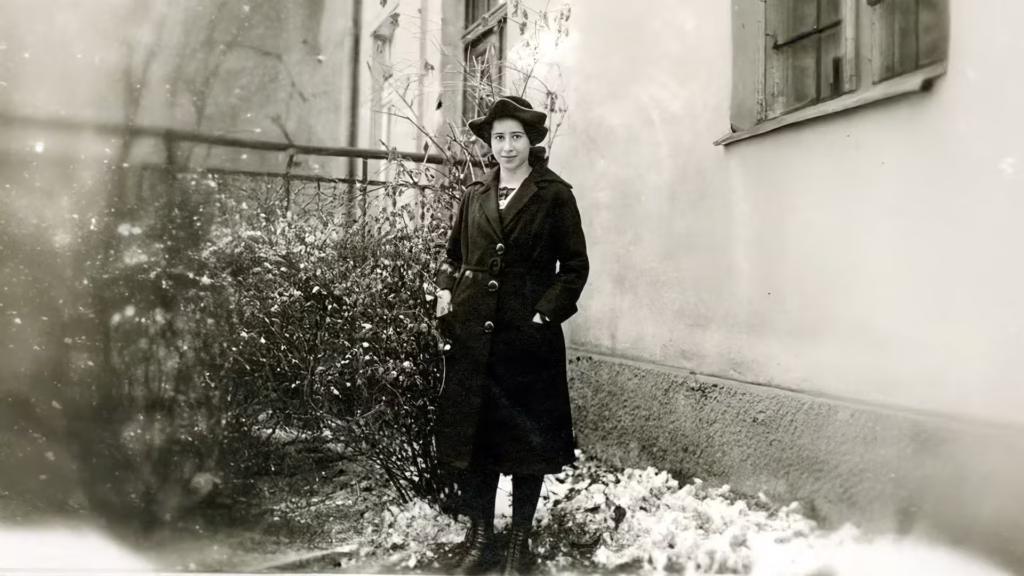 Political Theory